
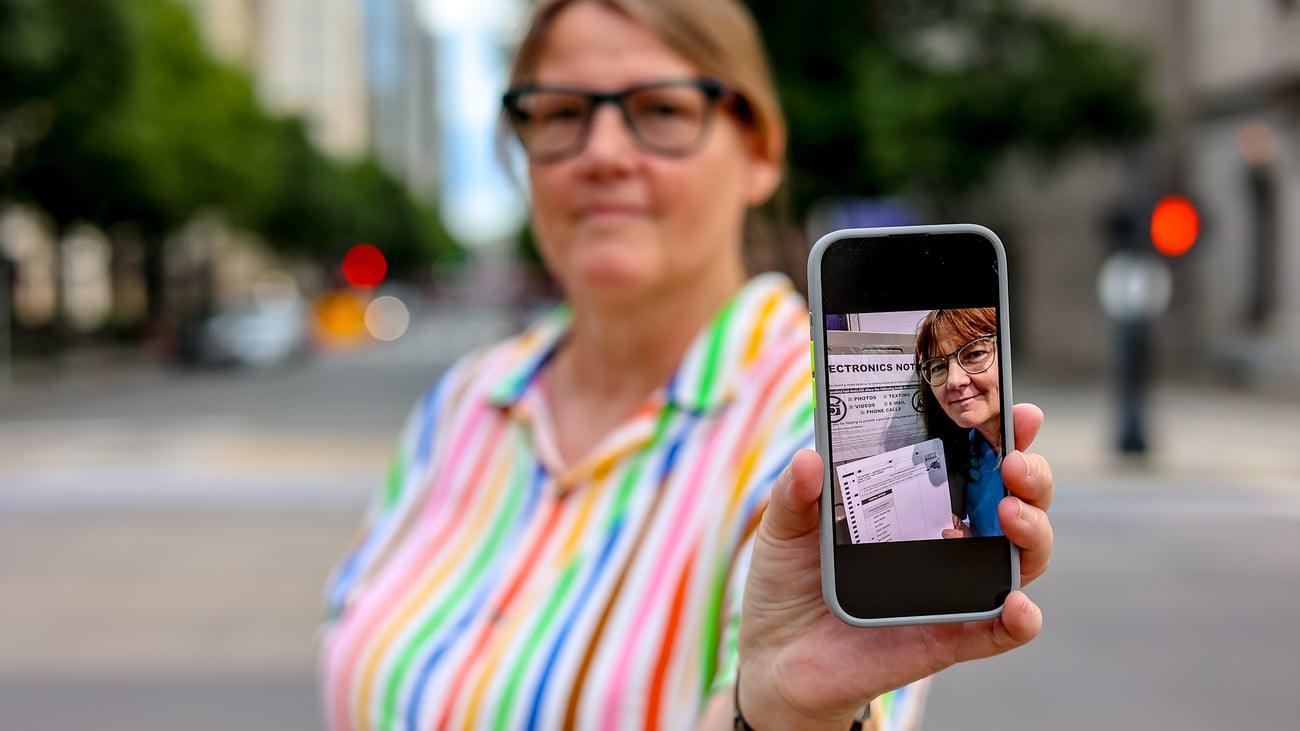
The state argues people might not vote their conscience if sharing photos of ballots becomes the norm.RICHMOND, Va. (CN) — A North Carolina woman argued before a Fourth Circuit panel Tuesday that North Carolina’s restrictions on ballot photography are unconstitutional.Susan Hogarth filed suit against members of the state board of elections in 2024, after posting a selfie online of herself holding up her ballot while voting in the Libertarian primary. The state board of elections contacted her and asked her to take the post down, notifying her it was a Class 1 misdemeanor.She sued, claiming the state’s laws prohibiting ballot photography violate the First Amendment. When she returned to the polls in November 2024 — armed with a court order allowing her alone to take pictures of her ballot — she was instructed by polling place staff to stop taking photos and delete them before staff called the state elections board to confirm she had an exemption.In court Tuesday, Jeff Zeman, a Foundation for Individual Rights and Expression attorney representing Hogarth, argued the state is suppressing political speech.“The only thing North Carolina’s ballot selfie ban does is criminalize otherwise lawful speech,” Zeman said, also adding that the state’s photography restriction goes beyond polling places, and prohibits snapping a photo of a filled-out absentee ballot in the privacy of a voter’s own home.Deputy Solicitor General Thad Eagles — who represents the state board of elections, its investigator and its Executive Director Sam Hayes — countered by telling the panel that prohibiting photography preserves the secret ballot.“We know that vote buying and voter intimidation is rare, but we know that it occurs,” Eagles said. “We know that those schemes require proof of how the voter actually cast their ballot in order to work.”The panel discussed whether it would be necessary to determine if voting spaces outside of polling places could be considered nonpublic forums that are subject to similar restrictions.“There does seem to be ways these statutes apply outside of the polling place,” said U.S. Circuit Judge A. Marvin Quattlebaum Jr., pointing to the issue of absentee ballot photography.“Is the ballot itself a forum?” the Donald Trump appointee questioned Eagles.People might not vote their conscience if sharing photos of ballots becomes the norm, Eagles said. He also argued the state is regulating the mechanics around an election — rather than pure speech — when it prohibits photography.“North Carolinians are free and encouraged to tell everyone they want who they voted for and why in any number of different ways, “ Eagles said. “The state’s concern is not with the message here. It’s not about the communication, it’s about the probative effect of a picture of a marked ballot.”“This is speech about the election; not part of the election,” Zeman responded. “Expression about elections and referenda is the type of speech indispensable to decision making in a democracy, and thus at the heart of the First Amendment’s protection."The existing restrictions are content neutral and exist to prevent vote buying and voter coercion, Eagles argued.The laws protect the privacy of other voters and avoid delays in polling places, the defendants emphasized in their brief, and serve as a “necessary deterrent” to vote buying that enforces public trust in election integrity. The state allows selfies with unmarked ballots, and doesn’t wholesale ban photography in the voting booth, they added.North Carolina’s law censors core political speech, Hogarth argued in her filings, and the provisions are not narrowly tailored to suit the state’s interests. The provisions are content-based restrictions on speech, she said, and the state doesn’t have a compelling interest in banning voters from photographing their ballots.The lower court also weighed the photography ban as applying only to polling places, Hogarth said, when it extends to photographing a filled-out absentee ballot anywhere.A lower court found in favor of the state board earlier this year, dismissing the case and concluding the government can have reasonable content-based restrictions on speech in polling places.The three-judge panel didn’t say when it planned to rule. U.S. Circuit Judge Allison Rushing, a Trump appointee, and U.S. Circuit Judge DeAndrea Gist Benjamin, a Joe Biden appointee, also heard the case.Absentee voting has already begun in North Carolina, the first state to begin mailing ballots for the midterm elections.A representative for the state board of elections declined to comment.Subscribe to our free newslettersOur weekly newsletter Closing Arguments offers the latest about ongoing trials, major litigation and rulings in courthouses around the U.S. and the world, while the monthly Under the Lights dishes the legal dirt from Hollywood, sports, Big Tech and the arts.Additional Reads
Fourth Circuit brings North Carolina ballot selfie ban into focus
Full Article
Original Source
Read the full article at Courthousenews →KhanList aggregates and links to publicly available news content. We do not host full articles from third-party sources. Always verify important information with original sources.