
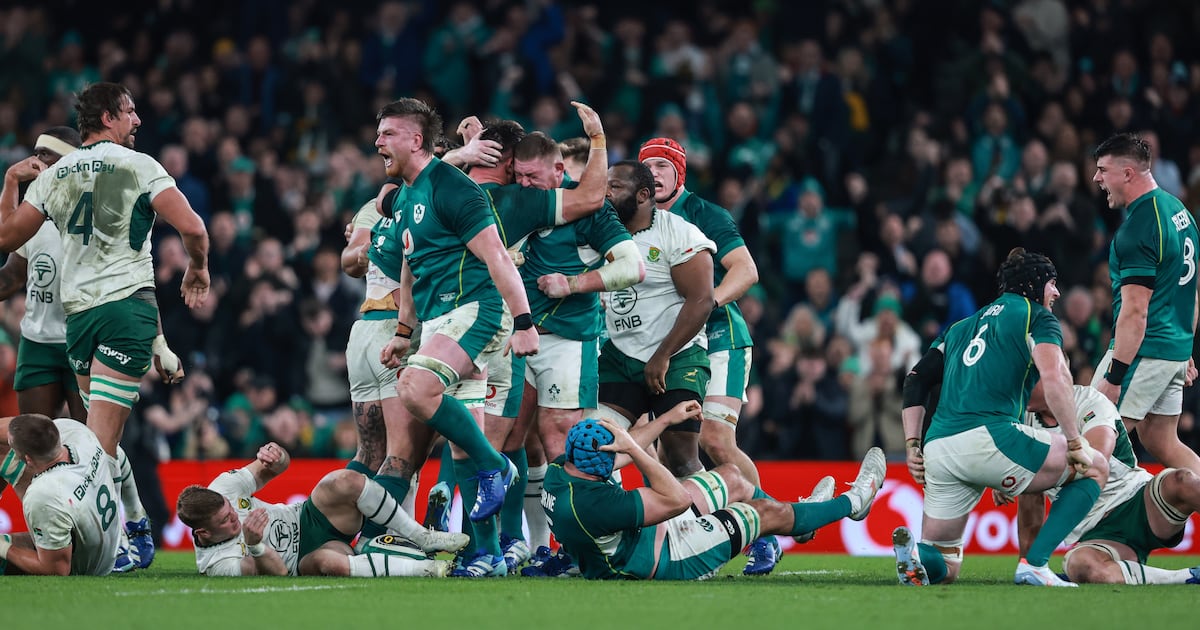
Scrum. Maul. Kicking. Physicality. These have been four of the key pillars behind South Africa’s dominance of global rugby. If you’re behind in any of these stakes, trouble is not far away. Let alone all of them. Ireland conceded more scrum infractions. They had fewer retained kicks. They lost the battle of dominant collisions. Yet for all these lost battles, they still won on the scoreboard. Analysing Saturday night’s victory over the double world champions, there was no silver bullet. No one tactical tweak or single piece of ingenuity that explained away perceived prematch weaknesses. READ MOREInstead, Ireland were sufficiently improved in these key areas of the game. Not sufficient to outdo the Springboks across 80 minutes in some of the above categories, Ireland nonetheless had enough key moments in the right parts of the pitch to ensure they broke their hoodoo against rugby’s big three. The scrumOf the 17 scrums that took place on Saturday, eight resulted in an Irish infraction. Including the advantage offered but not used when Morne van den Berg scored off the back of a dominant scrum, Ireland coughed up six penalties and two free kicks.South Africa’s Cameron Hanekom celebrates after Morné van den Berg scores a try against Ireland during the Nations Championship match at the Aviva Stadium in Dublin. Photograph: Morgan Treacy/Inpho Against any other opponent, to be penalised almost half the time would raise the alarm. Not against South Africa. Such is the extent to which they move the Overton window of acceptable scrum woe. In this fixture last year, Ireland conceded one scrum try and two props to the sin bin. South Africa’s drive still led to one score this time, but no Irish frontrows were given their marching orders. Ireland also won a morale-boosting scrum penalty on 26 minutes. What was the difference 12 months on? Especially as South Africa had Ox Nche, arguably the world’s best scrummager, at their disposal after he missed this fixture in 2025. [ Ireland needed to beat South Africa after disappointing summer, says GoodmanOpens in new window ]For one, Ireland had a bigger pack this time around. Speaking in these pages following last year’s scrum demolition, former tighthead Mike Ross explained the importance of the mass pushing behind the frontrow. With Dan Sheehan at number eight instead of Caelan Doris, Ireland added roughly four kilos to the backrow. Joe McCarthy’s return added a few more, given his slight weight advantage over James Ryan. Pack weights are always difficult to discern given players can add and shed mass quite quickly, but according to what is publicly available, Ireland were six total kilos heavier this year compared to last. Not a huge difference, but when battling to recoup a scrum disadvantage, every little helps. Following Saturday’s win, Ireland spoke about working on technique. For all that talk, though, Sheehan cites attitude as the catalyst for Ireland’s improvement: “It’s a mentality of buying in. You can look at angles and all this crap but if you don’t go forward, you’re not getting anywhere.”The skies Again, on paper Ireland lost the battle in a crucial part of the game. The official stats tell you that South Africa retained five kicks to Ireland’s three. Watching the game live and again after the fact, the bare numbers didn’t give an accurate reflection of which side felt on top aerially. Memories abound of Rob Baloucoune and Hugo Keenan winning high ball after high ball. When Ireland kicked themselves, it’s fair to say they didn’t get much change. They retained just three of their own 10 contestable kicks, albeit you could add a fourth given one kick was allowed to bounce and Ireland won the scraps. South Africa’s Kurt-Lee Arendse and Ireland’s Hugo Keenan contest a high ball during the Nations Championship match at the Aviva Stadium in Dublin. Photograph: Nick Elliott/Inpho When South Africa kicked, though, Ireland were excellent. Including goal line drops that led to aerial contests, the Springboks kicked to contest 15 times. Ireland secured possession on 11 occasions – a number that goes a long way to explaining Ireland’s first-half territory dominance. Part of the reason for the success is down to South Africa. For some reason, they insisted on kicking to Keenan and Baloucoune, the aerially stronger duo of Ireland’s backthree. Equally, Ireland planned well for the ‘scraps’ when contests saw the ball hit the deck. Ryan Baird’s positioning in this regard was often excellent. Ryan Baird and Rob Baloucoune (circled) position themselves closer than any South African counterpart to recover any 'scraps' from an aerial contest. The detail The high-five shared between Andrew Goodman and Paul O’Connell upon Rónan Kelleher’s try told of analysis work spotting a chance to try a move successfully. For what it’s worth, when Rassie Erasmus’ sound was briefly on during his watch-along, he said South Africa saw that move coming and had the defender in the right place. They simply suffered due to a poor tackle attempt from Canan Moodie. Ireland’s Rónan Kelleher scores a try against South Africa during the Nations Championship match at the Aviva Stadium in Dublin. Photograph: Dan Sheridan/Inpho The decision to feign a maul sucked in Ox Nche at the front of the lineout, leaving two Irish attackers running at one ‘Bok in Malcolm Marx. Jamison Gibson-Park’s run towards the backline ensured the tail of the lineout could not cheat to catch up to Kelleher. Ireland's maul at the front sucks in everyone bar Malcolm Marx. The forwards at the back (circled) have to keep an eye on Gibson-Park, leaving van der Flier and Kelleher running at an isolated Marx. This comes after Ireland’s set-piece fired beautifully against Argentina. It’s been a good three weeks for the coaches charged with manipulating gaps off first-phase strikes. The physicality Again, South Africa statistically came out on top in one important metric. They had 23 dominant tackles to Ireland’s six. On paper, it was a bloodbath. Yet Ireland held in the physical fight at crucial moments. Joe McCarthy’s pair of breakdown turnovers spring to mind. As does Ireland’s defensive maul. South Africa’s other superpower alongside the scrum, one that led to seven tries in the Nations Championship, was largely kept at bay. Baird and McCarthy both did their part in splintering through the middle of catch-and-drives. South Africa’s Eben Etzebeth is tackled by Ireland’s Sam Prendergast during the Nations Championship match at the Aviva Stadium in Dublin. Photograph: Brian Lawless/PA Moments that don’t show up in team-wide statistical analysis also warrant mention. There was a second-half rip in contact close to the 22. Sheehan’s line speed in another defensive set forced a spill. The most eye-catching? Ireland’s first tackle of the game. South Africa’s lineout gave Damian de Allende an early chance to charge at Sam Prendergast, the weakest Irish defender as well as the subject of plenty of Springbok ire. Prendergast didn’t force a turnover, but neither did he shirk the contact. He charged out of the line, chopping de Allende down.Sam Prendergast made Ireland’s first tackle of the game on Damian de Allende. Prendergast still went on to miss four tackles, but most of these saw sufficient physicality to slow runners until help arrived. In Ireland’s team-wide review of the game, you wouldn’t be surprised if Andy Farrell used the clip of his first tackle to express satisfaction with how everyone fronted up. [ ‘A pesky, determined Irish side’: South Africa media reactionOpens in new window ]
Four pillars that underpinned Ireland’s gritty victory over South Africa
Full Article
Original Source
Read the full article at Irishtimes →KhanList aggregates and links to publicly available news content. We do not host full articles from third-party sources. Always verify important information with original sources.