
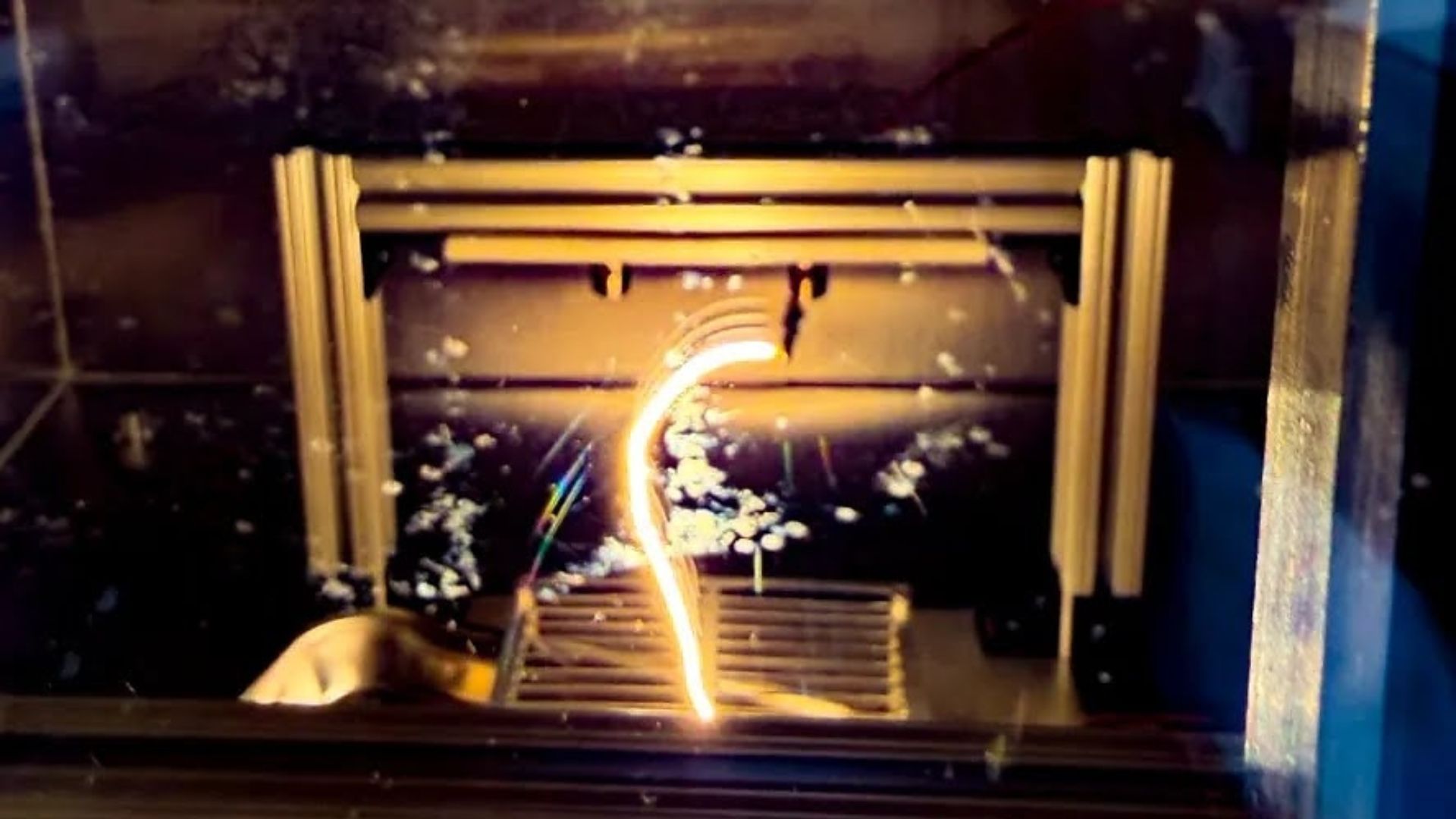
It takes roughly 15,000 years of harsh, unshielded exposure to the sun for raw lunar soil to trap enough volatile gases to make off-world mining worthwhile. Interlune just cloned that entire millennia-long process before lunch. In a milestone announcement, the Seattle-based space resources startup revealed it has synthesized gas-bearing lunar dirt on Earth. Years of intense solar radiation damage were recreated in just four hours by bombarding targeted mineral grains with accelerated helium plasma inside a high-temperature vacuum chamber. “This demonstration is a force multiplier not only for Interlune’s broader technology development, but for others building hardware for the moon,” said Rob Meyerson, Interlune co-founder and CEO. “It gives the industry a practical way to validate core processing technology on Earth, learn faster and accelerate progress toward Moon readiness.” Space tech shortcut The 1970s research of Apollo samples identified ilmenite as the main helium-retaining mineral in lunar regolith. In natural mineral grains, atoms form an ordered crystal lattice structure, but eons of solar wind bombardment disrupt the outer edges of lunar ilmenite. It leads to microscopic defects where volatile gases, like helium, become trapped. In the replication of this phenomenon on Earth, the team energized helium gas into plasma in a vacuum chamber using electron emissions from a heated filament. Next, the process accelerated these helium ions directly into simulated ilmenite at solar-wind energy levels. Overall, the technique disrupted the mineral’s crystal lattice rim and trapped the helium inside artificial micro-defects. Further, the ilmenite was gradually heated in a vacuum chamber to verify the implantation. A mass spectrometer measured the escaping gas, revealing that helium was released between 300°C and 800°C (572°F and 1,472°F) — a profile that directly matches Apollo sample data. The final step involves blending this gas-infused ilmenite with other terrestrial minerals to mimic specific lunar locations, enabling engineers to refine and test resource extraction systems on Earth without depleting rare moon rocks or waiting for future lunar missions. This development provides Interlune and the broader space resources industry with a practical, highly accurate test material to validate extraction hardware on Earth before deploying it to the moon. Standard lunar regolith simulants match the particle sizes and mineral composition of moon dirt. But lack the solar-wind volatiles, like helium and hydrogen, trapped in authentic lunar samples. Interlune’s new demonstration fills this gap by producing a gas-bearing material. Further, Interlune is planning to offer both the material and specialized testing services to space companies, research institutions, and government agencies. Prepares harvesters for the moon Interlune plans to use its new helium-bearing simulant to test the extraction hardware for its Harvesting System, which uses mechanical methods rather than high heat to release volatile gases from lunar regolith at an industrial scale. Compared to other extraction concepts that heat regolith to nearly 1,000°C (1,832°F), this mechanical approach is designed to cut power consumption by up to ten times. It will be a critical efficiency gain on the moon, where both mass and power are severely constrained. Interlune is consolidating its R&D at the Houston-based Interlune Research Lab (IRL), backed by up to $4.84 million from the Texas Space Commission and staffed by experts across geochemistry, plasma engineering, and industrial design. Furthermore, the goal is to tailor the simulant’s mineral composition and gas concentration to mirror specific landing sites across the moon. This new approach could also provide a deeper atomic-level understanding of how eons of solar wind exposure alter lunar materials.Get the latest in engineering, tech, space & science - delivered daily to your inbox.Mrigakshi is a science journalist who enjoys writing about space exploration, biology, and technological innovations. Her work has been featured in well-known publications including Nature India, Supercluster, The Weather Channel and Astronomy magazine. If you have pitches in mind, please do not hesitate to email her.
Four hours instead of 15,000 years: Interlune makes gas-rich moon dirt on Earth
Full Article
Original Source
Read the full article at Interestingengineering →KhanList aggregates and links to publicly available news content. We do not host full articles from third-party sources. Always verify important information with original sources.