
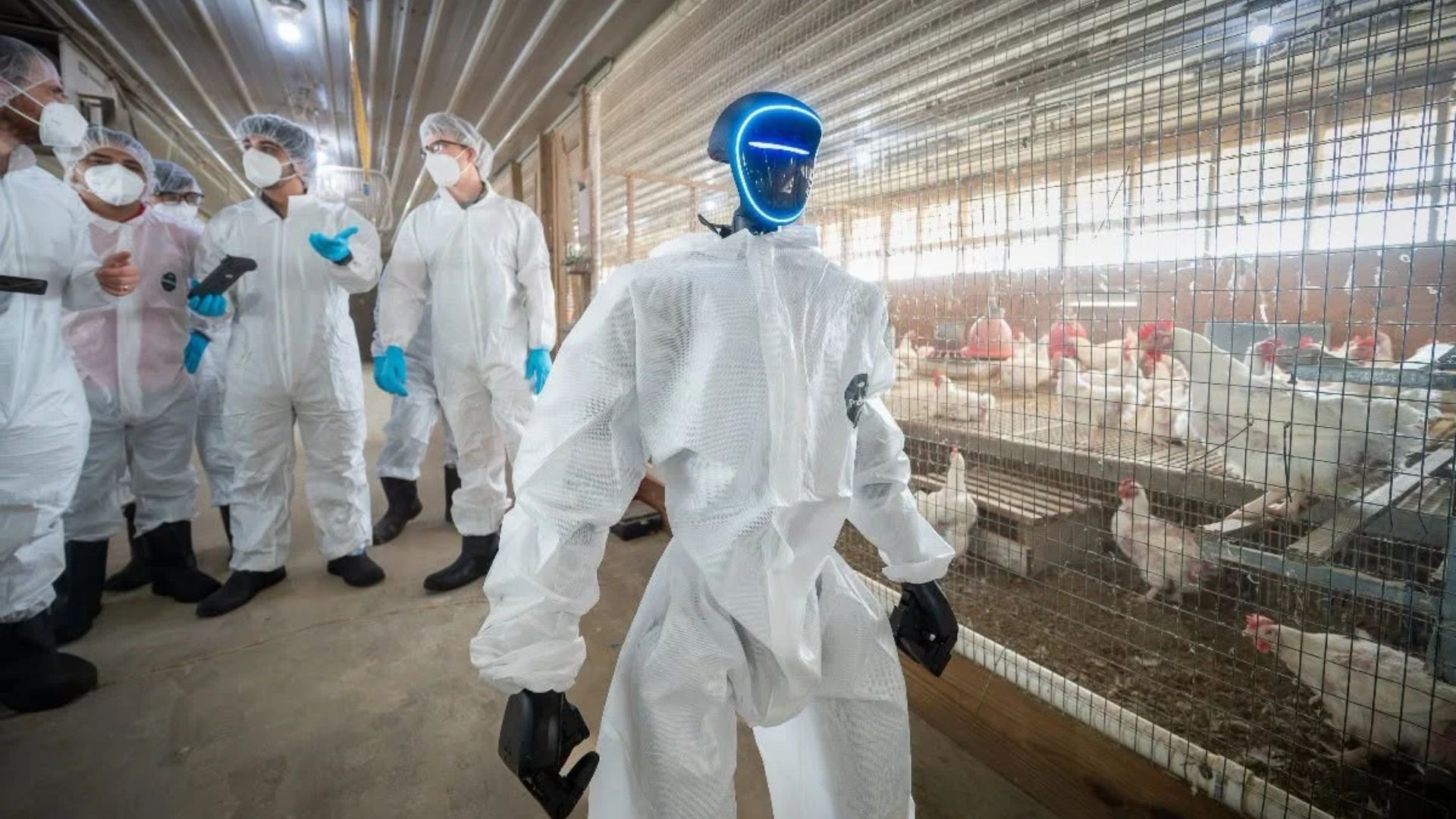
Humanoid robots are taking on an unusual new chore: collecting eggs from poultry farms. Researchers at North Carolina State University are developing Howl, a four-foot-tall robot that detects and picks up eggs laid on the floors of cage-free poultry houses. The project, which uses Unitree G1 robots as a base, aims to address labor shortages while improving bird welfare and productivity. The egg-collecting robot is part of a broader effort by the university’s Artificial Intelligence & Robotics Lab to bring advanced automation to commercial poultry farming. AI-powered egg harvester The four-foot-tall robot called Howl, which is basically a Unitree G1 humanoid, detects and retrieves eggs laid outside nesting boxes in cage-free poultry houses. The project is part of a broader effort to use automation, machine learning and computer vision to address labor shortages, reduce egg losses and improve animal welfare. The shift toward cage-free egg production has created new challenges for poultry farmers. Unlike conventional cage systems, where eggs roll onto conveyor belts for collection, cage-free barns require some eggs to be gathered manually from the floor. In some environments, these floor eggs can account for 2 percent to 15 percent of total production. Members of the AIR Lab are working to code Howl’s movements so the robot can pick up floor eggs. For a farm housing around 100,000 birds, that could mean as many as 15,000 eggs requiring collection each day. The process is labor-intensive, and delays in retrieving eggs can affect product quality. Howl is being developed to automate this task using artificial intelligence and robotic manipulation. The robot is designed to identify eggs on the floor, approach them, and pick them up using its robotic hands. Training the humanoid to perform these movements requires developing its control and response systems largely from scratch. Researchers are using virtual reality (VR) manipulation to demonstrate tasks and program robotic movements. The training also incorporates machine learning techniques, including reinforcement learning and imitation learning, to help the robot learn how to handle eggs. The team is currently refining Howl’s programming and training, with egg-detection and retrieval simulations expected to be completed before moving toward practical demonstrations. The researchers aim to have the robot performing these tasks by early 2027. Smarter poultry farming Beyond robotic egg collection, the university is developing AI tools to help poultry producers make better use of farm data and scientific information. One project, called Poultry Talk, is a retrieval-augmented generation (RAG) platform designed to function as a specialized AI assistant for the poultry industry. It combines a large language model with a curated database of poultry science documents, including peer-reviewed research and publicly available agricultural extension publications. Users can ask questions about subjects such as poultry nutrition, disease diagnosis and prevention, housing, animal welfare, production management and precision farming. Rather than relying on generic internet information, the system retrieves relevant material from its specialized knowledge base to generate more focused responses. The platform has a working demonstration that is being shared with poultry professionals for feedback and further development. Another project focuses on monitoring the health of individual birds using computer vision and AI. Researchers are installing fixed two-dimensional and three-dimensional cameras inside a poultry research facility, where computer vision models analyze individual birds and assess their physical condition. The system evaluates characteristics such as feather condition, plumage density, and body weight to generate individual health assessments. By tracking these indicators, the technology aims to identify early signs of disease or stress that might otherwise go unnoticed in large flocks. The collected data could also support precision feeding systems, allowing farmers to adjust diets and management conditions according to individual birds’ needs rather than treating an entire flock as a uniform population. Together, the projects demonstrate how humanoid robotics, computer vision and specialized AI platforms could bring more automation and data-driven decision-making to poultry production. The longer-term goal is to reduce dependence on manual labor while improving egg collection, flock monitoring and the efficiency of commercial farming operations. Get the latest in engineering, tech, space & science - delivered daily to your inbox.Jijo is an automotive and business journalist based in India. Armed with a BA in History (Honors) from St. Stephen's College, Delhi University, and a PG diploma in Journalism from the Indian Institute of Mass Communication, Delhi, he has worked for news agencies, national newspapers, and automotive magazines. In his spare time, he likes to go off-roading, engage in political discourse, travel, and teach languages.
Four-foot humanoid robot learns to collect floor eggs for cage-free US poultry farms
Full Article
Original Source
Read the full article at Interestingengineering →KhanList aggregates and links to publicly available news content. We do not host full articles from third-party sources. Always verify important information with original sources.