
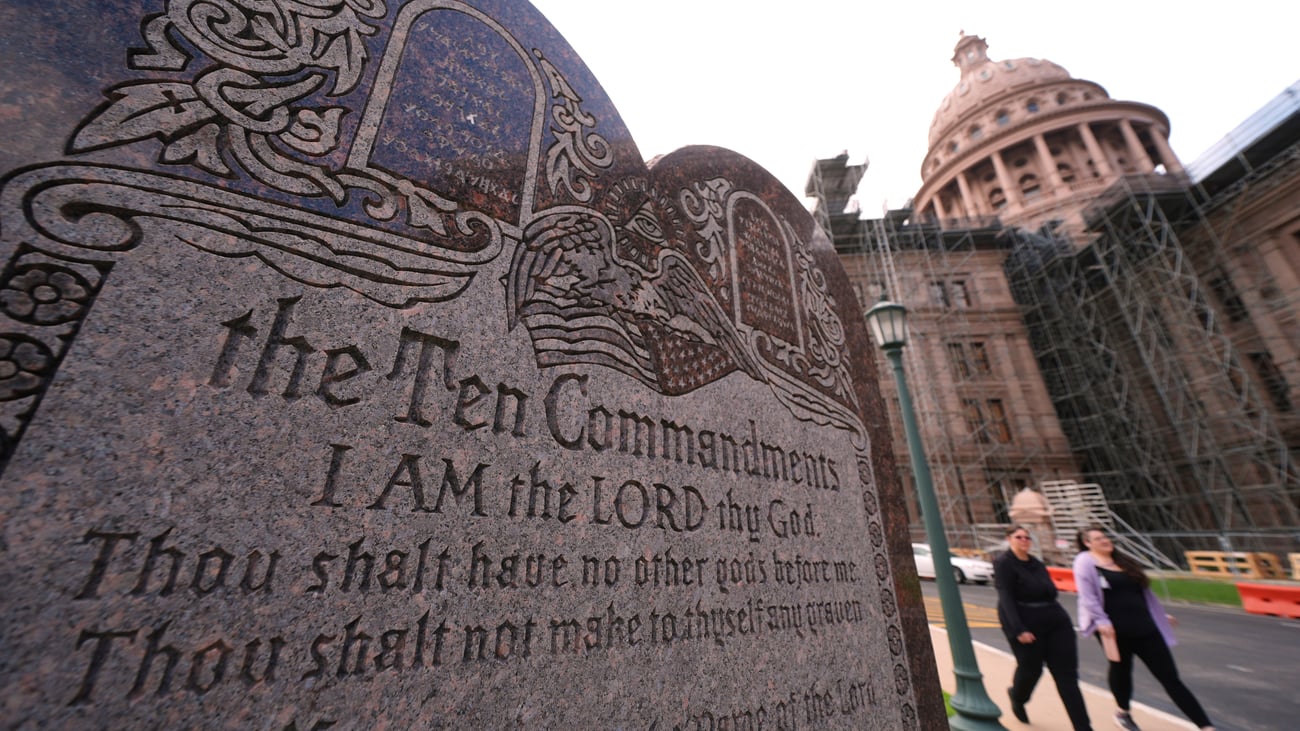
WASHINGTON (CN) — Conservative states’ push to put the Ten Commandments in public school classrooms has set up a major clash over church-state relations that could land at the Supreme Court next term.A coalition of multifaith Texas families plans to ask the justices to review whether the display of the Christian religion in government-run schools violates the First Amendment in the coming weeks, arguing the Lone Star State’s law runs afoul of the establishment clause.While over four decades of precedent weighs against religious displays in public schools, the appeal comes amid the Supreme Court’s push toward originalism and a growing debate over the founders’ views on the separation of church and state.“An earlier generation of the court had tests that asked whether the government was favoring religion,” Christopher Lund, a professor at Wayne State University, said. “Now the court is talking about history and tradition in ways that make it seem more sympathetic towards the government taking positions on religion — maybe even advancing them in the public schools. That’s the big question in the Ten Commandments case.”History and traditionIn 1980, a group of Kentucky parents asked whether a state law requiring a display of the Ten Commandments in public school classrooms violated the First Amendment. In a divided ruling known as Stone v. Graham, the Supreme Court sided with the parents, holding the Ten Commandments weren’t confined to secular matters and therefore violated the Constitution’s establishment clause.Earlier this year, the Fifth Circuit heard a nearly identical case stemming from Texas’ SB10 but came to the opposite conclusion. U.S. Circuit Judge Stuart Kyle Duncan, a Donald Trump appointee, claimed Stone was no longer relevant under the Supreme Court’s recent ruling in Kennedy v. Bremerton School District.The 2022 case threw out a method of determining whether a law violated the establishment clause known as the Lemon test. Since Stone was upheld under Lemon v. Kurtzman — the ruling creating the defunct test — Duncan reasoned both were now null and void.Similar to originalist inquiries under the Second and 14th Amendments, the Supreme Court’s Kennedy test for the First Amendment requires judges to ascertain how modern laws would have been seen at the founding.Joe Davis, senior counsel at Becket, said the founders were keenly aware of what the establishment of religion looked like because there were established religions in the colonies, states and in England.“It was things like, you know, control over the established church, so the government would actually choose the leaders of the established church,” Davis said. “It was mandatory worship, like you had to go worship in the established church or else you were punished. If you worshiped in dissenting churches, that was illegal.”Davis said the Fifth Circuit was right to determine a poster on the wall depicting the Ten Commandments — which he described as an important document to American history — didn’t meet the characteristics of an established church at the time of the founding.But, like the Supreme Court’s switch to originalism in other areas of the law, there are disagreements over this historical analysis.“Public schools didn’t exist at the time of the founding,” Heather Weaver, senior counsel for the program on freedom of religion and belief at the ACLU, said. “But the founders despised religious coercion. They despised official denominational preferences by the government. And posting the Ten Commandments in every public school classroom manages to do both of those things.”The ACLU is supporting the coalition of multifaith families challenging Texas’ law with Americans United for Separation of Church and State, the Freedom From Religion Foundation and Simpson Thacher & Bartlett.Weaver said the Fifth Circuit’s historical analysis ignored the founders’ explicit views and ran afoul of a long line of precedent emphasizing public schools are a special context that requires protections against the government’s imposition of religion.What would Thomas Jefferson do?For over 200 years, the First Amendment’s establishment clause protections have been characterized by a metaphor used by Thomas Jefferson in 1802. In response to the Danbury Baptist Association’s concerns about interference from Connecticut’s established church, Jefferson described a “wall of separation” between church and state.But that understanding is facing a challenge from conservative advocates who say the “belabored metaphor” has been taken out of context. In a report last month, a White House religious liberty commission argued the founders never intended to completely sever the relationship between religion and government.“The concept of a ‘wall of separation between church and state’ can wrongly imply that church and state are opposed to one another and must remain completely separate,” the commission wrote in a draft report. “In reality, however, church and state strengthen and support one another.”Instead of a wall, the commission said religious liberty should act as a bridge between church and state, claiming it “isn’t simply an appendage of our society. It is the beating heart of our republic and the lifeblood of America’s success.”Under its interpretation of the founders’ views, the commission advocated integrating religious works into schools, suggesting they could teach students about the historical, moral and cultural significance of such texts.“For example, the Book of Genesis could be studied as a literary masterpiece, or the Ten Commandments could be studied for its influence on the development of law,” the commission wrote.Lund refuted arguments that the separation of church and state was a secular concept. He cited a Bible verse that says, “Render unto Caesar what is Caesar’s; and render unto God the things that are God’s,” as an example of the concept’s deep roots in Christian theology.“That starts a whole line in Christian theology that goes for 2,000 years separating civil institutions, political institutions, institutions from the institutions of the church,” Lund said. “So the modern understanding of separation as sort of being anti-religious is something I don’t get.”The ACLU argues the White House commission and other advocates with similar views were attempting to rewrite history and water down the founders’ views.“The founders believed, and our history demonstrates, that true religious freedom for people of all faiths can only exist and thrive if there’s a strong separation between religion and government,” Weaver said. “Without it, any claims of religious freedom are illusory.”Majority ruleOpponents to Texas’ law argue it creates an official denominational preference by incorporating scripture into state law, Weaver said.“The goal behind putting the Ten Commandments in the classrooms is to convert children to Christianity,” Weaver said. “It’s using the public schools and the state’s compulsory education power to induce children to have certain religious beliefs and engage in certain religious practices, even when their own faiths and their own beliefs that their parents teach them at home may run counter to those religious dictates.”Vice President JD Vance rebutted these claims in a recent podcast interview where he defended Texas’ law. Because the founders themselves were Christians, Vance argued the Ten Commandments were an important concept to Western civilization most people would agree with even if they’re not themselves religious.“Christianity is the majority religion of the United States,” Vance said. “It is the religion that was extraordinarily influential to our founding and to the constitutional principles.”Vance’s justification, however, highlights a problem some court watchers have with the high court’s history test elevating majority faiths.“By and large, the government was supposed to be religiously neutral, which was a protection for religious minorities because they could count on the government not trying to undermine their religious commitments with their children,” Lund said. “But now these Ten Commandments cases raise the real concern that the government is going to be sort of using the public schools to push changes on their children.”While those concerns might not have been addressed in Kennedy, Lund says the Supreme Court ruled in favor of similar claims from parents in Mahmoud v. Taylor. The 2025 case held public schools were required to provide religious parents with an opt-out when LGBTQ-inclusive books were read in classrooms.The ACLU says Mahmoud weighs in its favor because it relied on establishment clause cases involving school coercion of students. The group also says the ruling supports its claims under the free exercise clause.“It’s reaffirming that that case law remains good law and is binding,” Weaver said.But Weaver said the justices didn’t have to go that far to resolve the case.“Our view is that it should be an easy case under Stone v. Graham, where the Supreme Court struck down a nearly identical Kentucky law almost 50 years ago,” Weaver said. “The court has never questioned the outcome in that case. So our view is that this is the basis in which the case should be resolved.”The ACLU says it will be filing its petition within the next month.Subscribe to our free newslettersOur weekly newsletter Closing Arguments offers the latest about ongoing trials, major litigation and rulings in courthouses around the U.S. and the world, while the monthly Under the Lights dishes the legal dirt from Hollywood, sports, Big Tech and the arts.Additional Reads
Founders’ views on church-state relations face new scrutiny as Ten Commandments case heads to SCOTUS
Full Article
Original Source
Read the full article at Courthousenews →KhanList aggregates and links to publicly available news content. We do not host full articles from third-party sources. Always verify important information with original sources.