
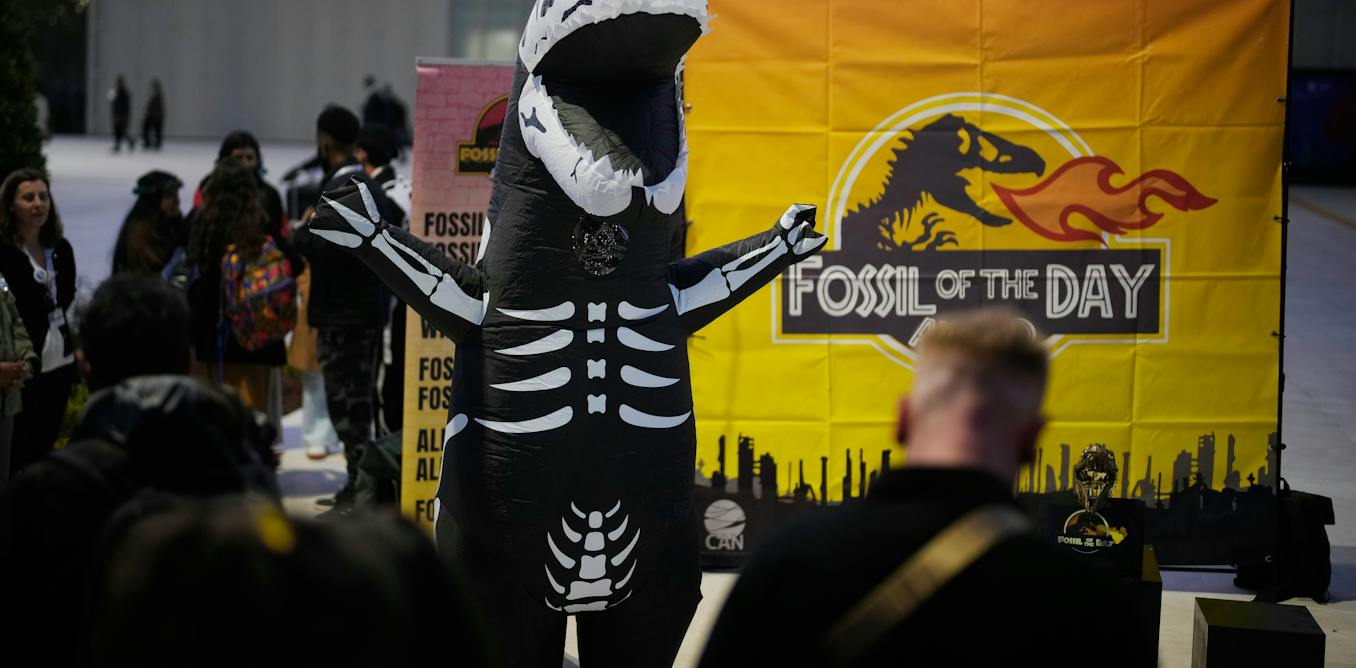
Climate activists at COP31 in Antalya, Turkey, awarded Canadian Prime Minister Mark Carney a Fossil of the Day award, along with other leaders from wealthy countries who skipped the summit. The satirical award is given to countries and leaders seen as doing little to support efforts to tackle climate change. The award was not the only criticism of Carney’s climate credentials. Newsweek listed the prime minister at No. 2 on a list of “climate heretics,” just behind Microsoft founder Bill Gates and ahead of United States President Donald Trump. Canadian Prime Minister Mark Carney scratches his head as he speaks with media during a news conference in Manila, Philippines, on Nov. 14, 2026. THE CANADIAN PRESS/Adrian Wyld These criticisms might seem surprising, as Carney has been seen as a climate champion. At the 2015 COP in Paris, Carney said companies need to develop plans for net-zero emissions. Yet, after becoming prime minister, he scrapped the federal consumer carbon tax and signed an agreement with Alberta to push forward a new oil pipeline. How should we make sense of the Fossil of the Day award? How did Carney go from seeming climate hero to climate villain? As sociologists, we have written about and researched environmental activism around COP summits. These gatherings are not only places for policy discussions. They provide a platform for activists to push for action and direct criticism toward obstructive governments and corporations. Fossil of the Day as a strategic event Social movements take advantage of global events such as COP to name and shame political leaders or corporations that they identify as climate villains. At COP summits, the Climate Action Network hosts the Fossil of the Day award, as well as some other awards. The ceremony resembles a TV comedy sketch, where activists describe the key climate negotiation events they wish to highlight, and set out to embarrass those obstructing progress. While this is going on, a person in a dinosaur suit dances and music from Jurassic Park plays. Meanwhile, activists sing songs with lyrics they make up for the event. Fossil of the Day is about taking advantage of a critical event. Groups like the Climate Action Network award Fossils of the Day to try to affect media coverage, influence public opinion and ultimately pressure governments to take greater action to tackle climate change. Some critical events like COP happen on a regular schedule that is known in advance. We have referred to these as regularly scheduled critical events. Groups can plan ahead and take advantage of opportunities to comment on and critique the conversations going on in official spaces of deliberation among global leaders. Relatedly, interaction ritual theory explains phenomena that often occur in the context of a common action or event. Some key elements of the process include: group assembly (bodily co-presence), mutual focus of attention and shared mood. Engagement in interaction rituals often fosters group solidarity, emotional energy, symbols of social relationship and standards of morality. We can think about the Fossil of the Day in these terms. Activists and other COP participants routinely try to attend the Fossil of the Day award. It is an opportunity to meet up and rub elbows. Participants benefit from camaraderie, some light-hearted humour, and also, in some cases, righteous anger directed at leaders, governments and other bodies who obstruct climate action. These get-togethers reinforce social ties among the participants. Canada: Climate hero to climate villain? At COP21 in Paris, then-Prime Minister Justin Trudeau announced, “Canada is back!” The Trudeau government’s environment minister, Catherine McKenna, helped to negotiate the Paris Climate Agreement. One of Carney’s first acts as prime minister was to cancel the consumer carbon tax Trudeau brought in. And, among other things, Carney is now working to develop new oil and gas projects. At COP31, Carney was a no-show at the leaders summit. This past week, two former environment and climate change ministers criticized the record and direction of the current government. McKenna stated that the claim that Canada is still committed to its targets is “factually untrue.” Indeed, Canada consistently has one of the worst climate performance records. The Climate Change Performance Index, which compares the climate performance of 64 countries and the European Union, ranks Canada 62nd. This poor performance started before Carney’s tenure as prime minister, but Canada has been backsliding on the climate change file since he took office. In the view of many Canadians, Canada faces serious, and even existential, threats from the Trump-led United States. In the wake of this threat, Carney has been trying to boost economic growth and diversify international and domestic trade. Much of this has involved plans to grow the fossil fuel sector. The strategy has also been an attempt to assuage discontent fuelling separatist sentiments in oil-rich Alberta. What is not entirely clear is whether the direction of Carney’s energy and climate policies is a short-term strategy to deal with these crises, or a longer-term pivot away from climate action.
Fossil of the Day: Has Mark Carney made Canada a climate heretic?
Full Article
Original Source
Read the full article at Theconversation →KhanList aggregates and links to publicly available news content. We do not host full articles from third-party sources. Always verify important information with original sources.