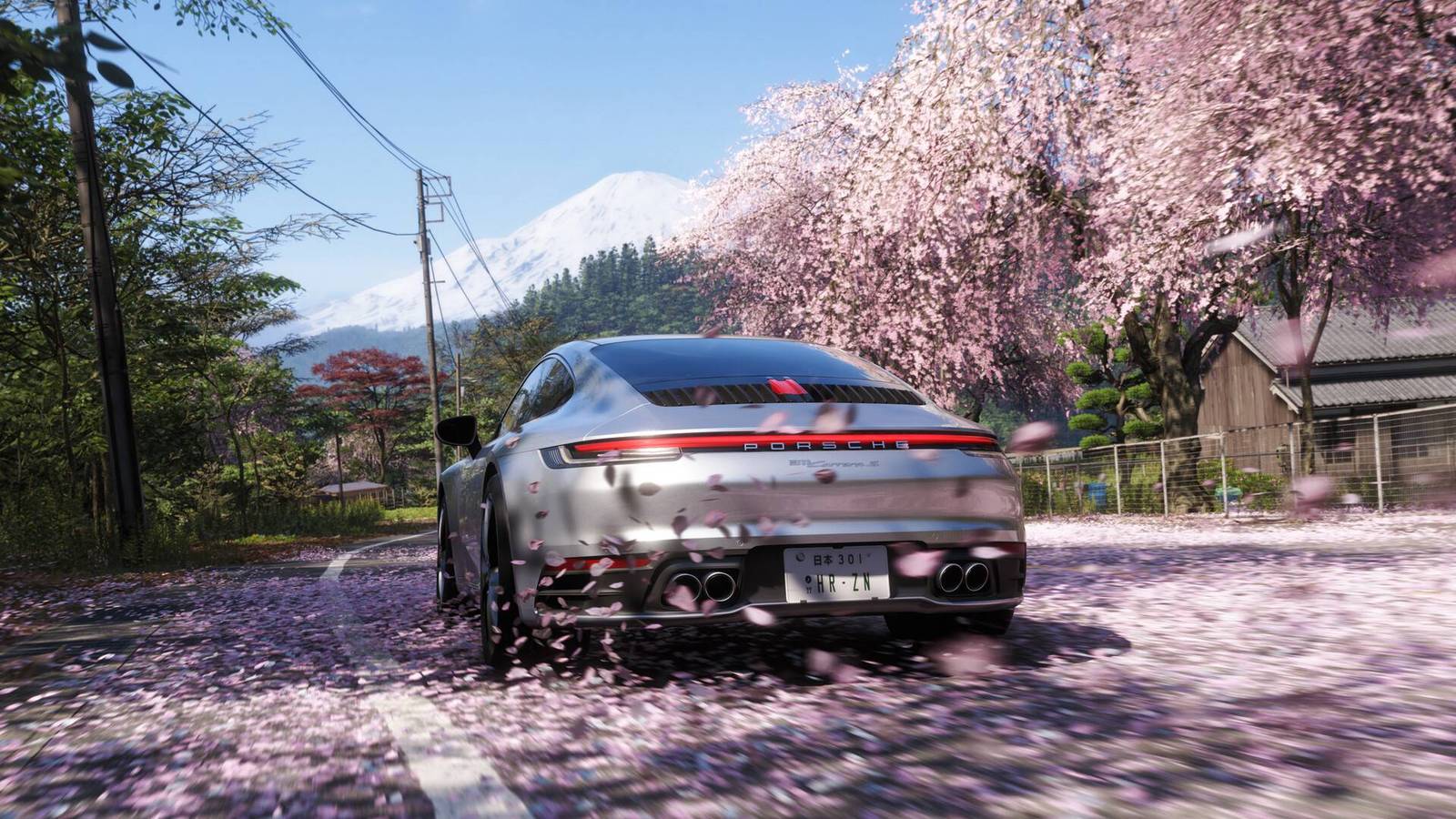
Published Jul 19, 2026, 12:00 PM EDT My thumbs are officially unemployed Image: Playground Games/Xbox Game Studios Forza Horizon has always occupied a strange place in racing games. It's more approachable than simulation-heavy racers like Assetto Corsa or iRacing, but it's also far more nuanced than people sometimes give it credit for. On a controller, it's easy to lose yourself in the spectacle — especially in the lush Japanese setting of Forza Horizon 6. Blasting through rural fields, drifting around sweeping cherry blossom-laden street corners, and bouncing between supercars with barely a second’s thought are as exhilarating as they are endlessly enjoyable. But it's also effortless when you’re only using your thumbs. Sitting behind a proper racing wheel and cockpit changes all of that. After spending time playing Forza Horizon 6 with Logitech's RS ecosystem — including the RS wheel, RS pedals, clutch module, and Playseat Trophy racing seat — I don't think I can go back to a controller, nor do I ever want to. Not because the racing wheel suddenly turns Horizon 6 into a hardcore simulator, but because it makes every drive feel tangible in a way a controller simply can't replicate. Logitech’s RS ecosystem transforms a game I'd happily zone out with into one that constantly demands my attention, rewards precision, and somehow makes every victory feel more earned. Image: Polygon The first thing that surprised me was the sheer level of immersion you can get from a cockpit setup. There's something fundamentally different about physically climbing into a racing seat, planting your feet on a set of pedals, and wrapping your hands around a steering wheel before you even press the accelerator. It's the kind of setup that tricks your brain into treating Horizon 6 differently, and makes you feel like Max Verstappen, if only for a brief moment. Instead of absentmindedly flicking a thumbstick while leaning back on the couch, you're actively using your whole body to drive, requiring you to sit differently, approach corners differently, and exercise far more caution. Even long highway stretches feel more engaging because you're constantly making tiny steering corrections and shifting gears instead of simply holding a stick slightly to the left. Then the force feedback kicks in. It's easily the star of the experience. Logitech’s RS wheel fights you through tight corners, goes light as the tires begin to lose grip, rattles over rough terrain, and shudders after hard impacts. Even though Horizon has always leaned toward accessibility rather than simulation, the game still communicates a surprising amount of information through Logitech’s racing wheel. You begin to feel the weight of different cars instead of simply seeing them on-screen, which extends to how you get to know those cars and where best to use them. And yes, every now and then, the RS wheel shakes with an enthusiasm that reminds me a little too much of my IRL 2000 Mitsubishi Eclipse whenever it crept past 70 mph on the highway (anyone who's owned an older Eclipse knows exactly what I mean). Thankfully, Horizon's loaded list of cars inspires far more confidence. Image: Polygon The added immersion isn't just about making the game feel cooler, though. It also makes it a dramatically harder driving experience. Controller inputs hide a lot of bad habits. Tiny corrections happen almost subconsciously, and modern racing games do an incredible job of smoothing out jerky thumbstick movements into believable steering. With a full wheel setup, every mistake becomes fully your own. Turn in too aggressively, and you'll need to fight the wheel back into line. Mash the throttle exiting a corner in a rear-wheel-drive car and you're suddenly looking at the scenery instead of the road ahead. Cars that felt effortless on a controller suddenly demand respect, and that’s not easy to get used to for racing wheel newcomers. I spun out constantly during my first few hours. It can be utterly frustrating, but that’s the main learning curve behind racing wheels. Eventually, I started learning better ways of approaching steering with different cars. Different drivetrains suddenly mattered in ways I'd never fully appreciated before. Front-wheel-drive cars behaved predictably. All-wheel-drive machines inspired confidence on loose surfaces. Rear-wheel-drive cars became equal parts exhilarating and terrifying. Gradually, I stopped treating every vehicle the same way and started adapting my driving to each one. Image: Polygon It's a learning curve that feels strangely rewarding because Horizon 6 never stops being fun while you're climbing it. The game's forgiving personality is still there, and you can absolutely tweak the experience in a variety of ways. You're still flying off ridiculous jumps, weaving through traffic at impossible speeds, and occasionally (or not-so-occasionally) demolishing a stone wall because you misjudged a braking point. But the extra effort required to keep control of the car makes those moments feel earned rather than automatic. “For those 10 seconds or less, I’m free,” as Dominic Toretto so eloquently puts it in The Fast and the Furious. That's probably the biggest surprise of all. With Forza Horizon 6, developer Playground Games obviously isn't trying to position it as a racing simulator, but instead aims to celebrate the joy of driving and racing by balancing the game’s arcade-style mechanics with proper sim functionality. A cockpit setup amplifies that experience instead of fighting against it, and the hardware itself helps keep that process approachable. Since I was using Logitech's full RS ecosystem, getting everything connected wasn't nearly as intimidating as I expected. Most of the hardware simply worked as intended out of the box, leaving the majority of the tinkering inside Horizon's own settings menu. You'll probably want to spend a few minutes adjusting steering sensitivity, force feedback strength, and pedal response until everything feels natural, but that's less about fixing problems than tailoring the experience to your own preferences. If you're coming from a controller, it's worth resisting the temptation to make the wheel feel exactly the same. The heavier steering and stronger force feedback can initially seem overwhelming, but dialing everything back too far also strips away much of what makes the cockpit setup feel special. Give yourself time to adapt before deciding something feels wrong. Forza Horizon 6 offers a bunch of ways to adjust driving, like tuning, assist mechanics, and peripheral customization. Get a lay of the land and try to piece together the best driving feel first, but do be aware that cars will vary, so learning the different drivetrains will also take some time. Comfort surprisingly ended up mattering more than I expected. Long racing sessions are only enjoyable if the seat disappears beneath you, and Logitech's Playseat Trophy did exactly that. It offers enough adjustment to find a natural driving position without feeling overly complicated, making it easy to settle in for hours at a time. It's one of those pieces of hardware you stop thinking about once you're driving, which is exactly what you want. It was also fairly easy to assemble, taking no more than an hour or so, and weighs just a little over 40 pounds even with the peripherals attached, so it’s fairly easy to move about by yourself — but a pair of small wheels under the pedals would go a long way. Image: Polygon My only real snag involved the RS H-Shifter. I quickly discovered there wasn't an obvious way to mount it with my current setup, only to learn that Logitech sells a separate Gearshift Holder accessory for exactly that purpose. It's not a dealbreaker, especially since the paddle shifters on the RS Wheel are excellent, but it's something prospective buyers should know before assuming every component bolts together straight out of the box. The RS H-Shifter, plus the add-on for the seat, adds roughly $220 on top of everything else, so if you’re planning to pursue a similar setup, I’d recommend trying out the RS Wheel with the paddle shifters first before leveling up, especially since shifting manually can be even more complicated for newer sim drivers. That's also a reminder that racing cockpits can easily turn into a rabbit hole. There's always another accessory, another adjustment, another way to make the experience feel just a little more authentic. Thankfully, none of that feels mandatory for Forza Horizon 6 or the Logitech setup, as you can get by with the essentials. Even without every possible add-on installed, the jump from controller to wheel is enormous, and not everyone might be willing to go the extra mile of getting a VR headset and 3D printing air vents for the best possible immersion. Will everyone want a racing seat and wheel setup like this? Probably not. A quality racing cockpit represents a serious investment, and Forza Horizon 6 remains an outstanding game with a standard controller. Most players will never feel compelled to dedicate a corner of their living room to a racing seat, wheel, and pedals, much less pay the astronomical price to get them all. But I also think those players are missing one of the most enjoyable ways to experience Playground Games' open-world racer. Playing with a racing seat doesn't simply make Forza Horizon 6 more immersive. It makes me notice things I used to ignore. I pay closer attention to the road surface. I think more carefully about weight transfer. I respect different cars instead of treating them like interchangeable stat sheets. Even driving from one event to another — something I'd normally rush through — has become part of the fun, made all the more enjoyable thanks to the serene and exotic scenery dotting Tokyo and beyond. That's a remarkable transformation for a game I've already spent countless hours playing with a controller. Forza Horizon 6 was already one of the most engaging racing games around. Sitting behind a proper wheel brings you closer to what makes the game so incredible. The spectacular landscapes feel more inviting, the cars feel more alive, and every corner asks just a little more from you. Once you've experienced Horizon that way, going back to a controller feels a little like watching someone else take the wheel.
Forza Horizon 6 is so much better with a racing seat, I can never go back to a controller
Full Article
📰 Original Source
Read full article at Polygon →KhanList aggregates and links to publicly available news content. We do not host full articles from third-party sources. Always verify important information with original sources.