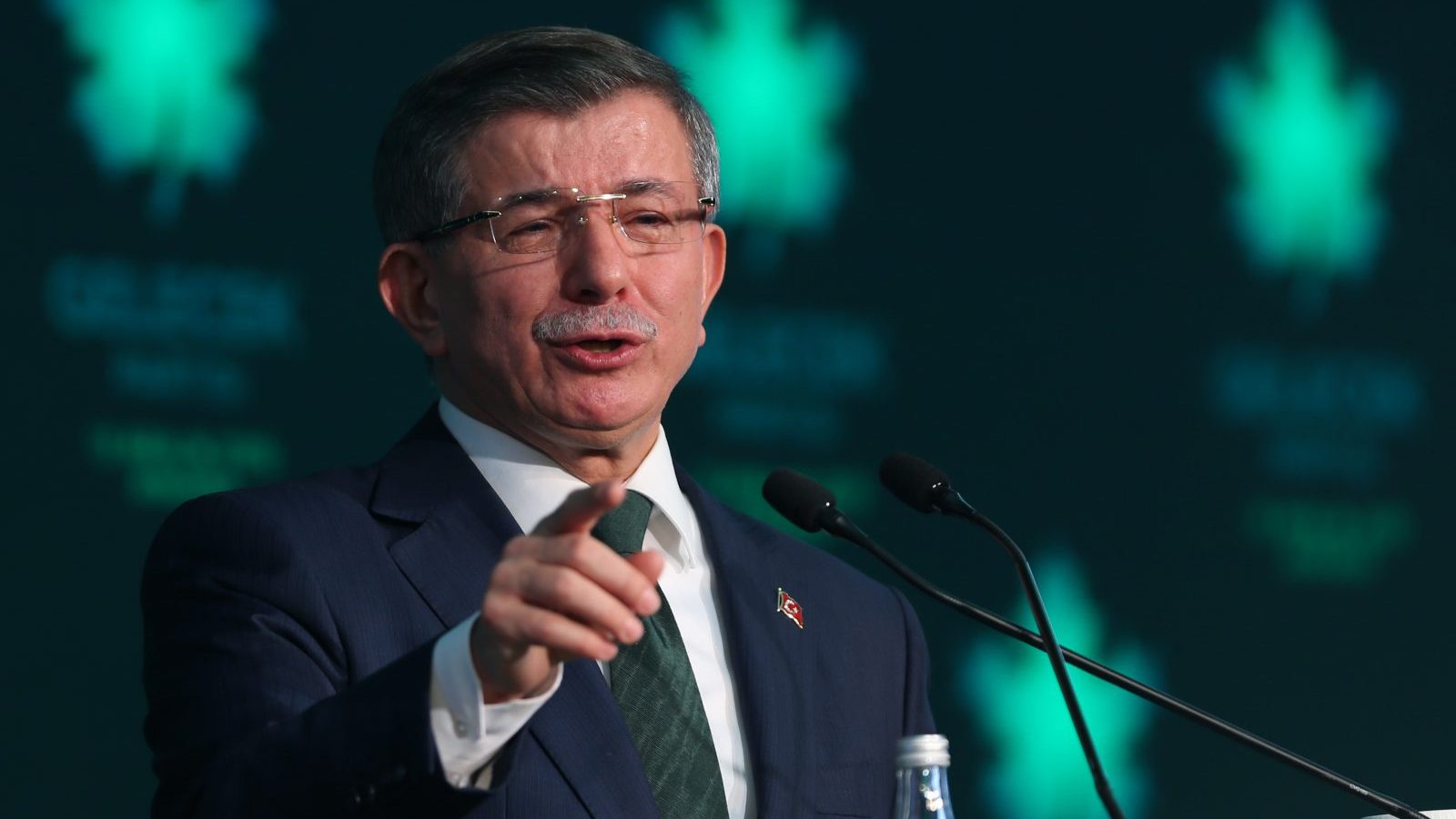
Ahmet Davutoglu. Photo: Future Party. Former Turkish Prime Minister Ahmet Davutoglu announced on Wednesday that he is leaving politics and is dissolving his failing Future Party. “We have decided to withdraw from party politics and bring the Future Party’s political activities to an end, in order to avoid becoming part of the polluted political climate,” Davutoglu said in a statement. The party currently has four seats in parliament. The party was established in 2019 with high hopes and entered parliament in 2023 thanks to a political alliance with the main opposition Republican People’s Party, CHP. However, it failed to become a popular choice among conservative and Islamist voters, who are seen as the bastion of President Recep Tayyip Erdogan’s ruling Justice and Development Party, AKP. According to Davutoglu, his party tried to gather conservative forces together but did not succeed. “From the outset, we sought to unite this new group internally first and then, if possible, merge it with the other conservative parties into a single party. Where that was not possible, we aimed to build a close, organic alliance. However, those efforts were ultimately unsuccessful,” he said. Davutoglu was an architect of an AKP foreign policy that has seen Turkey extend its influence across the former Ottoman lands of the Balkans and the Middle East. Known as the policy of “zero problems with neighbours”, Davutoglu developed the strategy while working as a professor of international relations at institutions including the prestigious Malaysian Islamic University. In 2003, he was appointed an ambassador by then Prime Minister Abdullah Gul before going on to become chief foreign policy advisor to Gul’s successor, Erdogan, and then foreign minister in 2009. The neighbourhood policy was outlined in his 2001 book, Strategic Depth, which advocated greater Turkish engagement and influence in the region, focusing on the Balkans, the Caucasus, the Middle East and Central Asia. His star rose when he was appointed prime minister in 2014, when Erdogan moved into the presidency. But a number of disagreements between the two and Davutoglu’s efforts to play a more visible role in domestic and foreign policy led to his resignation in 2016, under pressure from Erdogan. He finally resigned from the AKP in 2019. Davutoglu saw the Balkans as a “natural and historical hinterland” for Turkish foreign policy given the strong bonds forged through centuries of Ottoman domination. His promotion of Turkish ‘soft power’ saw the growth of government-backed bodies such as the Turkish aid agency, TIKA, the Yunus Emre cultural institutes, Turkish universities in the Balkans, media outlets and the Turkish Religious Authority, Diyanet. Davutoglu founded the Future Party mainly with former AKP figures in a bid to challenge the President. According to recent opinion polls, however, the party had lost support. The four Future Party MPs are expected to join the AKP or remain independent in parliament. Despite his fading career in politics, Davutoglu still sounded a proud note. “This is not a decision of surrender. It is a decision to draw a moral line. This is not an abandonment of politics; it is a call for everyone to rethink politics.” Davutoglu wrote.
Former Turkish PM Davutoglu Quits Politics After Failing to Unite Conservatives
Full Article
Original Source
Read the full article at Balkaninsight →KhanList aggregates and links to publicly available news content. We do not host full articles from third-party sources. Always verify important information with original sources.