
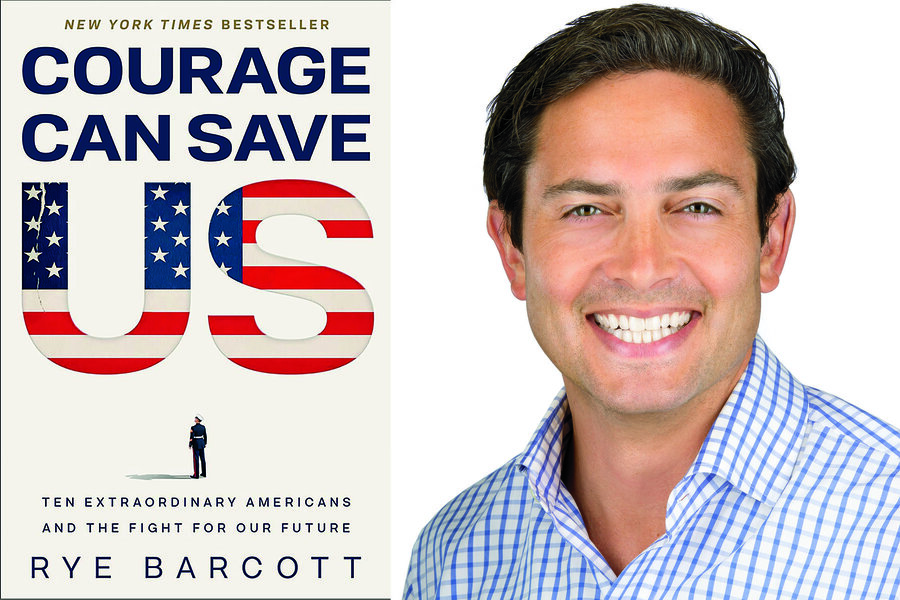
Rye Barcott served as a U.S. Marine and is the co-founder and CEO of With Honor, a nonprofit that addresses governmental polarization through empowering veterans to run for office. His latest book, “Courage Can Save US: Ten Extraordinary Americans and the Fight for Our Future,” profiles 10 government officials (nine of whom are veterans) who have taken strides to overcome partisanship. In an interview, he discussed his book and what it takes to stand for “copartisanship.” The interview has been condensed and edited for clarity. What was your criteria for selecting the 10 public servants you wrote about? I was looking for individuals who would be comfortable with me telling their story in a way that was not just telling a hero’s journey, but trying to give a full picture. These are 10 individuals who are currently in the public arena and not historical figures. That results in a level of immediacy but also recognizes that there are things that we won’t know until history plays out. Why We Wrote This The CEO of nonprofit With Honor celebrates 10 resilient public servants. “Courage, as a form of service, can really be a source of salvation for our country,” he says. Why did you feel strongly about starting With Honor and how does it support veterans as they move into public office? What has occurred in the United States is very difficult for collaboration across party lines, because our congressional districts have become gerrymandered into safe partisan districts. And that results in more partisan behavior. Our organization recognizes that reality. We spend a lot of time focused on primary elections, where we try to identify the individuals who are really governance-minded, truly committed to serving with integrity and civility and courage. We’re really looking for a track record of being able to work across party lines and do what you say you’re going to do. We then support them so that they can win the primary elections. We’ll help educate and recruit candidates and then be there for them.The book profiles government officials who cooperated across party lines. What is the most instructive lesson for those searching to build copartisanship? One of the main themes that emerged was the resilience of each of these individuals. All 10 had striking examples where they faced hardship. But they were able to rebound and keep going. The way they rebounded was having a service mentality – that your life is here for a greater purpose. I find that there are three underlying values behind courage: integrity, humility, and commitment. Commitment speaks to the resilience point. Integrity is at the root of moral courage; it is doing the right thing as you assess it. Humility is realizing that we are one of many and it’s not all about you. What is it about veterans that enables them to work across the aisle? Service in uniform forces you to be with other Americans from all different walks of life on a common mission. For most of the Marines that I served with, I had no idea what their ideological or their political beliefs were. We saw each other as human beings and comrades first. You take an oath that, if called, you will give up your life for this mission.That experience of not only working with others who are different from you, but also working in service to something larger than yourself – that has a humbling and leveling effect. What are the largest barriers government leaders face to displaying the courage exemplified in the book? I think almost all the incentives now run against the courage to be governance-minded. The incentives in politics are so tied to money. Often, the way that you raise money is by fear-mongering and going the way of the algorithms. It is counter-cultural to suggest not to do that. We can do something about that by recognizing folks who rise above it and have found ways to communicate upbeat messages that are factually accurate. Americans are hungry for that. Let’s focus on where we can go in the future. Let’s be clear-eyed about what our challenges are, but let’s stay positive.What are the characteristics of a good fighter? Reflecting on the 250th anniversary of the U.S., what would help the country’s future? Roughly two-thirds of all of our presidents have served in uniform. George Washington set the stage by voluntarily stepping down from power. I conclude the prologue with his farewell address. The No. 1 issue that he warns us about are factions. The greatest threat is from within. How do we propel the country, not just beyond 250, but to really be thriving in the next 250 years?It is widely accepted across party lines that more voluntary national service is something that can not only help heal wounds within the country, but also help young Americans.Is there anything else you would like to share? My hope is that the book can help individuals reflect on moments of courage that they have witnessed. On our website, we added a courage platform where you can share your moment of courage. I do believe that courage, as a form of service, can really be a source of salvation for our country as well as for us as individuals.
Former Marine Rye Barcott lauds ‘humbling and leveling effect’ of service
Full Article
Original Source
Read the full article at Csmonitor →KhanList aggregates and links to publicly available news content. We do not host full articles from third-party sources. Always verify important information with original sources.