
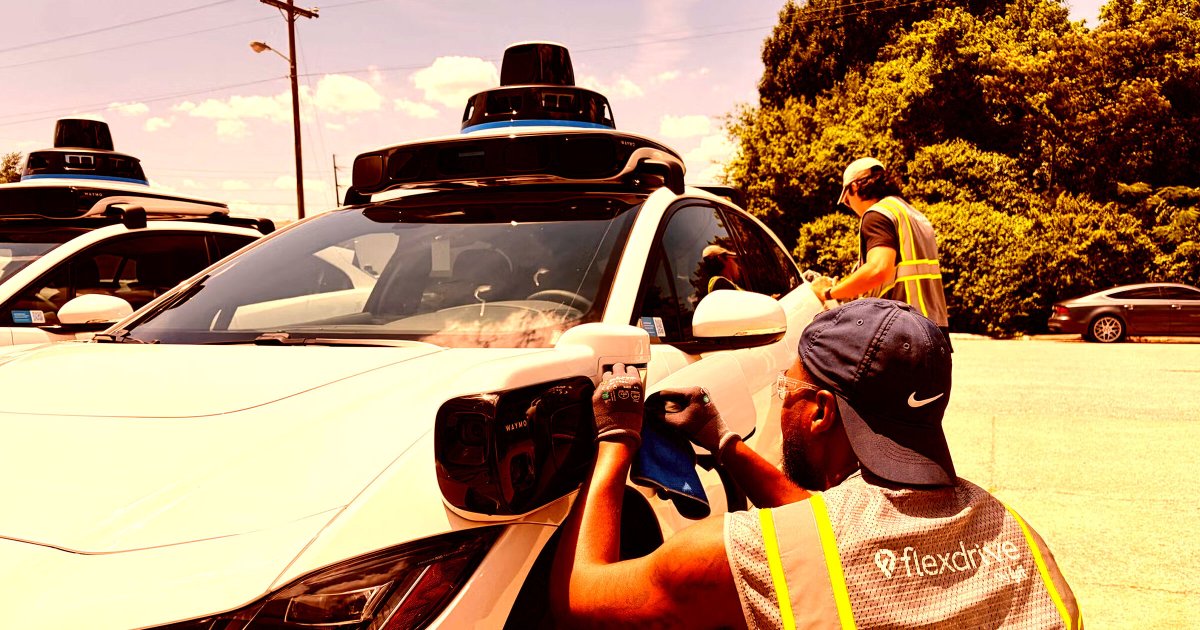
Sign up to see the future, today Can’t-miss innovations from the bleeding edge of science and tech When robotaxis start taking over, what happens to Uber and Lyft drivers? According to a new Business Insider piece, some of them start working for the robotaxi companies that’re outmoding them. The autonomous cars may be self-driving, but they aren’t self-sufficient. Someone needs to clean and service them on the daily, making sure everything runs smoothly. Waymo, the leading robotaxi firm, maintains depots across the country where this type of work is performed, and many of their employees used to drive for rideshare apps themselves. The ones that BI spoke to who work at Waymo’s Nashville depot, which is run by Lyft, seemed to like their new jobs — though it’s worth noting that Lyft arranged the interviews, so the selection may not be representative. Chauncy Thompson said he strongly prefers being a fleet operations associate for the robotaxis to being a Lyft driver, citing for one, its consistent hours. His job involves inspecting each car, charging it, cleaning it, and checking tire pressure — the kind of attention to detail he paid to his own vehicle when he was giving rides. “I wanted my car to look nice on the road and my tires to be in perfect condition before I hit the road,” he told BI. Jonathan Baines, who drove for Lyft for over a decade, likes the idea of working on something on the cutting-edge. “It’s new. It’s innovative,” Baines told the outlet. “This is going to give me opportunities within the AV industry, here within Lyft and Flexdrive, that I wouldn’t otherwise have.” “I miss driving because I love interacting with people,” Baines added. “But in terms of the actual work itself, I love this more.” Waymo and Lyft are opening another Nashville depot in October, where half of its workforce will be former rideshare drivers. Menial as the work may be, you could argue that it’s giving a new opportunity to the workers whose jobs are being, or may soon be, replaced. But on the other hand, those opportunities are scant. According to BI, the 80,000 square foot facility — Waymo’s largest yet — will employ about only 70 full-time workers. That’s not nothing, but when you consider the fact that a single robotaxi, which doesn’t need to take breaks and can operate around the clock, can handle the workload of multiple human drivers, and it paints a less encouraging picture of the jobs that robotaxis will create compared to the ones they’re replacing. Alexander Alonso, chief knowledge officer at the Society for Human Resource Management, said that the transition from driving to servicing robotaxis illustrates a more useful way to think about AI and employment: the “redesign of work.” “The big metric is not only jobs lost,” Alonso told BI. “It is: How are jobs changing?” Some of SHRM’s research suggests that this re-skilling of sorts is already happening, BI noted, with 35 percent of the skills in current job postings not being in postings for the same jobs a year and a half ago. Waymo, notably, won’t say how many people it employes to service its fleet of over 3,500 robotaxis. More on robotaxis: Labor Union Sues Over Self-Driving Trucks
Former Lyft Drivers Now Doing Menial Tasks for Their Waymo Overlords
Full Article
Original Source
Read the full article at Futurism →KhanList aggregates and links to publicly available news content. We do not host full articles from third-party sources. Always verify important information with original sources.