
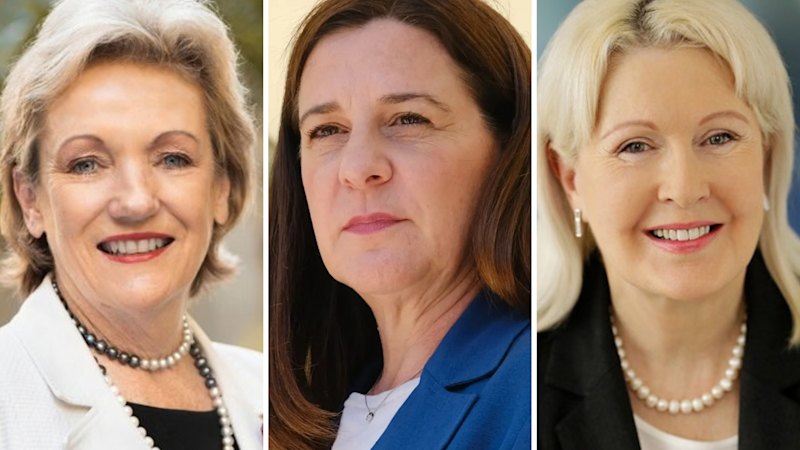
Welcome to Brisbane Times’ Queensland public sector column, Public Circus. This week: quiet QCAT appointments, pointy public debate questions posed in rights watchdog review, and annual report sifting delivers (some) transparency.Among the various boards and other entities overhauled, or still being swept, by the Crisafulli LNP in the past two years, the Queensland Civil and Administrative Appeals Tribunal has not been exempt.More than half of its 143 members have been appointed (or reappointed) since the election. However, it’s a handful of more recent ones which have caught our eye: those tasked with hearing cases involving alleged wrongdoing by lawyers.Former Turnbull government minister Jane Prentice (left) and Howard government minister De-Anne Kelly (right) are among three former LNP MPs, and a broader group of five with links to the party, landing QCAT gigs from Attorney-General Deb Frecklington last month.Metro North Health, Matt Dennien, LinkedIn/De-Anne KellyAttorney-General Deb Frecklington made nine appointments to the tribunal in early September to update the dozen-or-so members of its specific legal practitioner disciplinary function.These figures are called on by the tribunal to assist in matters involving bad behaviour from the sector, and are split into “practitioner” and “lay” members – lawyers and non-lawyers.The latter, according to the Legal Profession Act which sets up the process, are only eligible if they have never been a lawyer and have “high level experience and knowledge” in fields including consumer protection, business, and public administration.And wouldn’t you know, two of the five tapped for that gig – revealed only with an update to a sprawling government appointment register – just happen to be former federal LNP MPs!Former Turnbull government minister and Brisbane City Council figure Jane Prentice, whose brutal 2018 preselection loss to Julian Simmonds in Ryan saw her pushed out of parliament, is one of the names.(An event manager before politics, Prentice was made a member of the federal Administrative Appeals Tribunal after her dumping, and has also been on the Metro North Health board since her appointment by the then Labor state government in 2024.)Howard-era veterans affairs minister De-Anne Kelly, who held the seat of Dawson between 1996 and 2007 – and has more recently been dabbling in the world of offshore casinos – has also been handed one of the paid gigs.Another lay member, “Liberal Party grandee” Patrice McKay, has another three years in the role after a 2023 appointment by Labor.Newman government Ipswich MP Ian Berry has joined the tribunal as a practitioner member, as has Crisafulli and Co’s handpicked WorkCover board chair Chloe Kopilovic.Jules Moxon, a barrister who briefly served as an advisor to then Commonwealth attorney-general George Brandis, rounds out those with links to the governing party.Circus, of course, does not suggest any of the new members are not qualified or suitable for the roles.Asked about the selection and appointment process, and why this could have resulted in such representation for those with LNP links, Frecklington did not give a direct answer.“These appointments include highly regarded members of the legal profession and respected community representatives,” a spokesperson said in a statement.“[They] will help address significant caseload pressures and backlogs after Labor repeatedly kicked the issue down the road and placed QCAT in the too-hard basket”.Human rights office review poses pointy questions about public debateLast week saw some more shape added to the review of Debbie Platz’s Queensland Human Rights Commission, in the form of a discussion paper released by reviewer Peter Flanagan.The retired Supreme Court justice has been tasked with looking over the office’s functions and performance, required by law, but has been asked to go beyond that.Queensland Human Rights Commissioner Debbie Platz APM in her Brisbane office earlier this year.Matt DennienCircus’ pass over the paper has caught some interesting questions being posed to potential submitters, particularly given recent scrutiny (including from this column) around the commission’s involvement in public debate and policy development.The paper noted there is “no existing express function” under the Human Rights Act for the commission to examine proposed laws, and a narrow power to do so only at the attorney-general of the day’s discretion for the Anti-Discrimination Act the watchdog also oversees.Under its more general functions around promoting and understanding and discussion of human rights, the commission was found to have made 61 submissions to parliamentary committee consideration of bills.“A preliminary analysis of these public submissions shows that they often raise issues about matters concerning government policy rather than focusing on the application of the HRA to the proposed legislation and the potential impact on human rights,” the paper said.This approach is suggested to raise questions about the effectiveness of submissions in achieving a different outcome after a bill has been introduced, and “the effect on the relationship between the government and the QHRC”.The paper cites the ACT Human Rights Commission as one with a more “frequent and early engagement” with ministers and departments during policy development and cabinet process, and asks if Queensland should adopt this more “collaboratively” minded approach.“The ACT experience is that this model does not result in a loss of independence,” the paper said.Another of the review’s tasks, to consider the rights of victims of crime, has seen it pose the question of whether new, specific, human rights should be outlined in state law – something the review said may come with “real difficulties”.It also took a “preliminary view” echoing an earlier review of the Human Rights Act that the system which requires parliament (read: the majority government of the day) pass a declaration if elements of a bill are incompatible with human rights should be repealed.“The short point is that, where the sovereignty and paramountcy of Parliament is maintained under the HRA, there is simply no requirement for Parliament to make an override declaration,” the review said.The review’s final report, also considering elements of the former Labor government’s paused Respect At Work laws, will be handed to the government in March next year.Annual report watch: Growing RTI pressure and lobbying watchdog winsSince the government, again, dropped dozens of annual reports on AFL Grand Final eve, we’ve been slowly wading our way through the details.One which caught Circus’ eye was a comment from Information Commissioner and self-identified “QChatter” Joanne Kummrow.In her outgoing annual report, the introduction for which we assume was edited by the government’s internal generative artificial intelligence tool, based on Kummrow’s previous comments, she called out delays from agencies handing over requested information.Kummrow said government bodies were not keeping pace with growing demand for right to information and personal information requests, resulting in decisions not being made within required timeframes and rejected as a “deemed decision”.“In 2025–26, the OIC observed a corresponding sharp increase in external reviews of deemed refusal decisions, which we attribute to delays in agency decision-making,” she wrote.Information Commissioner Joanne Kummrow speaking at a Victorian parliamentary hearing in 2023.A total of 17 per cent of these external review requests were now related to deemed RTI decisions. This, Kummrow said, was the result of “significant resource constraints within agency RTI units” – something Circus has certainly had experience with.This also led to a lift in Kummrow’s issues of formal notices to agencies to produce information as part of those reviews, totalling 11 in 2025-26 compared to just three in the previous financial year.Meanwhile, the Office of the Queensland Integrity Commissioner revealed it had used new compliance powers to cancel the registration of a lobbyist for failing to complete mandatory training, and issued 17 compliance notices for breaches of the code of conduct.Lobbying activities recorded by the watchdog’s public-facing register totalled 1324, down from the recent election-year high of 1446 in 2024-25 (but still shy of the 2021-22 high-water mark of 1518).In one example of the benefit of the database, Circus’ post annual report flick-through found approaches by SAS Group’s Malcolm Cole to the office of Premier David Crisafulli on behalf of Clive Palmer’s Waratah Coal.This was despite both Palmer and Crisafulli refusing to answer questions for our reporting of three meetings between the pair, the most recent in July after Palmer renamed the company to Energy A.Cole reached out to Crisafulli’s office through the government portal just two days before the July 24 meeting, and then held a follow-up meeting with the premier’s chief of staff Richard Ferrett in early August.Both were described in the register as “commercial-in-confidence”, but relating to the portfolios of resources, energy, and regional and state development.An entry in Ferrett’s own diary for August goes further, categorising the purpose of his get-together with Cole as a “discussion regarding Energy A’s proposed coal mining operations in Queensland”.Sometimes, transparency gets a bit of a win.Have a curiosity for the Circus tent? Email on m.dennien@nine.com.au. For more security, sing out with a non-work device and network via Signal (mattdennien.15 or here) and mattdennien@protonmail.com.Start the day with a summary of the day’s most important and interesting stories, analysis and insights. Sign up for our Morning Edition newsletter.From our partners
Former LNP MPs tapped for roles on legal sector disciplinary tribunal
Full Article
Original Source
Read the full article at Smh →KhanList aggregates and links to publicly available news content. We do not host full articles from third-party sources. Always verify important information with original sources.