
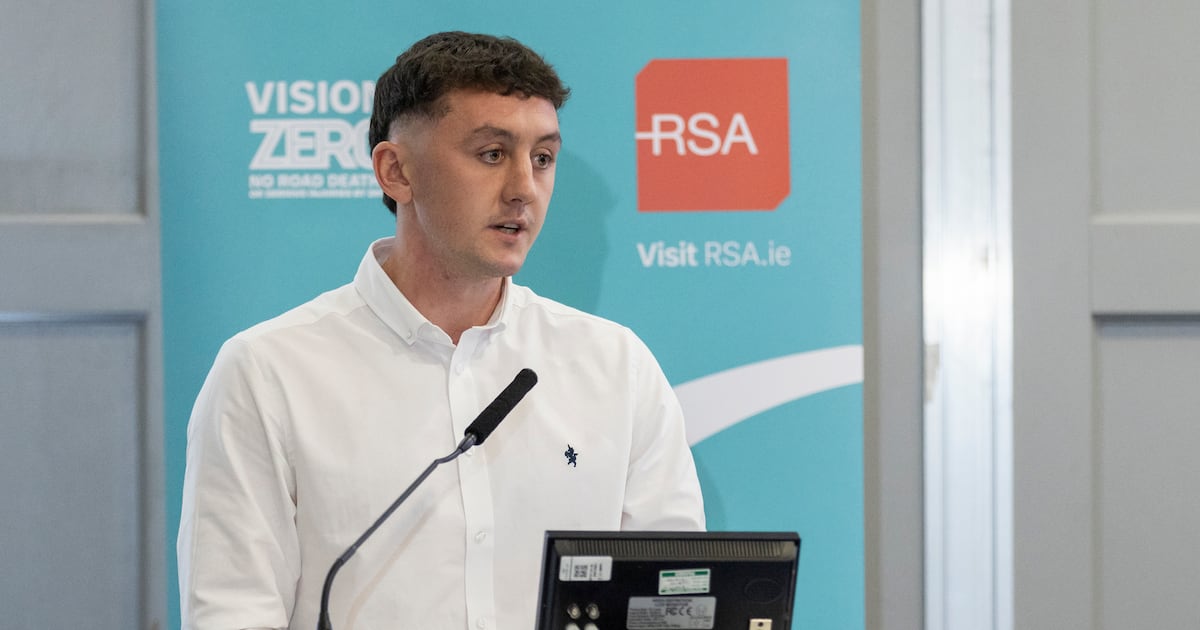
A former Kerry footballer has said “10 seconds of recklessness” by a young driver changed his life forever. Seán O’Leary (27) was seriously injured in a crash on July 10th, 2021, while travelling home from a match with his girlfriend Emma O’Connor.Their car was struck near Abbeyfeale, close to the Limerick-Kerry border, when another driver overtook traffic on a bend on the wrong side of the road. O’Leary said the actions of Michael Harty had “severe consequences for myself and Emma, and for all our loved ones”.READ MOREThe All-Ireland minor football winner sustained life-changing injuries and developed post-traumatic stress disorder after the “horrific” crash. He was unconscious for about 15 minutes after the crash, and O’Connor thought he was dead. He woke up in “excruciating” pain and saw “my right femur bone hanging out through my leg”.O’Leary was rushed to University Hospital Kerry in Tralee, where he was resuscitated.He recalled the crash while speaking at the Road Safety Authority’s (RSA) annual conference in Dublin on Thursday. The theme of the event was young driver risk.Seán Canney, Minister of State with responsibility for road safety, also addressed the conference. He said the fatal M9 motorway crash in August “showed the terrible harm that reckless behaviour can cause”.“Wrong-way driving is extraordinarily dangerous, and no moment of attention, online or otherwise, is worth putting a life at risk,” Canney said.[ A5 ruling a ‘relief’ for bereaved families, All-Ireland winner who lost two siblings saysOpens in new window ]Five teenagers, who were in a car driving the wrong way down the motorway, died in the collision on August 16th. Three women and a child, who were in a vehicle struck by the teenagers’ car, were seriously injured.The crash highlighted a trend of young people filming themselves driving the wrong way down roads and posting the footage on social media.Canney said the crash brought the reality of reckless driving “home in the starkest possible way”. O’Leary said, following the crash in 2021, he “had to endure an absolute rollercoaster of a journey, both physically and psychologically, in order to get myself and my life back on track”.He sustained several injuries, including fractures to both femurs, a fracture to his right tibia and fibula, a fractured sternum and a significant concussion. He spent four months in a wheelchair and underwent multiple surgeries, including the insertion of titanium rods into both legs. His recovery involved a lengthy period of physical and psychological rehabilitation. [ Calls for ban on rickshaws in Dublin following death of young motherOpens in new window ]The crash brought his inter-county football career to an end. “In the years since the crash, Emma and I have had to travel the length and breadth of this country, working with physical and rehabilitation specialists and psychological professionals trying to rebuild our lives.”O’Leary said he and O’Connor are aware they are very lucky to have survived the crash, but added: “I don’t think lucky describes what people have to deal with after a serious car crash, especially the ones that they do not cause themselves.”Harty, who had a previous conviction for speeding, pleaded not guilty to dangerous driving causing serious bodily harm, but was found guilty by a jury and jailed for four years with the final year suspended in 2024.O’Leary said the fact Harty received a jail sentence and a driving ban “really mattered to us, because people convicted of dangerous driving must be held accountable ... but nothing that happened in court that day can undo the damage”.[ What one Kerry road tells us about speed limits and road safetyOpens in new window ]O’Leary said he speaks publicly about his story to “prevent it from becoming someone else’s”. He received a standing ovation after his speech.The crash O’Leary was injured in happened at about 11pm, while the M9 crash occurred at around 3am. Research published by the RSA on Thursday showed that late night and early morning are particularly high-risk periods for young drivers involved in fatal crashes.Between 2021 and 2025, 189 drivers aged between 17 and 25 were involved in 178 fatal crashes in the Republic. These young drivers accounted for 19 per cent of all drivers involved in fatal crashes during this period.Nearly one-third of fatal crashes involving a young driver occurred between 8pm and midnight. A further 21 per cent occurred between midnight and 4am. Of the 189 young drivers, 156 (83 per cent) were male. Sam Waide, RSA chief executive, said the research “shows that while young drivers account for a relatively small proportion of the driving population, they are over-represented in fatal collisions”. “The concentration of fatal collisions during late-night and early-morning hours, alongside the strong representation of young men, highlights particular areas for continued focus in road safety policy, education, enforcement and intervention.”[ Seven years after asking, gardaí cannot access driving licence photosOpens in new window ]Canney said the Government is committed to reducing the number of deaths on Irish roads, which have increased in recent years after “decades of reducing road deaths”.“Reversing that trend is a central priority for me, for my department and for this Government.”He said he hoped new learner permit rules, stricter regulations on e-bikes and scramblers and education campaigns targeting young drivers would help reduce collisions and fatalities.
Former Kerry footballer says ‘10 seconds of recklessness’ by driver changed his life forever
Full Article
Original Source
Read the full article at Irishtimes →KhanList aggregates and links to publicly available news content. We do not host full articles from third-party sources. Always verify important information with original sources.