
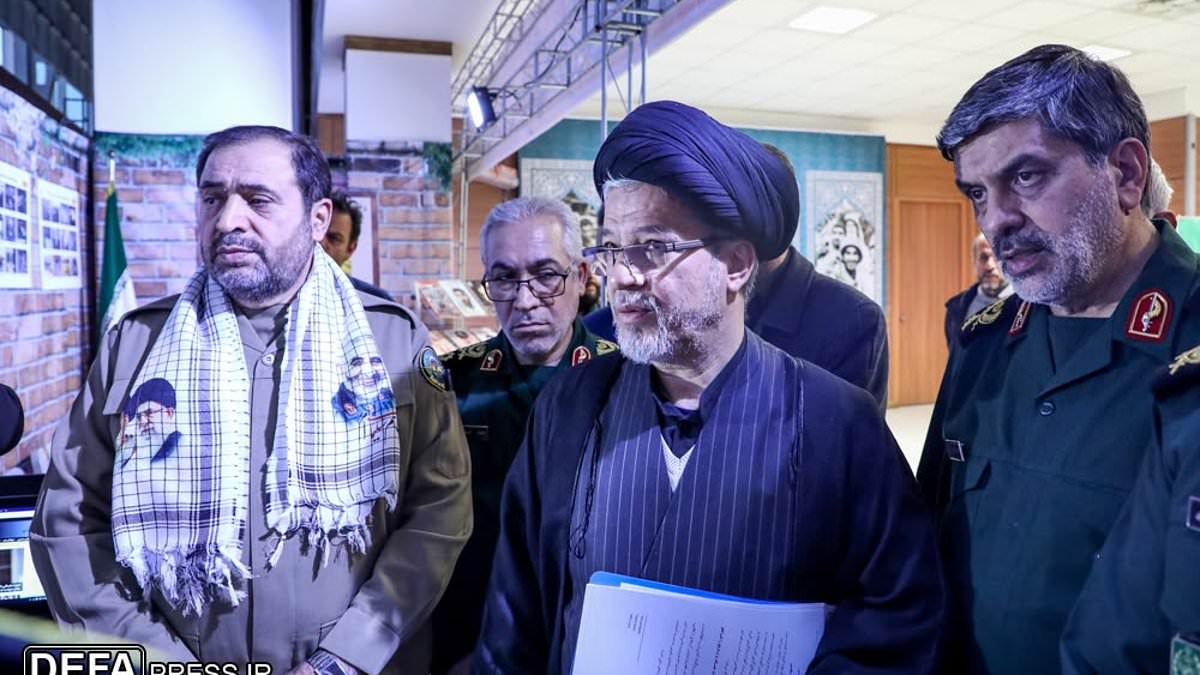
A former Islamic Revolutionary Guard Corps (IRGC) commander, who helped to launch a crackdown on women's clothing that led to widespread protests and dozens of deaths, is to deliver a keynote speech at a London conference on Islamophobia. Saied Reza Ameli has been announced as one of the keynote speakers at the Islamic Human Rights Commission's (IHRC) thirteenth annual conference, entitled: 'Artificial Intelligence and Islamophobia.'Ameli, who will deliver his speech remotely on December 13, was the secretary of Iran's Supreme Council of Cultural Revolution from 2019 to 2023, which drew up the tougher guidance on the compulsory wearing of the hijab.It was during Ameli's time as secretary that the late Iranian President Ebrahim Raisi commanded Iran's morality police in July 2022 to find women breaching the law by failing to wear their headscarves properly. Mahsa Amini, 22, died in police custody in September 2022 after being arrested by the morality police because of her 'inappropriate dress', sparking nationwide demonstrations which saw at least 476 protestors killed by security forces.Ameli, who is still a member of the Supreme Council of the Cultural Revolution, joined the IRGC in 1980 and was previously the Deputy Commander of Imam Sadeq Brigade in the IRGC's Seyed-al-Shohada Division from 1997 to 1999.He served under Ali Fazli during the Iran-Iraq war, according to United Against Nuclear Iran (UANI). Fazli, the former head of the IRGC’s Seyyed al-Shohada Corps in Tehran Province, was later sanctioned by the UK for his role in overseeing the police, Basij and IRGC crackdowns on civilians during 2009 unrest in Iran, resulting in hundreds murdered as well as thousands imprisoned and tortured. Saied Reza Ameli has been announced as one of the keynote speakers at the Islamic Human Rights Commission's (IHRC) thirteenth annual conference on December 13 Saied Reza Ameli, centre, pictured with Second Brigadier General Majid Hashemi-Dana, a senior commander of the Islamic Revolutionary Guard Corps. Material obtained by Kasra Aarabi, Director of IRGC Research at United Against Nuclear Iran (UANI), and shared with the Daily Mail Ameli, who will deliver his speech remotely, was formerly the secretary of Iran's Supreme Council of Cultural Revolution, which drew up the tougher guidance on the compulsory wearing of the hijab. Material obtained by Kasra Aarabi, Director of IRGC Research at United Against Nuclear Iran (UANI), and shared with the Daily MailThe IHRC, a non-governmental organisation, is funded by a charity called the Islamic Human Rights Commission Trust (IHRCT), which is based in the same building in Wembley, northwest London.The trust is being investigated by the Charity Commission due to concerns about its involvement in publications made and events organised by the IHRC.A Charity Commission spokeswoman told the Daily Mail: 'The Commission has previously engaged with the Islamic Human Rights Commission Trust and provided regulatory advice and guidance regarding its relationship with the non-charitable organisation Islamic Human Rights Commission. 'We have since launched a statutory inquiry into the charity over ongoing concerns about its relationship. This remains ongoing.'Ameli founded the IHRC in 1997 and was director of its Board of Trustees between 2006 and 2022.He was co-director alongside Massoud Shadjareh, who still holds the role.In January 2020, Shadjareh praised the Iranian general Qasem Soleimani, who was killed in a US drone strike, as a 'martyr' during a meeting at the Islamic Centre of England. The centre received an official warning from the Charity Commission in 2020, and is now also the subject of a statutory inquiry after failing to comply with the regulator's 'Action Plan'.This year's IHRC conference focuses on the 'manifest challenges and implications of AI on Muslims' lived experiences, with political and policy consequence'.'For some analysts, Gaza has been described as the world's first AI-assisted genocide,' a description on the IHRC website about the conference says.'Allegations abound that Israeli authorities have used Artificial intelligence to collect data, locations and to target Gaza for maximised infliction of casualties, including on women, children and other innocent Palestinians. 'It is further speculated that western countries have been deferential to Israel's Gaza campaign to learn how to use AI effectively in their own projects of violence, both within their own respective countries and elsewhere, even beyond efforts currently underway. 'In many western countries, governments and private entities have used AI to identify protesters, doxxing them and referring them to law enforcement and security services for detention, prosecution and deportation.' The IHRC has an 'advocacy service' that offers free advice to 'help people through the complaints process if they are subjected to racial or religious discrimination in public services including housing, education, from the police and other bodies'.In one 'success story' posted on the IHRC website, the organisation claims to have assisted a teenager to 'successfully challenge a referral by her school and social services to the Prevent deradicalisation process, Channel, despite a police decision not to pursue a case against her'.The IHRCT's legal fund offers support to 'individuals on low income struggling with immigration problems'.Between February 1, 2025, and January 31, 2026, the fund assisted nine individuals with their leave to remain applications and saved individuals and families a total of £18,832 in Home Office fees and £16,000 in professional fees. Mahsa Amini died in custody in 2022 after not observing Iran's ultra-conservative dress code, causing outrage across the country and beyond Material obtained by Kasra Aarabi, Director of IRGC Research at United Against Nuclear Iran (UANI), and shared with the Daily Mail Material obtained by Kasra Aarabi, Director of IRGC Research at United Against Nuclear Iran (UANI), and shared with the Daily MailAmeli claimed after the Supreme Council published the guidelines on 'chastity and hijab' in 2019 that they were needed for 'social health, protection of the family'. He said that foreign television shows were designed to 'weaken chastity and hijab'. In 2001, Ameli obtained a doctorate in the sociology of communication at Royal Holloway University of London in 2001. In 2006 he was co-author of a book about the hijab and British women, based on research by the IHRC. Its recommendations to the government included a national policy incorporating the hijab into work and school uniforms and having 'women-only spaces in public places'.Ameli is now a professor of communication at Tehran University as well as holding influential official posts.He held a business interest in London until June 14, 2023, when he resigned as director. While no reason for the resignation is given, Canada had sanctioned Ameli a few months earlier for 'gross and systematic human rights violations in Iran, including through the lethal suppression of demonstrations across Kurdish areas of Western Iran'.Additionally, the UK sanctioned the Supreme Council of the Cultural Revolution and another organisation with which Ameli remains affiliated, the Supreme Council of Cyberspace, less than a month after his resignation from the UK business. Amini went into a coma after being arrested in Tehran and died while she was in police custody in Kasra hospital of the capital in 2022 Iran morality police detain and arrest a woman for not wearing a headscarf The Supreme Council for Cyberspace is considered Iran’s top internet policy making body. 'Reportedly dominated by security agencies and with no public oversight, the Supreme Council of Cyberspace directs the filtering of the internet in Iran and determines which websites should be blocked,' the UK government wrote.A May 2019 resolution by the council, ‘Policies and Actions to Organise Domestic Text Messaging Apps’, was adopted during Ameli's membership.This resolution described the necessity of ‘storing’ and ‘processing the data related to texting apps’ inside the country, according to the charity Justice for Iran.The resolution also stated that the application’s user would be persecuted for their online activities, reportedly stating: 'The users are responsible for their actions on social media, and the service providers of text messaging apps are obliged to cooperate with officials.’The US sanctioned the Supreme Council of Cyberspace in 2018 'for engaging in censorship or other activities with respect to Iran that prohibit, limit, or penalise the exercise of freedom of expression or assembly by citizens of Iran, or that limit access to print or broadcast media'. Some experts believe Ameli was one of the 'main designers' of the National Information Network (NIN) project, known as the 'National Internet' - one of the most important projects of the former President Hassan Rouhani's government.The Supreme Council of Cyberspace defines the NIN as 'a network based on the Internet Protocol with switches and routers and data centres which allows for data requests to avoid being routed outside of the country and provides secure and private intranet networks'.The ongoing project would create a domestic, government-controlled internet, in which the state would decide all content and access, according to the Centre for Human Rights in Iran.'In effect, the National Internet would create a locked wall around the Internet for users inside Iran, with the government as the sole key holder. Needless to say, as sole holder of the key, the government would have full access to the content of any account,' the rights goup said.Following Ameli's appointment to the Supreme Council of the Cultural Revolution, Kaveh Azarhoosh, an internet policy researcher in London, told BBC Persian: 'With the advances made in the infrastructure of the national information network, it seems that the appointment of an agent at the head of the Supreme Council of the Cultural Revolution was because the council is supposed to play a more prominent role in the gradual disconnection of Iran's internet from the global network by advancing conservative cultural policies designed for cyberspace.'He added: 'Ameli is actually the driver of these policies.'A 2021 decree issued by the Supreme Council of the Cultural Revolution showed that the IRGC, intelligence services and the police force had been given 'maximum' access to Iranian universities and their international partnerships, in order to acquire sensitive research from overseas.Advanced weaponry, drones, aerospace propulsion systems, artificial intelligence and sophisticated warfare software were listed among the top defence priorities for the nation.The 'strategic document', issued when Ameli was still secretary, stated that 'professors, researchers and students' should be utilised to secure these military capabilities in response to Tehran's 'defence needs'.Kasra Aarabi, Director of IRGC Research at United Against Nuclear Iran, told the Daily Mail: 'Ameli is on record confirming that he joined the IRGC in 1980/81 and served under Ali Fazli, one of its most extremist commanders, a sanctioned individual linked to gross human rights violations and terrorist activities abroad.'More recently, he has been a key member of the Supreme Council for Cultural Revolution, the Islamic regime’s highest authority on cultural, research and educational policy. The Council has played a central role in enforcing the regime’s Islamic morality policies, including the violent imposition of compulsory hijab on women.'But the implications extend far beyond domestic repression in Iran.'The Council also facilitated and oversaw a strategic agreement with the IRGC, granting it maximum access to academic relationships between Iranian and Western universities. This created a mechanism through which the IRGC exploits partnerships between Iranian and Western universities to procure sensitive and dual-use research for its military programmes.'The IRGC has used such arrangements to procure sensitive research for the development of its lethal drone programme, including from British universities. These are the same drones now being deployed in conflicts across the Middle East and Ukraine.'Crucially, the strategic agreement, in which Ameli was involved through his senior role on the Council, explicitly identifies the IRGC’s procurement priorities, including artificial intelligence.'Someone with Ameli’s background and connections should never have been allowed to enter Britain, let alone establish organisations here.'This represents a serious failure of government oversight and raises fundamental questions about whether Britain has the necessary policies and safeguards to identify, disrupt and counter the Iranian regime’s networks and influence operations on British soil.'The IHRC told the Daily Mail: 'Prof. Ameli is a brilliant and sincere academic who has consistently taken an inclusive approach to his work. 'He has championed multiculturalism and sought to foster understanding between different worldviews, a position that has even led to accusations of being pro-Western in his own country. He has also been critical of the retreat of multiculturalism in the West.'In regards to the Canadian sanction against Ameli, the IHRC said: 'That being the case, there is no legal impediment against him participating in the conference. Canadian sanctions have no force in the UK.' It added that Ameli is on public record opposing the enforcement of hijab in Iran.
Former IRGC commander behind Iran's brutal hijab crackdown to give keynote speech at London 'Islamophobia' conference
Full Article
Original Source
Read the full article at Dailymail →KhanList aggregates and links to publicly available news content. We do not host full articles from third-party sources. Always verify important information with original sources.