
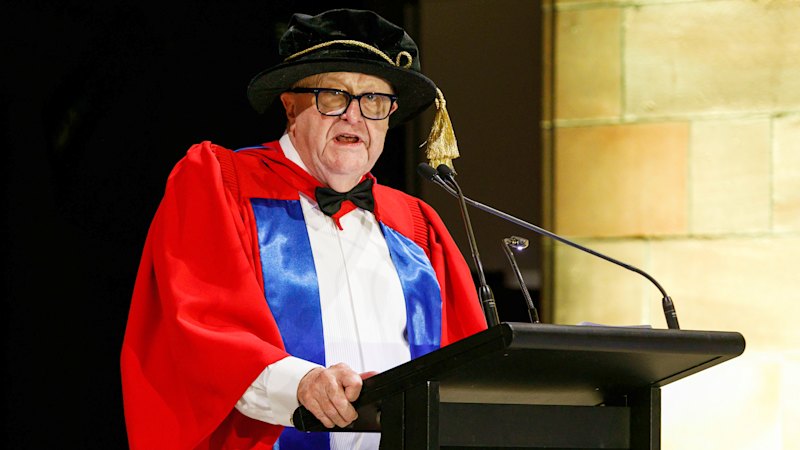
November 10, 2026 — 1:22pmFormer International Olympic Committee vice president and Australian Olympic Committee honorary life president John Coates has been presented with an honorary law doctorate from Sydney University in recognition of his contribution to Australian sport and to the university.The doctorate is the university’s highest degree, and caps an impressive list of achievements by the former lawyer and rowing cox, who is also one of the youngest recipients of the nation’s highest honour, Companion of the Order of Australia.John Coates makes a speech after accepting his honorary law doctorate from Sydney University.© Karen Watson for Sydney UniversityThe citation to his award, conferred at a ceremony at Sydney University last Friday, notes: “Through his leadership, advocacy and service, John has strengthened Australia’s global reputation, fostered regional cooperation and advanced fairness and professionalism in sport. His legacy endures in the institutions he has built, the athletes he has empowered and the enhanced standing of Australia on the world stage.”In just one year, in 2021, at the end of his three-decade reign as AOC president, Coates achieved three honours: leading Australia to its highest Olympic gold medal tally, at the Tokyo Games; running the Games themselves as chair of the IOC’s Co-ordination Commission, in the midst of the COVID pandemic, while also convincing his fellow IOC members to award Brisbane the 2032 Summer Olympics.Yet the university’s decision to confer its prestigious award on Coates focused on his role as President of the Court of Arbitration of Sport, the international body which resolves complicated sporting disputes. Forty years ago, sport at both the amateur and professional level was often mired in conflicts between athletes and administrators over matters from team selection to doping, with decisions made by sporting bodies often ill-equipped for the purpose.By 1990, Coates was AOC president and deputy chair of the Australian Sports Commission, when the despotic head of the Australian Commonwealth Games Association, Arthur Tunstall, was typical of sports administrators. Tunstall interfered with selections, threatened Cathy Freeman for carrying an Aboriginal flag at the 1994 Victoria, Canada Games and won votes by delivering whisky bottles inside boxes of cornflakes to delegates from impoverished countries.Coates with Sydney University chancellor David Thodey (right) and deputy chancellor Alan Pettigrew during the official conferral ceremony.© Karen Watson for Sydney UniversityCoates, therefore, had a front-row seat to all the emerging controversies in drugs, host city decisions and the retreat of Olympic sports from amateurism.He was a founding member of the International Council of Arbitration for Sport upon its creation in 1994, subsequently known as CAS. Two years later, at the 1996 Atlanta Olympics, CAS formed an ad-hoc division as a practical solution to resolve disputes during the Games, quickly and efficiently without disrupting competition. The increasing complexity of international sport required a mechanism capable of delivering justice, sometimes only an hour before athletes loaded themselves into the starting blocks of the 100-metre sprint.CAS, based in Lausanne and chaired by Coates for 15 years, now receives 1100 disputes annually for arbitration and mediation. In his address accepting Sydney University’s honorary doctorate, Coates pointed to the increasingly blurred lines between legal disputes and what are generally called field-of-play decisions.He quoted the case of a Ukrainian skeleton racer who was disqualified from competing at the 2026 Milano Winter Olympics after refusing to stop wearing a customised “helmet of remembrance” honouring fellow athletes and coaches killed in the Russian invasion.John Coates at Homebush for the swimming during the Sydney Olympics in 2000.Craig GoldingCAS viewed the case as a legal one because it breached rule 50 of the Olympic charter, rather than treating it as a sporting judgement, despite the involvement of Ukraine president, Volodymyr Zelensky. As Coates said, “The CAS panel had to balance freedom of expression with the principle of political neutrality in the Olympic charter. It reached a conclusion on the merits – not just procedure.”He concluded his speech with a reference to the Brisbane Olympics, which he first championed as a young lawyer leading the bid for the Queensland capital to be granted hosting rights for the 1992 Games, won by Barcelona.“CAS, particularly the ad hoc division, provides something essential: legal certainty and finality at a moment when uncertainty would be most damaging and amount to a denial of justice,” Coates said. “What matters ultimately is that the system continues to be trusted to act independently. This same spirit will, I am sure, continue to guide us, not least as we steadily move towards the Games a little closer to home in Brisbane.”Coates, now aged 76, hopes to attend the Brisbane Olympics in 1932, despite a series of serious health battles the past ten years which would have felled an ox. His enemies have long considered him Machiavellian, but he now more closely resembles another political operative, Rasputin, who survived multiple attacks.He can still switch, mid-sentence, from fluent legalese to the language of the locker room. He may need the latter vocabulary at the Los Angles Olympics in 2028, when President Trump will still be in office and may order CAS to overturn medal results against American athletes.News, results and expert analysis from the weekend of sport sent every Friday. Sign up for our Sport newsletter.Roy Masters is a Sports Columnist for The Sydney Morning Herald.Connect via email.From our partners
Former AOC president John Coates awarded honorary law doctorate from Sydney University
Full Article
Original Source
Read the full article at Smh →KhanList aggregates and links to publicly available news content. We do not host full articles from third-party sources. Always verify important information with original sources.