
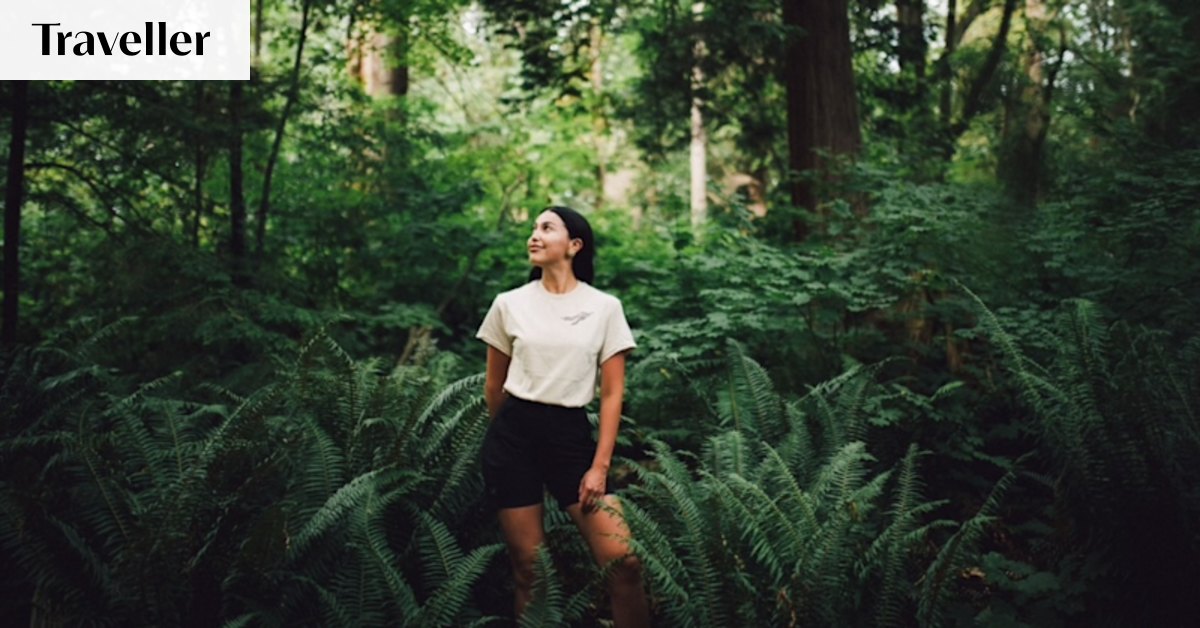
October 25, 2026 — 5:00am“We are the land and the land is us,” explains Talaysay Campo, born and raised in the Squamish and Sechelt cultures of Canada’s First Nations.On Campo’s Talking Trees tour in Vancouver’s Stanley Park, the city’s vast green 400-hectare lung, we are introduced to the plants, medicines and technologies of her people.Vancouver’s Stanley Park stays lush and green thanks to 169 days of rain a year.iStockFirst, we meet the vine maple tree. “It doesn’t know personal space – it likes to branch out and reach for that sunshine,” Talaysay says. Its wood is strong but flexible so it is useful for constructing shelters. If the tree arched in shape, then that shape would form the frame for a shelter.Next, we meet the mighty Douglas fir, which soars into the sky with bark so thick it resists forest fires but, ironically, there’s an element in its sap that helps start fires, and it was tapped for just that purpose.Deeper into the forest we find salmonberries, huckleberries and more. “This is one of the first laws we learn: you never take the first berry, and you never take the last berry,” says Talaysay.Sign up for the Traveller Deals newsletterGet exclusive travel deals delivered straight to your inbox. Sign up now.“My ancestors dried the berries so they had fruit all year round. Our four-legged friends don’t have that privilege, so for the first two weeks, when everything is in bloom, we save berries for our relatives, the animals. That way, they get the berries they’ve been waiting two seasons for.Talaysay Campo guides guests through the forest of her ancestors.“The reason we don’t take the last berries is a teaching from the bear, which never completely strips a berry bush. It gives the final berries on the branches the opportunity to fall back into the earth and regenerate.”Further along is the western red cedar. Its outer and inner bark is a universal resource: the outer suitable for shelters and the inner for clothing (both practical and ceremonial), ropes, bedding and much more. “We use it from cradle to grave.”There are rules for the bark harvest: “If you can reach around the tree and touch your hands, move on because the tree is too small. When you find a tree old enough, measure two hand widths, make a cut and pull the bark away. That might strip as much as five metres, it will stop where the tree wants it to stop.”From that park full of trees, stroll along the shores of English Bay and catch a ferry to Granville Island.While the First Canadians would harvest from the forest, here’s where the locals harvest their fresh food today.“The market is who we are,” says my Vancouver Foodie tour guide Sandra Trotter. “Here’s the best of Vancouver – food, wine and the outdoors. We aim for this to be the world’s best market.” The morning is sunny and the crowds are building.There are no franchise outlets on the island and most of the produce we taste on this tour with Trotter is local and artisan. The Benton Brothers make their small-batch cheese from the milk that comes in from the Okanagan region. Oyama Sausage makes its meaty creations from five generations of charcutiers.Fresh produce at the Granville Island Public Market.BloombergWild salmon from Longliner Seafoods.And the morsels of wild-caught Canadian salmon we try at Longliner Seafoods (the maple candy salmon is what I’m going back for) is another story of the generations. Jim Moorehead, himself a longline fisher, founded the business in the late 1970s and was one of the market’s original tenants.Back then, the island was mainly used for warehousing and as a base for the local fishing fleet. Beyond the market, you’ll find those warehouses have been transformed into studios for artists and artisans – painters, jewellers, glassblowers, even broom makers.And before it hosted those warehouses, the island’s sandbars were a food source for the First Canadians. When the tide was out, the food was on. And so it continues.Jim Darby is a senior producer for Traveller and the author of White Gold, a history of Australia in winter sports.Connect via X or email.From our partners
Forgotten forest secrets in Canada’s greenest city
Full Article
Original Source
Read the full article at Smh →KhanList aggregates and links to publicly available news content. We do not host full articles from third-party sources. Always verify important information with original sources.