
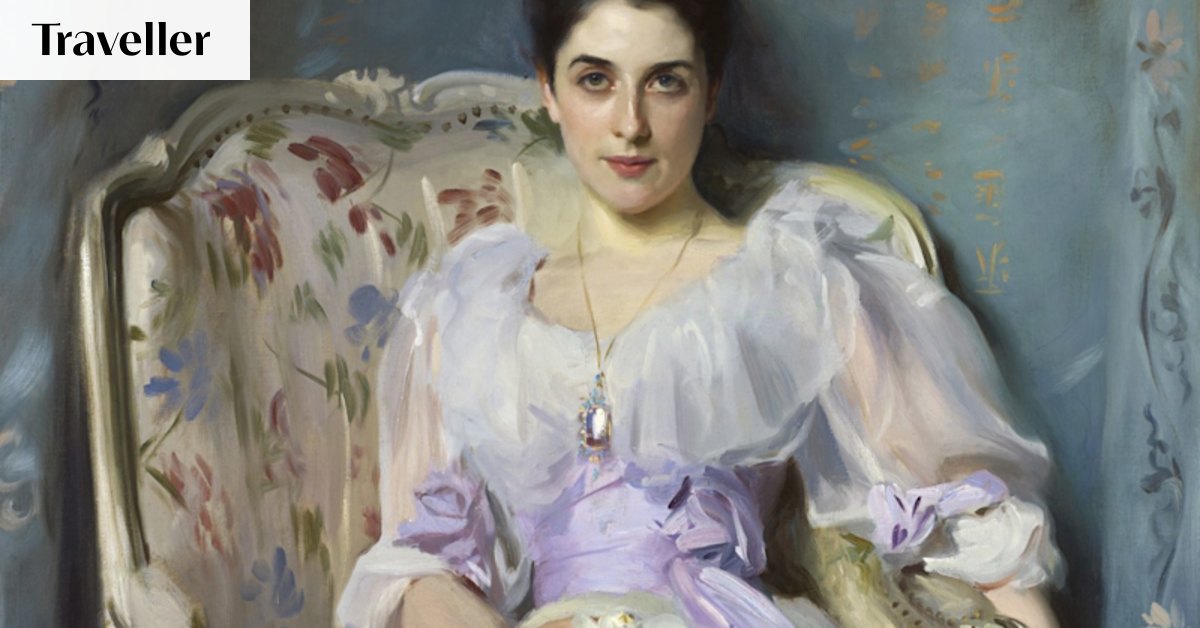
Imagine you’re in one of the world’s great galleries, trying to view every painting. Several hours later, your feet hurt and your brain is so over-stimulated that you crumble and stumble out, wondering what you’ve missed. You’re doing this art appreciation thing all wrong.Fiona Lowry, the 2014 Archibald Prize winner, says that when looking at a painting, you should allow time to feel your feelings. “Notice what you see first, what you initially miss, where your eye travels and what other images come into your mind – then come back to it,” she says.Traveller asked seven experts – curators, artists, gallery directors and more, including Lowry – for their most magical paintings, excluding Leonardo da Vinci’s Mona Lisa, viewed by millions of people each year. Pop them on your must-see list and go ahead and feel those feelings.THE PAINTINGSLady Agnew of Lochnaw, 1892, John Singer SargentJohn Singer Sargent, Lady Agnew of Lochnaw.National Galleries of Scotland, Edinburgh.Sign up for the Traveller Deals newsletterGet exclusive travel deals delivered straight to your inbox. Sign up now.Maria Stoljar, creator and host of Talking with Painters and self-confessed portraiture tragic, nominates this work as one of her all-time favourites. “Capturing a young woman’s face is difficult enough – a millimetre of misplaced paint can lose the likeness. But Sargent goes well beyond likeness here. It’s the enigmatic expression and pose that I find so compelling – is she languid, sultry or just bemused? The restrained palette, composition and seemingly effortless handling of paint make this one of his most brilliant portraits.”Where National Galleries of Scotland, National, The Mound, Edinburgh, Scotland, UK. See nationalgalleries.orgThe Death of Sardanapalus, 1844, Eugene DelacroixEugene Delacroix, The Death of Sardanapalus.The Louvre, ParisRaafat Ishak, the Victorian College of the Arts’ head of painting, says he’s had a postcard of this painting in his studio for years. “There’s something about the Baroque realism of it that’s quite fascinating with the swirling bodies – everything goes around in circles and comes back to the same point again. It’s very big and dominates the space and everything around it as well. It’s the reds and the flesh – it’s a full-on work.”Where The Louvre, Paris, France. See louvre.frCool White, 1959, Lee KrasnerLee Krasner, Cool White.National Gallery of Australia, Canberra © Lee Krasner, ARS/Copyright AgencyWhile many people visit the National Gallery of Australia to see its most famous – and infamous – painting, Jackson Pollock’s Blue Poles, for NGA curator Magda Keaney the painting that’s almost always hanging beside it, Cool White, is alone worth a trip to Canberra. “To stand before it is as much a physical experience as a visual one: its scale, energy and totemic presence is both disorienting and hypnotic. What first appears chaotic or unresolved, soon reveals a rigorous visual logic and structure. Krasner’s an extraordinary colourist yet this monochrome canvas belongs to her Umber Series. Suffering from insomnia, and still recovering from the deaths of Pollock – her partner in life and art – and her mother in 1959, she began working at night. This nocturnal process shaped the palette: she turned to natural and earthy pigments rather than her characteristic bright colours that required daylight.”Where National Gallery of Australia, Canberra. See nga.gov.auSaint Francis in the Desert, c.1475-80, Giovanni BelliniGiovanni Bellini, St. Francis in the Desert.Michael Bodycomb/Frick Collection, New York.Art Gallery of NSW chief curator Justin Paton recommends setting aside at least 30 minutes, “or maybe a day”, when visiting this painting. “From the rabbit poking its nose out in the foreground to the patchwork of fields on far hills, it’s a picture you can enter at any point and make your way through imaginatively,” he says. “Saint Francis, barefoot on the sun-warmed stone, is undergoing a mystical event. Bellini brings the rapture to us through his reverent, deeply felt details. We sense the spreading warmth of the morning sun, the way light shakes through the laurel tree. Surely, this is one of the most grateful and generous artworks ever made.”Where The Frick Collection, New York City, US. See frick.orgThe Return of Judith to Bethulia, c.1470-75, Sandro BotticelliSandro Botticelli, The Return of Judith to Bethulia.Uffizi Gallery, FlorenceAs Keaney explains, Judith is the warrior heroine who, with her attendant Abra, beheads the Assyrian general Holofernes to save her home of Bethulia. “The story was taken up by many Renaissance artists,” she says. “But Botticelli’s Judith is especially beguiling because we encounter her not at the violent climax but afterwards on the road home with Abra. I’m captivated by the quietness of this imagined journey – Judith is almost ethereal in her blue robes and, although she still carries her sword, her face is saintly and serene. While Botticelli’s The Birth of Venus is also at the Uffizi, this small-scale panel is unfamiliar, beautiful and strange all at the same time.”Where The Uffizi, Florence, Italy. See uffizi.itKrishna defeats the demon Bana, c.1585–90, artist unknownKrishna defeats the demon Bana.Art Gallery of NSWPaton says that sometimes looking at paintings is just a licence to wonder, “to marvel at what human hands have made. I’ve seldom seen more wonder per square centimetre than in this page from a late 16th-century folio on show in Avatar: Forms of Vishnu (on until October 5). Carnage and lyrical beauty mingle as blue-skinned Krishna does battle with Bana, whose fanned arms (several dozen of them) send the painting into imaginative overdrive. A tiny work that feels gigantic, a 400-year-old work that feels thrillingly alive – little wonder so many Sydney artists have loved spending time with this painting.”Where Art Gallery of NSW, Sydney. See artgallery.nsw.gov.auThe Crossing of the Red Sea, 1632, Nicolas PoussinNicolas Poussin, The Crossing of the Red Sea (detail).National Gallery of Victoria, MelbourneIshak says you can “read” this painting in a zigzag from the top to the bottom, or vice versa. “I often go to the NGV just to look at it – I sit there for five or 10 minutes, sometimes half an hour. It’s more about the construction of the painting and how it works that interests me – it really motivates me to paint.”Where NGV International, Melbourne, Vic. See ngv.vic.gov.auJimson Weed, 1936, Georgia O’KeeffeGeorgia O’Keeffe, Jimson Weed. Indianapolis Museum of Art at NewfieldsStoljar says that what she’s found from interviewing artists is how often they paint what’s personal to them. “Jimson weed, which grew around O’Keeffe’s New Mexico home, is beautiful but poisonous. What isn’t apparent in a reproduction is this work’s scale – it’s more than two metres wide. She takes something small and familiar, and makes it monumental, forcing us to stop and examine it.”Where Indianapolis Museum of Art, Indiana, US. See discovernewfields.orgThe Ditchley Portrait (Queen Elizabeth I), c.1592, Marcus Gheeraerts the YoungerMarcus Gheeraerts the Younger, ‘The Ditchley portrait’ (Queen Elizabeth I). National Portrait Gallery LondonThe National Portrait Gallery’s Tudor galleries are extraordinary, says Keaney. “When I worked there, I never tired of spending my lunch break on the third floor, especially with the fabulous and disconcerting Ditchley Portrait. It’s hard not to be captivated by Elizabeth I. This monumental painting is designed to humble the viewer: dense with symbolism, it asserts the Queen’s supremacy and power while also revealing the personal histories and intrigues of her court. It’s both majestic and unsettling. Her costume is staggering and there’s considerable pleasure in simply indulging in its splendour. But nothing in the portrait is neutral: almost every detail speaks to empire, trade and power. It’s a captivating history lesson.”Where National Portrait Gallery, London, UK. See npg.org.ukThe Incredulity of Saint Thomas, c.1601-02, CaravaggioCaravaggio, The Incredulity of Saint Thomas. Hans Bach/Sanssouci Picture Gallery, PotsdamPaton says that in the Sanssouci Picture Gallery’s long, gilded hall, one painting brings you to a shocked stop – Caravaggio’s image of Christ revealing his wounds to the apostle Thomas to prove the truth of the resurrection. “As the apostles lean in, foreheads gleaming, Christ draws back his garment and guides Thomas’s finger into the wound in his side. The fingernails are dirty, the wound is soft and sexual, and Thomas stares like a man utterly shaken. Caravaggio, the Baroque genius and troublemaker, performs his own act of persuasion, using shadow, light and the grittiest of details to convince us this is happening.”Where Sanssouci Picture Gallery, Potsdam, Germany. See spsg.deLandscape with a Man Killed by a Snake, c.1648, Nicolas PoussinNicolas Poussin, Landscape with a Man Killed by a Snake.National Gallery, London.Archibald Prize-winning Sydney artist Fiona Lowry says this painting makes you work a bit. “You don’t see the man killed by the snake straight away. You’re moving through the scene; it doesn’t give all the answers at once. I love the idea that a painting can resist being understood immediately and continue to reveal itself through sustained looking. It rewards time.”Where The National Gallery, London, UK. See nationalgallery.org.ukStag at Sharkey’s, 1909, George BellowsGeorge Bellows, Stag at Sharkey’s.The Cleveland Museum of Art Lowry finds the merging of the boxers’ bodies and the bodies in movement compelling, “because you’re not at the beginning or end of that moment – you’re in the middle of the action, unsure what the outcome is, and the morality of what you’re looking at is for you to uncover. It reminds me of Francis Bacon’s images of wrestling bodies.”The Cleveland Museum of Art, Ohio, US. See clevelandart.orgSelf-Portrait, c.1938-40, Pierre BonnardPierre Bonnard, Self-Portrait.Art Gallery of NSW“One of the saddest, wisest, loveliest self-portraits is right here in Australia,” says Paton. “Bonnard paints himself as an ageing dweeb seen at night in his bathroom mirror, his lumpy fists raised as if he’s shadow-boxing with mortality. Up close, the painted flesh of his head and hands looks fermented, almost rotten. At the same time, he makes this modest room in the south of France into a trembling light-chamber, its yellow walls glowing around him like the gold on a Byzantine icon. Beauty in mortality, radiance amidst loss – a glimmering, melancholy masterpiece.“Where Ground level, Naala Nura, Art Gallery of NSW. See artgallery.nsw.gov.auJudith Beheading Holofernes, c.1620, Artemisia GentileschiArtemisia Gentileschi, Judith Beheading Holofernes (detail).Uffizi Gallery, Florence“We sometimes take for granted how recently women have been recognised as equals in the art world,” says Stoljar, “and you could argue we’re not there yet. So it’s extraordinary to find a woman celebrated as a painter in the 17th century, and more surprising still to find her tackling a subject this violent. Its sheer expressiveness draws you in, but it’s the physicality that stays with me. These women aren’t posing – they’re using their strength. You can almost feel the effort.”Where The Uffizi, Florence, Italy. See uffizi.itEine Kleine Nachtmusik, 1943, Dorothea TanningDorothea Tanning, Eine Kleine Nachtmusik. © Tate “Surrealism is so often associated with male artists like Dali or Duchamp, but there were amazing women artists as well and Tanning is one of the best,” says Keaney. “I’ve been bewitched by the strangeness of this painting [part of International Surrealism from Tate at the Frist Art Museum, Nashville, until August 30] – everything’s enigmatic and dream-like, and I love that.”Where Frist Art Museum, Nashville, US. See fristartmuseum.orgI watched myself die and come alive, 2023, Tracey EminTracey Emin, I watched myself die and come alive.National Gallery of AustraliaWhen Keaney saw this work at the Tate Modern’s retrospective Tracey Emin: A Second Life (closing August 31), it was the final work encountered in the exhibition, and a showstopper. “We’re fortunate to have this pivotal painting by one of our most important contemporary artists in the national collection in Canberra. In London, it hung among paintings that made you draw breath: raw, expressive canvases articulating grief, loss and survival, including the death of Emin’s mother and her own experience of aggressive cancer. It’s a declaration of survival and of the undiminished creative impulse at the centre of Emin’s life.”Where National Gallery of Australia, Canberra. See nga.gov.auDaphne and Apollo, c.1470–80, Piero del PollaiuoloPiero del Pollaiuolo, Apollo and Daphne (detail).The National Gallery, London“This is probably my most beloved painting in one of the world’s great museums,” says Keaney. “Unless on loan, it’s hung in much the same place for the best part of 20 years. Seeing it feels like visiting a friend. It’s not on the main route through the galleries, and it’s small so you almost have to know to look for it. The myth of Daphne and Apollo is well known; what moves me in this version is its defiant representation of refusal: a woman going to extraordinary lengths to thwart a powerful suitor.“It captures the moment when Daphne, with the help of her father Peneus, transforms into a laurel tree as Apollo clings to her still-human legs in a futile attempt to possess her. To see her rendered as part woman, part tree is highly unusual in paintings of this subject, and I find the vision utterly fantastic and thrilling. I’ve pondered her expression many times. I see satisfaction, calm resignation and something else I still can’t quite name – and I hope I never do.”Where The National Gallery, London, UK. See nationalgallery.org.ukPainting is not making paintings, Agnes MartinAgnes Martin: Painting is not making paintings (installation view).Dia BeaconThe National Portrait Gallery’s Pickering describes contemporary art venue Dia Beacon as, “one of those places that, if you love art, you must visit in your lifetime. It’s about 90 minutes on the train from Grand Central in New York. Agnes Martin (1912-2004) was working at a time when minimalism was really happening, but her work is so material and meditative, and the shifts in her practice over time were slight rather than extreme. So you stand in this huge former box factory surrounded by a series of her works [in the retrospective Agnes Martin: Painting is not making paintings], and it’s so contemplative.”Where Dia Beacon, Beacon, New York State, US. See diaart.orgJuan de Pareja, c.1608–1670, VelazquezVelazquez, Juan de Pareja. The Metropolitan Museum of Art, New York“Power, beauty, energy, delicacy,” says Paton. “All these qualities can make a painting great. But Velazquez’s portrait of Juan de Pareja has something more – the mysterious quality called presence. Visit The Met’s Spanish rooms and Pareja is right there: proud, intelligent, observant. Velázquez’s brushwork breathes and moves and so, we feel, does Pareja. The subject was, in fact, Velazquez’s enslaved Afro-Hispanic assistant. Four years later he was released by his master to become an independent painter. So, the sense of a person alive within the painting is doubly charged and poignant. Here’s a soul who sees us.“Where Gallery 625, The Metropolitan Museum of Art, New York City, US. See metmuseum.orgSelf-Portrait, 1887, Van GoghVincent van Gogh, Self-Portrait. Art Institute of ChicagoKeaney saw this painting in London in the Courtauld Gallery’s “knockout” Van Gogh self-portrait exhibition in 2022. “It had only 16 works but was one of the most moving and memorable exhibitions I’ve ever seen. Each of Van Gogh’s self-portraits is a masterclass in the transformation of modern painting at the end of the 19th century. In this one, he tests the pointillist technique made famous by Georges Seurat; both artists were living in Paris at the time.Beyond that context, it’s an emotional force and the visceral uncertainties of this modest oil on board – the humanity, fragility, presence and self-doubt of the artist’s searching self-inquiry through paint – make it unmissable. The surface pulses with energy and intensity. The cosmos seems to swirl behind him, as in Starry Night, each atom of paint forming a circular aura. Most electrifying is the palpable trace of Van Gogh’s hand in the vivid red brushstrokes through his hair, as though the painting had been made yesterday.“Where Gallery 241, Art Institute of Chicago, US. See artic.eduJapanese Bridge, 1918-24, Claude MonetClaude Monet, Japanese bridge (Le pont japonais).National Gallery of Art, Washington, US“I didn’t expect this to be my favourite work [in our Impressionists exhibition],” says Geelong Gallery director Humphrey Clegg. “It’s a late work when Monet’s eyesight is failing. It’s this incredible symphony of greens. You have to see it – it doesn’t reproduce as well as it looks. He hints at the bridge with these splashes of red, which is really bold. With this, you see an artist at a point in his life where he’s in full command and just really enjoying painting. It has its own wall in a gallery we’ve painted yellow.”Where Discovering the Impressionists, Geelong Gallery (until October 11). See geelonggallery.org.auThe Death of Actaeon, c.1559-75, TitianTitian, The Death of Actaeon (detail).The National Gallery, London“Titian has painted this scene before – the difference being that Actaeon has come across Diana quite innocently,” says Keaney. “Here, she turns him into a stag and his own hounds set upon him so he has this terrible end. I love the idea of the woman not being the vulnerable subject of the painting but being the active warrior goddess. It also has a very loose feel to the brushwork that’s almost impressionistic.“Where The National Gallery, London, UK. See nationalgallery.org.ukWoman Reading a Letter, c.1663, Johannes VermeerJohannes Vermeer, Woman Reading a Letter.Rijksmuseum, AmsterdamThe Rijksmuseum has the world’s largest collection of Rembrandt paintings, including The Night Watch, but it was Vermeer’s small jewel of a work that transfixed Keaney. “It’s the woman’s absorption in the letter that I found so beautiful and captivating. Her day coat is also this lapis lazuli blue that Vermeer was well known for using – it’s stunning.“Where Rijksmuseum, Amsterdam, the Netherlands. See rijksmuseum.nlThe Body is Not a Thing, It’s a Situation, 2021, Andrea BowersAndrea Bowers, The Body is Not a Thing, It’s a Situation. Jeff McLane/Glenstone Museum, MarylandPickering says that “from far away, [American artist Bowers’] work almost looks like tapestries or very bright paintings. It’s not until you get closerthat you see the ‘card-boardiness’ to them. She’s using plays on material and medium to think about what it means to look at her work. She leads with her politics, oftenusing illustrations from the late 1800s that cast women in a particular light and makes slight adjustments with very contemporary materials like markers.”Where Glenstone, Maryland, US.…AND SIX AUSTRALIAN PAINTINGS NOT TO MISSUntitled, 1983, Sidney Nolan, Canberra Museum and Gallery, ACTFrom the artist’s Remembrances of My Youth series, this later period of Nolan’s career is undervalued, says Lowry. “The works still feel so contemporary and there’s a real looseness and immediacy to them.” See cmag.com.auSuper Cathy series, 2025, Kaylene Whiskey, National Portrait Gallery, CanberraKaylene Whiskey, Super Cathy series (detail). National Portrait Gallery, CanberraPickering says Whiskey honours one of her heroes, “at a really critical moment. It collapses time and place and pulls forward a moment (Freeman’s Sydney Olympics win).” See National Portrait Gallery, Canberra, portrait.gov.auAnwerlarr angerr (Big yam), 1996, Emily Kam Kngwarray, NGV, Melbourne“It’s monumental, which a lot of Emily’s works are,” says Pickering, “and an image that’s seared into our consciousness. When you stand in front of something at that scale, it moves in a way that wraps around you visually – she has the ability to make something that’s static feel like it’s moving.” See ngv.vic.gov.au Seven Sisters, 2019, Sylvia Ken, AGNSWSylvia Ken, Seven Sisters.Art Gallery of NSWStoljar says Sylvia Ken comes from a remarkable family of artists. Her mother, Iluwanti Ken, is the subject of this year’s Archibald Prize-winning portrait. “This 2019 Wynne Prize winner depicts the Seven Sisters from her Tjukurpa (creation story). I find the intricate layering of dots, lines and vividness of colour mesmerising.” See artgallery.nsw.gov.auThe expulsion, 1947-48, Arthur Boyd, Ngununggula, Bowral, NSW“I love how Boyd takes this enormous biblical story of the expulsion from the Garden of Eden, sets it in the Australian landscape, and makes it feel intimate and psychological,” says Lowry. Part of Ngununggula’s New Religion exhibition (until October 18). See ngununggula.comWilliam and Shirley, flora and fauna, 1985, William Robinson, QAGOMA, BrisbaneWilliam Robinson, William and Shirley, flora and fauna.Queensland Art GalleryStoljar says Robinson was famous for monumental, multi-panelled paintings of dreamlike landscapes. “This is more modest but demonstrates his signature shifting perspectives and gentle humour.” See qagoma.qld.gov.auSo, what did our panel overlook? Leave a comment below or write to Traveller at travellerletters@traveller.com.au and tell us, in 100 words or fewer, your own choice and criteria of a worthy, must-see painting in Australia or around the world. We’ll publish the most interesting correspondence at a future date.
Forget the Mona Lisa: Experts name 30 lesser-known paintings you need to see
Full Article
Original Source
Read the full article at Smh →KhanList aggregates and links to publicly available news content. We do not host full articles from third-party sources. Always verify important information with original sources.