
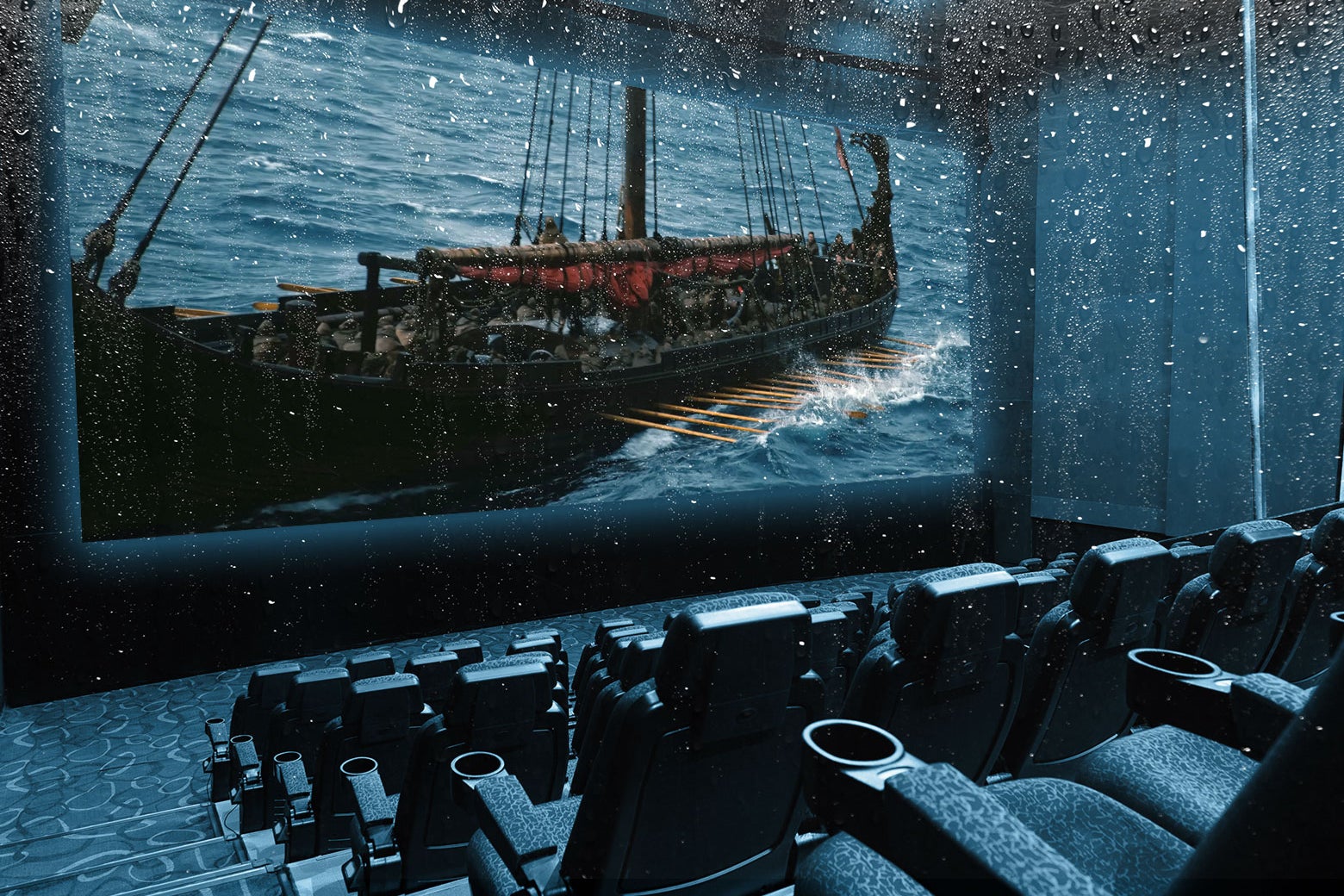
Movies I Watched The Odyssey in 4DX. It Was a Wild Ride. Forget IMAX 70 mm. The peak way to experience Christopher Nolan’s movie feels like getting tossed about at sea. By Enter your email to receive alerts for this author. Sign in or create an account to better manage your email preferences. Unsubscribe from email alerts Are you sure you want to unsubscribe from email alerts for Nadira Goffe? July 28, 20261:05 PM Photo illustration by Slate. Photos by gschroer/Getty Images Plus, Universal Pictures, and hxdbzxy/Getty Images Plus. Sign up for the Slatest to get the most insightful analysis, criticism, and advice out there, delivered to your inbox daily. A war. A man. A trick. And motorized chairs sending you what feels like throttling across the high seas. Ever since a few videos of moviegoers watching Christopher Nolan’s epic adaptation of The Odyssey in 4DX—an immersive movie theater format that features, among other things, scents, moving chairs, and water—have gone viral on the internet, much ado has been made of this particular way of seeing the film. I don’t know if you’ve ever been on a capsizing boat in the middle of a thunderstorm or tossed into a churning washing machine that’s sitting on the bed of a truck lane-switching like mad on a busy highway, but the shakily filmed clips of the 4DX experience make it seem as if that’s what watching The Odyssey in these special theaters would emulate. One X user claimed that the theater had them “turned every which way but loose,” while others joked about the sheer immersiveness: “I saw The Odyssey in 4DX and a Greek man came into the theater and touched me.” Of course I had to find out for myself if this was truly the case, so I set off on my own odyssey last week, to the nearest cinema offering this experience. Now, after having viewed The Odyssey in both 70 mm and 4DX, I have my gods-given answer: This format is not for the faint of heart. Apparently I wasn’t the only one with a death wish on Thursday night in Midtown Manhattan, as my theater—at the Regal Times Square—was full of other thrill-seekers. As I waited for the movie to start, one guy seated near me with his friends asked innocently, “Are there seat belts?” No, my friend, there are not, but maybe there should be. The Odyssey in 4DX starts off incredibly calm. Gentle movement of the chairs, accompanied by slight wind, makes you feel as if you’re gliding alongside the sweeping camera shots of Nolan’s Ithaca. But as soon as Odysseus and his men get into the thick of it, so, too, do you. The few jumpscares in the film are punctuated by jolts from the chair, arrows whizzing by are made real by air jets on either side of your headrest, and the many scenes of peril at sea are brought to life by seemingly every possible effect at 4DX’s disposal being thrown at you at once. This intensity is not random, however; there’s an art and a science to it, as I’ve reported on during Dune: Part Two’s theatrical run, when 4DX screenings of Denis Villeneuve’s movie garnered some popularity. No, the 4DX experience is not a slapdash result of button-mashing on a video-game controller. Instead, a small team of producers works tirelessly to craft as spellbinding a viewing experience as possible in a matter of days. According to Jaehyun Jeong, lead 4DX project director for CJ 4DPLEX, the South Korean subsidiary that owns the technology, this version of The Odyssey took a team of a few members and producers, working with the first editor on Nolan’s film, 15 days to create. Within that time, Jeong—who studied film and philosophy in school and has a filmmaking background—watched the nearly three-hour movie approximately 10 times, and some sequences and shots “more than 100 times,” as he relayed to me. This is nothing new for either party, considering that 4DX’s relationship with Nolan dates all the way back to Interstellar, at least as far as Paul Kim, 4DX’s chief operating officer, can remember. “You don’t necessarily think Christopher Nolan and 4DX,” Kim admitted, referring to the director’s history of making the types of “serious” cinema offerings that film bros fawn over. Nolan’s gimmicks tend to be of the nonsequential-storywriting and niche-aspect-ratio variety, not the theme-park-attraction variety. Still, Kim emphasizes that the 4DX team “maintained the contrast” of Nolan’s films by having the action ramp up from practically nothing at the start, rather than throwing audiences in headfirst. The result is a movie-watching experience that builds in tandem with the film. At The Odyssey 4DX’s peak are three scenes: the siege of Troy, of course, and two major events involving Odysseus and his men at sea. When—and pardon me if I spoil a nearly 3,000-year-old story here—Odysseus’ crew narrowly escapes the monstrous whirlpool Charybdis only to experience a surprise attack by the multiheaded beast Scylla, the 4DX chairs move wildly, bouncing viewers up, down, and forward, while being spray-misted multiple times. But rest assured: It doesn’t feel nearly as dramatic as it looks on X. This is, as Jeong puts it, due to the team’s dedication to “maintaining the balance.” He explains that the most important thing to the team is ensuring that “the audience could stay fully immersed in the story in the film without feeling overwhelmed.” As someone who struggles with motion sickness, I appreciate that. One of the standout sequences from the 4DX screening is a scene that comes later, when the gods exact their revenge upon Odysseus’ crew with a severe storm that claims the men and the boat. According to Jeong, the storm sequence gave the 4DX team “much more creative freedom” because, unlike typical action sequences, which require the physical effects of the theater to “strictly synchronize with what’s happening on the screen,” this scene includes other elements, like reaction shots from Odysseus, allowing the movements to “go beyond simply matching the picture on the screen.” This is perhaps the most activated the theater gets, as the chairs jerk you around and drop you, punctuating the boat ripping apart and Odysseus’ horror at it all. The wind blasts as the strobe lights (yes, there are strobe lights!) flash to mimic lightning. When I turned my head to look at my seat neighbors, the same guy who had asked about seat belts was throwing his arms over his friends as if he were protecting them from an incoming collision. After the movie, when I asked the guys what they thought of the experience, one of them remarked that the movie was “very long … very bumpy.” But this was appreciated, as they believed that “the seats made the scenes feel more real” and the chair movements helped keep them alert during the considerable run time. Though one of them opined that the boat sequence was “too much,” overall they said they would recommend the format and would even see a different movie in 4DX. (Not Jurassic Park, though, one guy commented, while another one interjected, “I would watch Jurassic Park in this!”) The experience wasn’t all grandiose displays, though. I appreciated the way that, every time Odysseus struck his bow, the chair would move. Leesette, another moviegoer at my screening, was also impressed by these subtle movements. “There are certain movies that are made for 4DX, and you can tell. This is one of them,” she said. “You get to experience the wind, the lightning, the water, the shaking, but it’s not just when you’re on the boat—it’s the scene where Penelope slaps Odysseus. The chair moves!” Similarly, Jeong says his favorite sequence is when the Greeks are hiding in the Trojan horse: The team added only “a little bit of motion” as the film depicts the point of view from inside the vessel, reflecting the fact that the soldiers are trying to hide. This moment also includes one of the most effective uses of water, when viewers who have opted to keep the water effects feel a spritz as the horse is stuck in the tide; the tide ends up drowning some of the soldiers clustered at the bottom of the vessel. Yes, moisture-averse viewers, you can turn off the water, although I would recommend leaving it on if you can bear it or what it might do to your hair. “Of course I had to turn the water on,” Leesette said when I asked her about it. “There’s no way we’re going to sit here in a three-hour movie about a boat on the ocean and have the water off!” Jeong explains that this is exactly why 4DX chose this effect: “We first check what is the key effect for each title. So, for example, in The Odyssey or Moana, the ocean and sea sequences are the most important and the main visual background. We don’t hesitate to put in the water effects because the water is the key of the film.” The team deploys this effect many times as Odysseus is at sea, with a special focus on shots in which the water sprays directly onto the camera lens, because it signals to the producers that the filmmaker wants the audience to feel the spray. The team also uses the effect for blood spatters or, as Kim notes, for his favorite use case: when someone sneezes. Try to imagine that without grimacing. But that kind of visceral reaction is the point. 4DX is a complex tapestry of gotchas that seek to engage all possible stimuli. Jeong walks me through the three scents the team uses throughout The Odyssey, including the ocean scents (in moments like when Telemachus first sets off for Sparta), the wet-soil scent (for when the soldiers land on an island where peril awaits), and the burning-rubber scent (as things are inevitably set on fire). But the most surprising effect to me was one that the 4DX team officially calls the “back tickler,” which essentially feels as if you’re sitting in a massage chair that is experiencing fits of rage. Whenever someone gets punched in the back, or during complex fight sequences, you feel a push directly in your back from the chair. Jeong tells me that this effect is used sparingly because, although sparse, it’s “powerful.” At the end of the day, 4DX is like a choreography, as Jeong puts it, in which following “the rhythm of the film and the emotion of the scene” is the main directive. I could sense this while watching The Odyssey, from the horror of the Polyphemus Cyclops scene, to the tragic absurdity of the storm scene, to the crescendo of the sacking of Troy. Three hours later, I exited the theater, enjoying that my fellow moviegoers were snickering about how delightfully bonkers the whole ordeal had been. It may not be the one true format, IMAX 70 mm, but 4DX offers something else: the feeling of walking out after a long voyage, pummeled by the elements but still in one piece, ready to face whatever comes next. Read more in Slate about The Odyssey. Get the best of culture Get the best of movies, TV, books, music, and more. Movies Christopher Nolan The Odyssey
Forget IMAX 70 mm. I Found a Better Way to Watch The Odyssey.
Full Article
Original Source
Read the full article at Slate →KhanList aggregates and links to publicly available news content. We do not host full articles from third-party sources. Always verify important information with original sources.