
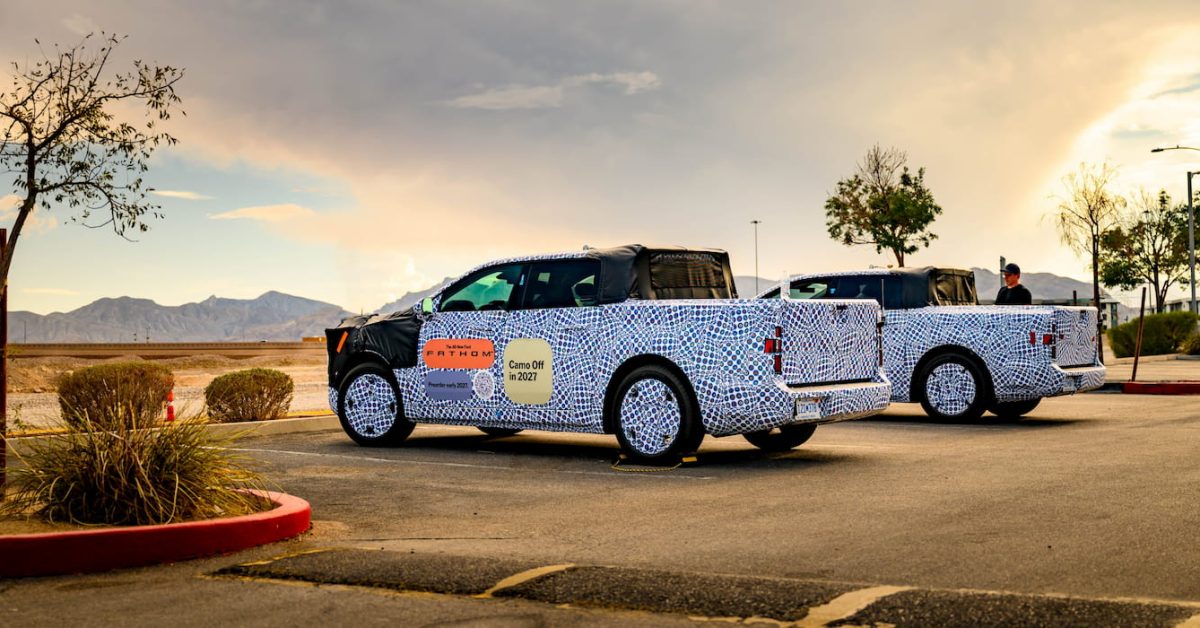
Ford has entered the battery business. The first LFP battery cells are now rolling off the assembly line at Ford’s BlueOval Battery Park plant in Michigan and are headed to power Fathom prototypes in Kentucky. Why is Ford using LFP batteries for the Fathom pickup? How do you get more out of a battery without adding weight or more cells? According to Alan Clarke, Ford’s vice president of advanced development projects, who is also leading its Universal Electric Vehicle (UEV) platform, the answer lies in lithium iron phosphate (LFP) technology. Unlike traditional lithium-ion, LFP batteries use no nickel or cobalt, which helps reduce costs. They also typically hold up better after years of use and charging. To make it a reality, Ford turned to CATL, the leading global EV battery manufacturer. Ford uses CATL’s licensed technology and manufacturing expertise at its BlueOval Battery Park Michigan plant. Ford said it will be the first in the US to deliver LFP batteries for mainstream automotive use, with the battery cells now rolling off the line in Michigan. The first LFP battery cells are headed to Ford’s Louisville Assembly Plant and will be used to power Fathom prototypes, its first vehicle based on the UEV platform. Ford’s first prismatic LFP battery packs undergo final inspection (Source: Ford) Ford designed and engineered the Fathom from the ground up for efficiency. As such, it chose prismatic battery cells because they fit directly into the chassis, reducing structural costs. With cells now being delivered from a plant that it owns and operates, Ford said it will use the knowledge gained in Michigan to support more affordable EVs and Ford Energy, its new battery energy storage business in Kentucky. Ford EV LFP prismatic battery cell (Source: Ford) At Ford’s new battery plant in Michigan, assembly lines can deliver 40 cells every minute, making it one of the fastest LFP prismatic battery assembly lines outside China. Although the accelerated output drives down costs, Ford said employees use AI-powered image recognition and inspection tools to spot defects in real time and maintain quality. “Our goal is to make defective cells so rare that we track their frequency per billion cells rather than per million,” Ford said. Covered Ford Fathom prototype at the Louisville Assembly Plant (Source: Ford) With production testing now underway, Ford plans to have the battery pack plant in Michigan up and running in 2027, ahead of schedule. Ford will open preorders for the Fathom in early 2027, starting at $28,350 for the standard-range model. CEO Jim Farley said on the company’s third-quarter earnings call last month that the Fathom, Ford’s first vehicle based on the UEV platform, remains on track to launch in Q4 2027. Ford Fathom EV pickup prototype (Source: Jim Farley) Farley said the Fathom is a “breakthrough product” that’s highly capable and still affordable. The starting MSRP is under $30,000, and the low cost of ownership is perfect for today’s market, he added. Ford said the Fathom will offer more interior space than a Toyota RAV4, and it will cost less to own over five years than a three-year-old used Tesla Model Y. The pickup will be the first vehicle to integrate Apple Maps directly into the navigation system. All versions will be BlueCruise-capable for hands-free driving, with standard Apple CarPlay and Android Auto, plus bidirectional charging capabilities. Although we have yet to see it, Ford said the Fathom features a “large touchscreen display” with easy-to-use navigation. Ford has not revealed battery specs or range, but we do know the pickup will have an NACS port after several prototypes were spotted at a Tesla Supercharger over the summer. FTC: We use income earning auto affiliate links. More.
Ford’s first LFP batteries are en route, and the $30,000 Fathom EV pickup will get them first
Full Article
Original Source
Read the full article at Electrek →KhanList aggregates and links to publicly available news content. We do not host full articles from third-party sources. Always verify important information with original sources.