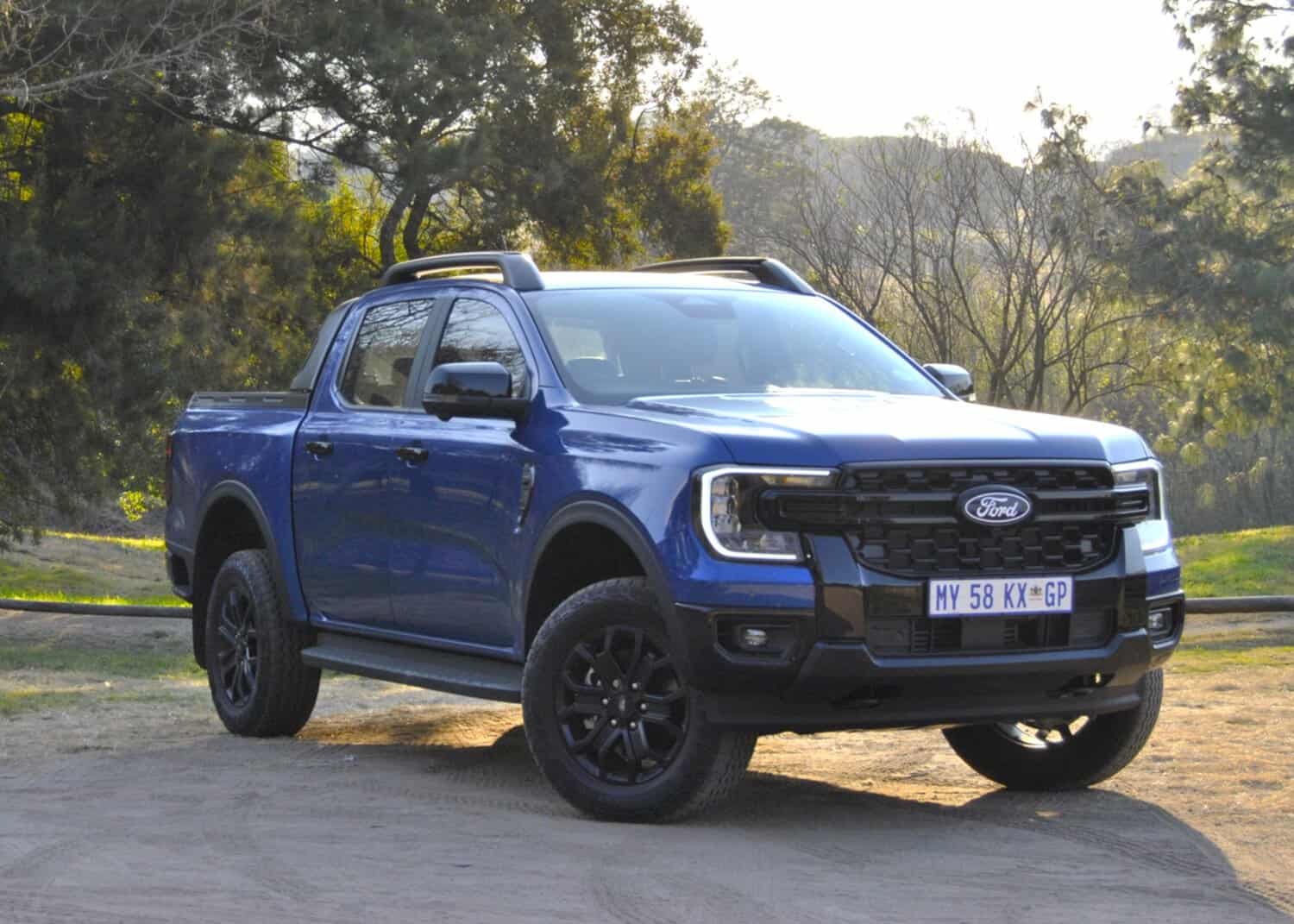
While it highlighted the arrival of the updated range with the 2.3-litre EcoBoost petrol engine, the other significance of the refreshed Ford Ranger line-up is the expansion of the 3.0-litre Lion V6 turbodiesel engine to a more derivative version. Out with the bi-turbo…. As is well-known by now, the revisions omit the usual array of cosmetic tweaks to the Blue Oval’s now four-year old locally produced bakkie. For the next six month, The Citizen will have the depicted Blue Lighting Ranger V6 Sport as a long-term companion. Picture: Charl Bosch Instead, it opted for a mechanical overhaul by removing the 2.0-litre bi-turbodiesel Panther engine, and equipping the carryover 2.0-litre single-turbo with a timing chain as opposed to a timing belt. In addition, all automatic models now feature the 10-speed ‘box co-developed with General Motors, while the Wildtrak X has been re-bundled into an optional package instead of a standalone derivative. … in with the V6 Whereas the centre of attention has been on the rear-wheel drive-only EcoBoost Road Test Editor Mark Jones tested at Gerotek last month, the expansion of the V6 can be a described as a welcome upgrade over the bi-turbo. V6 badge on the front wing vent differentiates the diesel Sport from the EcoBoost petrol. Picture: Charl Bosch In essence, while the EcoBoost replaces certain two-wheel drive versions of the bi-turbo, the V6 serves as the four-wheel drive successor, complete with the full-time all-paw gripping system instead of the part-time setup still available on the single-turbo. Return of the Sport At the same time, the Sport trim level returns, but no longer as the dedicated appearance package it was on the previous generation XL. As in Australia, it now becomes a trim level positioned between the XLT and the off-road focused Tremor. Sport is now a standalone model and not an appearance package as it was for the previous generation Ranger XL. Picture: Charl Bosch Identified from its EcoBoost sibling by the V6 decal on the front wings vents, the Sport also becomes the recipient of dual-zone climate control and the 12-inch SYNC 4A infotainment system all double cab variants now have as standard. Priced a shade under R1 million at R995 000, it is also the most affordable variant in the double-cab Ranger line-up to now offer the V6. All double cab Ranger models will have the 12-inch infotainment system as standard. Picture: Charl Bosch Therefore, and after previous spells with the pre-updated Wildtrak and Platinum, it presented the ideal derivative to get better acquainted with. As such, The Citizen will be spending the next six months in the company of the V6 Sport, which arrived decked out in not only the stunning Blue Lightning paint finish but also the pull-out flexible rack integrated into the sport bar. A tow bar, soft-lid tonneau cover and 18-inch alloy wheel wrapped in Goodyear Wrangler Territory all-terrain tyres round off “our” long-termer. V6 diesel vs EcoBoost petrol Arriving with just under 2 000km on its odometer, the Sport was immediately put to work with a visit to Gerotek and as the road trip wheels for newspaper editor Trevor Stevens – more about these in future updates. Producing an unchanged 184kW/600Nm, the biggest challenge of the V6 has always been fuel consumption. Whereas Ford’s official testing cycle claims a rather optimistic 8.3L/100km, previous spells with the Wildtrak and Platinum saw consumption around 13L/100km when driving it carefully. Sport is outfitted as standard with 18-inch alloy wheels wrapped in all-terrain tyres. Picture: Charl Bosch Along with its four-wheel drive system, careful consideration was given as to whether the EcoBoost, perhaps, presented a better option based on not only the price of petrol versus diesel, but also its reduced weight. However, concerns of it glugging petrol at the same 13L/100km to 15L/100km rate as its four-wheel drive Volkswagen Amarok sibling, eventually saw the V6 being opted for. Leather upholstery and electric adjustment for the driver’s seat only is standard on the Sport. Picture: Charl Bosch At the time of writing, consumption has been steady at 11.1L/100km, 0.5L/100km better than Mark’s tenure with the EcoBoost. The trade-off is nowhere near the response of the 2.3, which feels a lot more powerful and flexible despite some initial low-down lag. However, the V6 counters with a smoother torque delivery and once of up to speed, a tad quieter, with only a distinct six-cylinder rumble being audible. 4WD from the start Outside of its powertrain, the Sport is standard Ranger fare. Aside from its ride and comfort, the infotainment display has become easier to fathom, while material finish is premium and solid. Inclusion of the V6 means the part-time four-wheel drive system from the bi-turbo has been eschewed for the full-time system with the 4A setting. Picture: Charl Bosch As with the Wildtrak and Platinum, the electronic gear lever for the 10-speed ‘box moves automatically forward to Park when the ignition is switched off while left in Drive. At the same time, the 4A setting for the four-wheel drive system has been introduced, thereby allowing the Sport to be driven in four-wheel drive on the road without reverting to high range four-wheel drive (4H) or a gravel road. Conclusion Given its expanded timeframe, the next few months will be interesting as, apart from the daily grind, more road trips are likely being planned, along with what can only be described as the vehicular version of chores. Included in the double cab Ranger 3.0 V6 Sport 4WD’s price tag is a four-year/120 000km warranty and a six-year/90 000km service plan.
Ford Ranger V6 Sport out to show why it is the line-up’s sweet spot
Full Article
📰 Original Source
Read full article at Citizen →KhanList aggregates and links to publicly available news content. We do not host full articles from third-party sources. Always verify important information with original sources.