
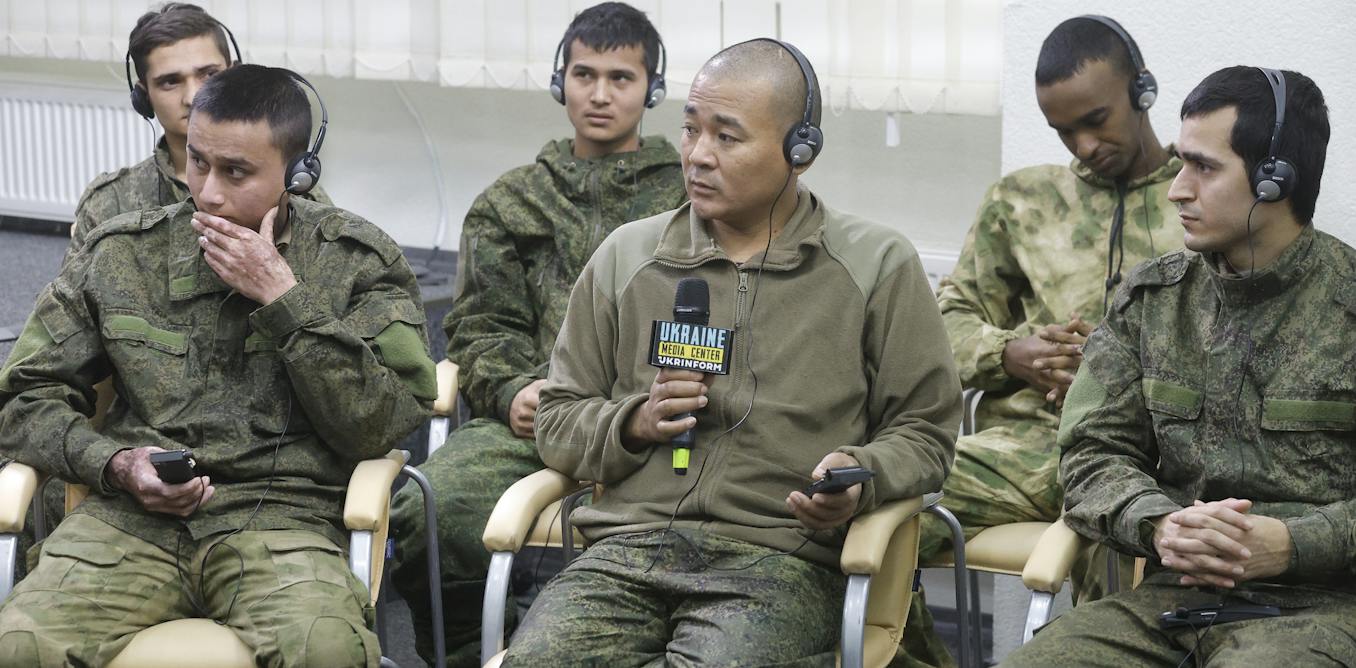
Ukraine recently captured its first Indonesian prisoner of war. According to the Ukrainian state-run I Want to Live project, the 49-year-old man from Java had been promised work in Russia’s construction industry only to realise he had been recruited into the army while being transported to Donetsk. This story is not an isolated case. Since President Vladimir Putin announced his support for a plan to recruit foreigners to join his forces in March 2022, hundreds of people from south Asia, south-east Asia, central Asia and Africa have fought with the Russians in Ukraine. Many of these fighters are mercenaries. But others, like the captured Indonesian national, went to Russia on the promise of civilian jobs or university places without knowing they would be sent to the conflict. Some of these people have reported travelling to Russia as tourists, before being taken to Belarus by agents, where they were detained and given to Russian authorities. Others have said they thought they were going to Dubai, Germany or Poland for jobs, only then to be sent to Russia by agents. These fighters recount having their passports taken away and being made to sign documents in Russian, later learning they had committed themselves to fighting with Russian forces. With minimal training, they report being sent to the frontlines in Ukraine and being beaten or jailed if they try to escape. I call these people “forced fighters” in my research. They are victims of human trafficking and should be given legal protection beyond that given to other combatants. Ukrainian servicemen bolstering defensive fortifications on November 12 near the frontline in the Zaporizhzhia region of south-eastern Ukraine. Daryna Naumova / EPA The mercenary label is often given to all foreigners fighting in Ukraine. But this is not correct. A mercenary is a person who is recruited to fight in an armed conflict, deliberately taking part in a war for significant payment. They are not members of the official armed forces of a party to the conflict. Unlike usual soldiers, mercenaries can be prosecuted for their mere participation in hostilities and are not entitled to prisoner of war status. Forced fighters, on the other hand, are not motivated to take part in hostilities by private gain. They do not know they are going to the conflict and, in many cases related to the Ukraine war, do not know they are going to Russia at all. In fact, as forced fighters in Ukraine have joined the Russian army, they are classed as privileged combatants under international humanitarian law. Privileged combatants cannot be prosecuted for their participation in hostilities. They are also entitled to prisoner of war status on capture, removing them from further participation in the conflict and ensuring their humane treatment while in captivity. This status does not, however, acknowledge the fact that forced fighters are misled into being combatants. And prisoner of war status is also only relevant in the specific circumstance of capture by enemy forces. Many of these forced fighters have been killed in the conflict rather than being captured, which is unsurprising given they are kept in poor conditions, given minimal military training and are sent to the frontlines as “cannon fodder” ahead of Russian troops. Human trafficking victims Human trafficking is defined in the Palermo Protocol, an international agreement adopted in 2000. It established that human trafficking takes place where a person is recruited, transported, transferred, harboured or received by means of a threat, force or other forms of coercion or deception for the purpose of exploitation. Forced fighters in Ukraine meet this criteria. Numerous accounts describe how Russian agents recruit forced fighters in their country of origin, often via social media, and that agents often provide transportation to Russia or the conflict zone. This recruitment is achieved often by the threat or use of violence and by deception – the promise of civilian work or other benefits – with agents receiving significant payment in return. The Russian president, Vladimir Putin, meeting Khadga Prasad Sharma Oli, who was Nepal’s prime minister at the time, in China in 2025. Alexander Kazakov / Kremlin Pool / EPA Human trafficking is prohibited under the right to be free from slavery, which is contained within the International Covenant on Civil and Political Rights. Russia has ratified this agreement and is therefore under an obligation to cease receiving and using forced fighters and to take measures to prevent agents from recruiting these fighters. Moscow was reminded of this recently. Following a report in early November that an Indonesian national was killed while fighting in Ukraine, a spokesperson for Indonesia’s foreign ministry, Yvonne Mewengkang, called on Russia to stop recruiting Indonesian citizens into its armed forces. She said: “The Indonesian government has asked the Russian government to take the necessary steps to ensure that Indonesian citizens are not recruited into the Russian military or other military-related formations through any channel.” Recognising forced fighters as victims of human trafficking would have a benefit for those already in Russia and on the frontlines in Ukraine, as well as those in Ukrainian captivity. The law of human trafficking provides what the status of combatant under international humanitarian law cannot: the remedy of repatriation before the end of the war. This is important, as Russia’s recruitment of foreign fighters continues to grow. According to I Want to Live, 283 Indonesians were recruited to Russia’s war effort in the first nine months of 2026 alone. No more than ten Indonesians had been recruited over the previous three years, the project said.
‘Forced fighters’ are being lured into Ukraine war under false pretences
Full Article
Original Source
Read the full article at Theconversation →KhanList aggregates and links to publicly available news content. We do not host full articles from third-party sources. Always verify important information with original sources.