
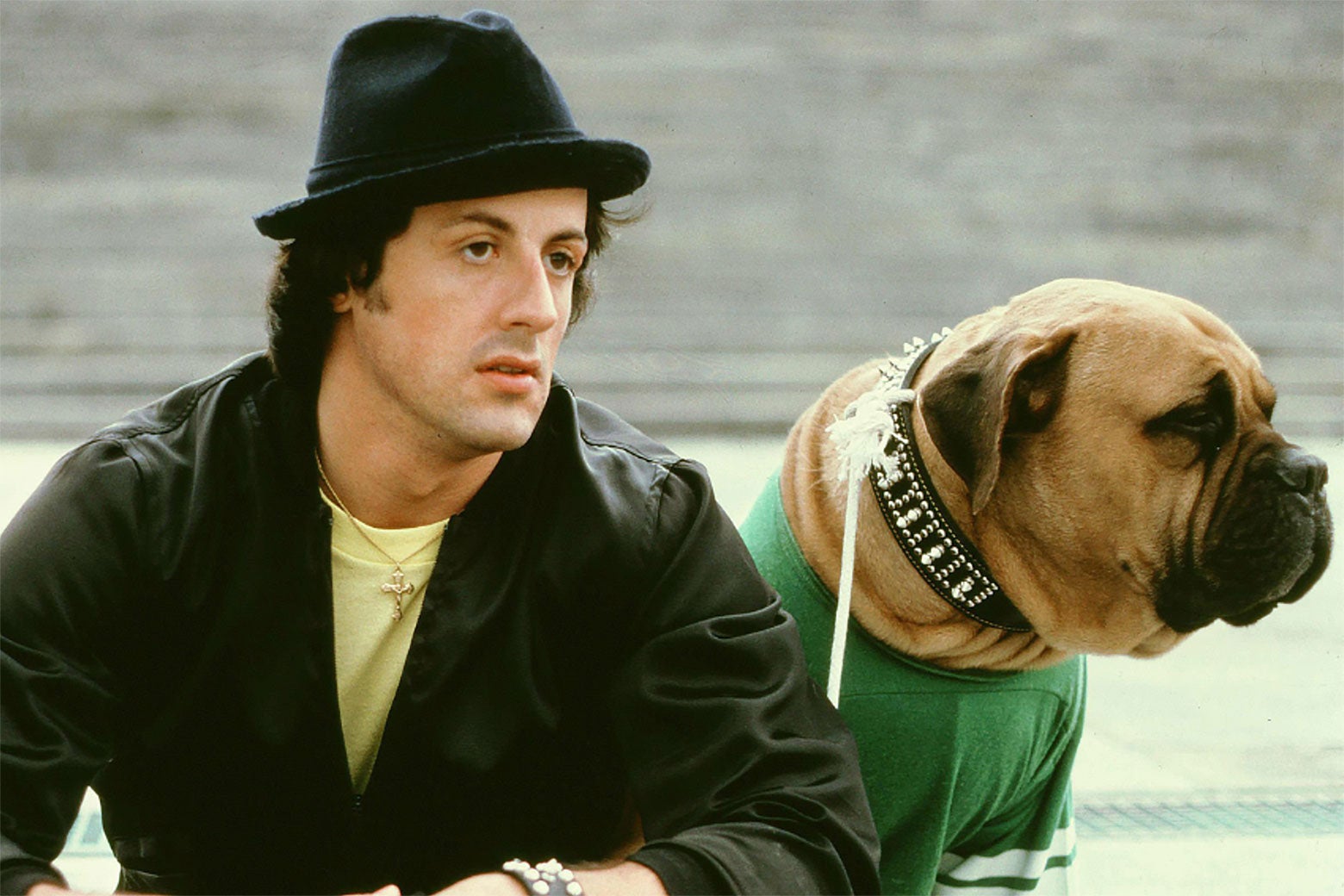
Movies Lie of the Tiger For years, Sylvester Stallone has been telling a famous story about his dog, his real trainer, and the making of Rocky. It’s a bunch of baloney. United Artists Sign up for the Slatest to get the most insightful analysis, criticism, and advice out there, delivered to your inbox daily. Before Sylvester Stallone could play a fighter, he had to get himself in good enough shape to be a fighter. It would be a long road for him to reach that point. He knew nothing about proper boxing technique. At director John Avildsen’s urging, he watched hours of professional bouts to familiarize himself with it, but he had no timing, no sense of balance, and with every punch, he threatened to sprain his wrists. “I didn’t know how I was going to fool the public into thinking that I was a professional fighter with twelve to fifteen years’ experience,” he once wrote. “It wasn’t going to be easy because I couldn’t even fool myself.” The responsibility for Stallone’s conditioning fell to Jimmy Gambina. The son of Ralph Gambina, who was a legendary boxing trainer in Southern California, Jimmy had experience in both the sport and show business yet didn’t seem at first glance to be a fit for either of those worlds. At the age of 13, he had been diagnosed with a congenital bone disease that caused the gradual deterioration of his hips. He would never grow to be more than 5 feet tall—hip surgery later in his life added two inches of height—and doctors had told him he would be paralyzed by his 18th birthday. But he was boxing by age 6 and acting by age 11 and even tried standup comedy when he was 20, and the combination of those skills afforded him plenty of opportunity to work in Hollywood as an actor, a boxing consultant, and a stuntman. Stallone, in a 2026 email, told me that he “did a favor” to Gambina’s father “and put him in the movie because his father was a real trainer, not like him. I don’t believe he’s ever trained anyone! I put him in the movie also because he was such an odd-looking character. I thought it would be interesting to have Rocky surrounded by all these outcast characters.” But that claim ignores both Gambina’s previous experience in the film industry and his other connections to Rocky. He’d already had brief roles in The Wild Wild West, Mission: Impossible, and Battle for the Planet of the Apes. Working as a stunt double in the 1974 Brian De Palma horror musical Phantom of the Paradise, he had met and befriended the actor George Memmoli, and Memmoli, who would play the ice-rink manager who does his best to ruin Rocky and Adrian’s first date, recommended to executive producer Gene Kirkwood that he hire Gambina to train Stallone. As a serendipitous twofer, Gambina would also appear in the film as Mickey’s assistant, Mike. Gambina had a hand in the selection of Carl Weathers as Apollo Creed; better an actor who was also an athlete, he figured, than an actor who wasn’t. “When Carl Weathers walked in,” Gambina told me, “I went, ‘Whoa!’ ” Before shooting began, Avildsen wanted both Stallone and Weathers to lose weight, to trim themselves so that they looked like real heavyweight fighters. Any jiggle of fat and flab would undermine the measure of realism that he sought to achieve in the championship fight. So Gambina worked with both actors for four months, but reshaping Stallone was his primary project. Stallone’s primary method of exercise before Rocky had been intense weight-lifting, and he wanted Rocky Balboa’s fighting style to be basic and brutal: no jabs, “everything like a real Philadelphia southpaw,” he once said, “hooking, hooking, hooking … a flat-footed steam engine who took 10 punches to give one.” But Gambina understood that even the biggest and bulkiest of heavyweights couldn’t be too muscle-bound; flexibility and endurance were just as important to a boxer as brute strength. Stallone’s training routine under Gambina was grueling: 4 a.m. wakeups and long runs, morning sparring, afternoon heavy-bag and speed-bag work at a gym in Northridge, rope-jumping, calisthenics, stretching. “I got him in condition to be a tough guy,” Gambina said, “not a good boxer, just a banger, a Joe Frazier type who weighed less.” He appreciated the faith and trust that Stallone placed in him, for Gambina had trained enough fighters, and enough people pretending to be fighters, to know that the role of Rocky Balboa was not without its dangers. Even the hardest-working, most committed amateur was still just an amateur. Avildsen and Stallone sought to depict boxing at its highest level, and Gambina knew that boxing, at even its lowest levels, hurt amateurs, no matter how rough and strong they thought themselves to be. In the ring, though, Gambina’s lessons tried both his own patience and Stallone’s relative toughness. At first, Stallone was on board with any of Gambina’s instructions and recommendations; he took notes. But his lack of boxing experience was obvious just from the manner he reacted and responded to the early conditioning. “I used to let Stallone hit me as hard as he could,” Gambina said, “and I used to laugh at him. He didn’t want people to know a little guy like me made him behave himself. He didn’t know what boxers went through.” What’s more, the actor wasn’t shy about expressing his concerns that training with a real fighter or fighters would cause him great pain and physical disfigurement. “He was scared about getting his nose broken,” Gambina once said. “He was a weightlifter, and his belly would hang over his shorts. When he stood up straight he looked real fine, but when he went into a boxing stance, his stomach muscles fell down. At times I just couldn’t get Sylvester to train. He was forever making excuses.” Gambina had Stallone spar with Ray Notaro, who, after winning a welterweight championship in the Marines and 19 of his 20 professional bouts, was now, in his mid-40s, the owner of the Left Hook Gym in Los Angeles. In the third round of one of their sessions, Notaro was gliding around the ring, flicking jabs at Stallone. Stallone straightened up and caught him with what Notaro later described as “a little tap.” Hey, Stallone asked him, is that the hardest you can hit? Notaro promptly landed a shot that, Stallone said in an email, “folded me in half,” sending him tumbling backward into the ropes, where he groped around, as if caught in a tangle of jungle vines, to regain his feet. “Sylvester,” Gambina said, “started to cry.” United Artists Gambina has struggled over the years since Rocky’s filming to contain his bitterness toward Stallone. Too often, Gambina believes, Stallone has presented himself as a real boxer, or at least capable of being a real boxer, when in reality he could never come close. Gambina despises such fakery, even if it was all just standard tricks of the movie trade. He set up a speed bag in Stallone’s apartment, but Stallone, he said, didn’t have the patience to teach himself how to punch it properly. So Gambina ended up rigging the bag so that when Stallone jabbed it, it moved in just one direction, snapping forward and back. The 4-inch lifts that Gambina says he saw Stallone wearing in his shoes so he would look taller than the other actors were the sign of someone too insecure to be himself. And Gambina perceived a different reason that Avildsen cut what would have been a significant scene in the film: the sequence in which another fighter, named Dipper, tries to intimidate Rocky by slapping him in the head and socking Mike in the face, only to have Rocky drop him with a blind shot to the ribs. To Gambina, it wasn’t just that Rocky would be too honorable to do such a thing. It was that Stan Shaw, who played Dipper, outshined Stallone in that scene—a characterization that Stallone, in a February 2026 email, disputed … and used as a reason to mock Gambina. “The scene was not very good, and it was the director’s choice to take it out. Not mine. I had no power to do that,” he wrote. “I believe another reason it was taken out was because … when Jimmy got punched, it looked so comical because he was so close to the floor. Naturally, it looked like a fire hydrant being tipped over!!! That’s the truth. Very comical.” What cut Gambina deepest, however, was another sacred narrative around Rocky, a narrative that persists to this day. Stallone has told a heartbreaking and heartwarming story many times over many years: that he was so broke before writing the script for Rocky that he had to sell his beloved bullmastiff, Butkus. So he stood outside a corner store in late 1974, waiting to see if a passerby responded positively to the dog. If someone did, Stallone would offer to sell Butkus to that person. A guy came along, petted Butkus, received some doggie love in return, and bought the pooch for 50 bucks. But once Stallone sold the script and the movie was going to be made, he needed Butkus—who would Rocky be without his four-legged pal? So Stallone had to go back to the new owner and, by whatever means necessary, persuade him to return Butkus. In 2013, he shared a version of this tale with Shortlist.com: “I got $50 from this guy called Little Jimmy,” he said, referring to Gambina. “When I sold the Rocky script, I went to see Little Jimmy and begged for the dog back. He lined up his children [Stallone mimes crying], ‘Oh my kids love the dog.’ I said, ‘You’ve only had him for a f*ckin’ week!’ He wanted to fight me and he said he was gonna kill me—he was a crazy little person! I couldn’t fight him—they’d arrest me—so I offered to pay double. Anyway, $3,000 and several threats later … I ended up putting him in the movie.” The next year, on an episode of The Graham Norton Show, Stallone repeated the account, claiming that Gambina would give Butkus back to him only in exchange for either several thousand dollars or a starring role in the movie. It is a testament to the desire of people to believe in Rocky’s creation myths that they accept Stallone’s story without even a sliver of doubt. (The story has since resurfaced and gone viral again and again and again.) A run-of-the-mill Google search for “jimmy gambina” would reveal the story’s holes. Stallone has painted Gambina as some random stranger who all but blackmailed him to be in the film: Gimme a part if you want your precious dog back. But what are the chances that someone with Gambina’s background and credentials in boxing and Hollywood would just happen to wander by Stallone and the dog on that street corner? Gambina’s account makes much more sense. Once the Stallones disembarked their train from the West Coast to Philadelphia in December 1975, someone had to care for Butkus while Sly was shooting the movie, while a pregnant Sasha cared for herself, and whenever Butkus wasn’t in a scene licking Rocky’s face or running alongside him. “They were leaving the dog in the hotel, and we were working 12, 14 hours a day,” Gambina said. “The dog needed to go out. I’d let the dog out. The dog and I got along real good. After that, and after Rocky got bigger and bigger, he knew he was going to have to travel a lot, and he was concerned about the dog and the new baby. He thought maybe the dog would be a little jealous of the baby. He knew how close I was to the dog and how much I loved the dog, so he gave me the dog.” Butkus was still the Gambina family’s pet in 1978 when Stallone embarked on Rocky II. “He called me and said, ‘Jimmy, I’ve got to have the dog,’ ” Gambina said. “I said, ‘Well, you come over and explain it to my son. If my son says it’s OK, I’ll let you have the dog back. But we’ve had the dog going on three years now, and we love the dog. My family loves the dog. It’s our family dog.’ I couldn’t believe it when he came over.” Butkus ended up in Rocky II, and Jimmy Gambina has ended up living the rest of his life as the scapegoat in a story that seems so touching and magical … so long as he isn’t the one sharing it. You’re the guy who took Sly’s dog from him. He wasn’t. He and Stallone haven’t spoken since 2005. The days that Rocky’s cast and crew spent working in Philadelphia would define the film’s staying power. They remain for Gambina a memory laced with pain. “You know what?” he said one night over the phone. “It’s hurt me in a lot of different ways. It’s broken my heart.” Slate receives a commission when you purchase items using the links on this page. Thank you for your support. From Going the Distance, by Mike Sielski. Copyright © 2026 by the author, and reprinted with permission of St. Martin’s Publishing Group. Books Dogs History Movies Sports
For Years, Sly Stallone Has Been Telling a Famous Story About the Making of Rocky. It’s a Bunch of Baloney.
Full Article
Original Source
Read the full article at Slate →KhanList aggregates and links to publicly available news content. We do not host full articles from third-party sources. Always verify important information with original sources.