
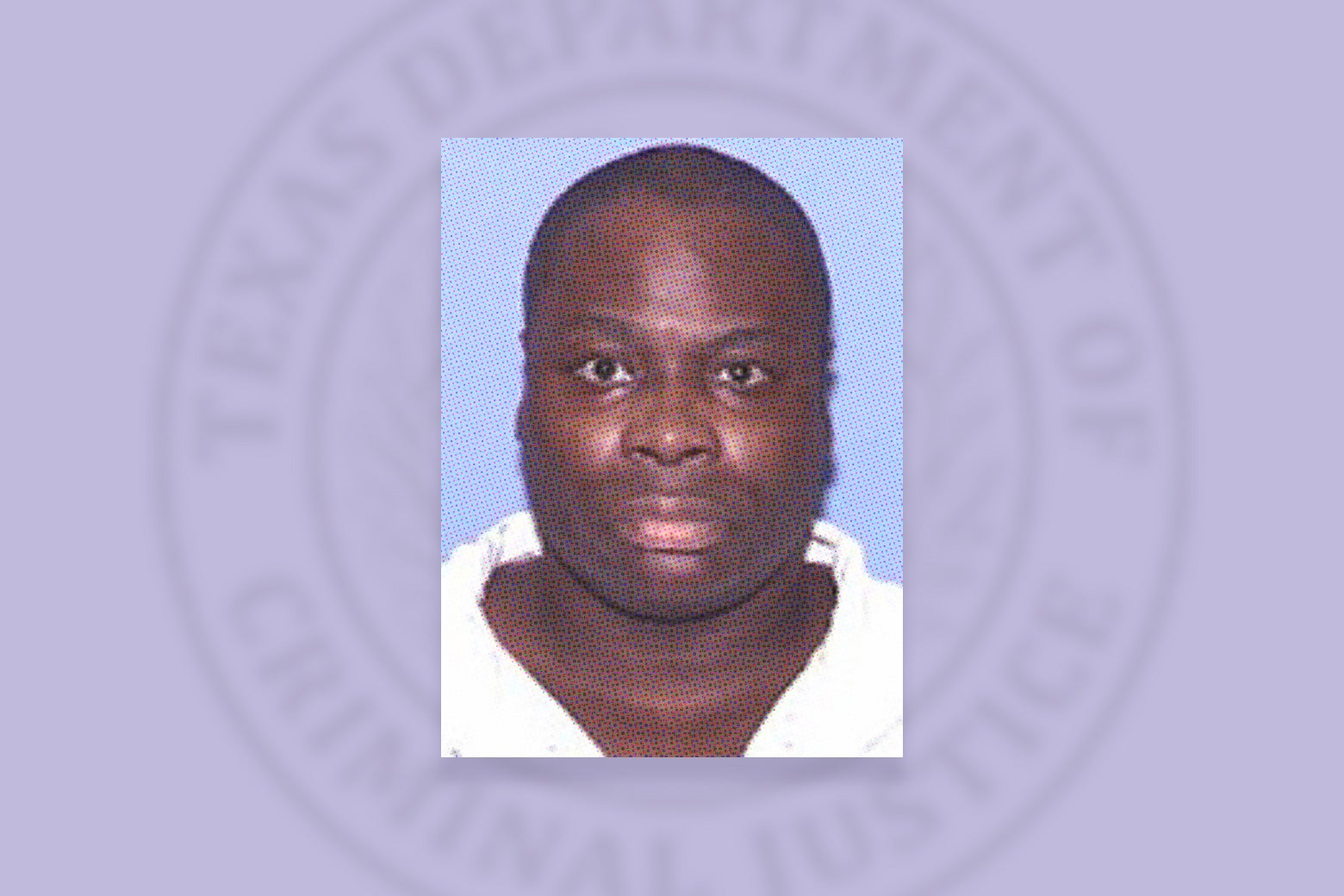
Life For years, I wrote to my friend on death row. He never should have had to die. Photo illustration by Slate. Photo by Texas Department of Criminal Justice. Sign up for the Slatest to get the most insightful analysis, criticism, and advice out there, delivered to your inbox daily. On May 14, 2026, they killed my friend. Edward L. Busby Jr.—or Eddy, as I knew him—was the 600th person Texas has condemned and executed since 1982. Texas was the first U.S. state to carry out an execution by lethal injection, executing Charles Brooks in December 1982. As of 2025, Harris County had carried out more executions than any other state in the U.S. Not county—state. Of the last 24 defendants sentenced to death in Harris County, 23 are people of color. In that sense, Eddy is just part of another shocking statistic for Texas when it comes to criminal justice. He was Black. And yes, he was a criminal—one I was very close to. I first wrote to Eddy in 2011 through Human Writes, a U.K. organization that connects inmates on death row in the U.S. with pen pals abroad. I’d seen an ad for Human Writes in the Big Issue, a street paper that supports homeless people, and it intrigued me. Perhaps I could make life a little less harsh and lonely for someone who, let’s be honest, probably didn’t wake up one day and decide to ruin their life and take someone else’s. In Eddy’s case, he’d been a desperate user and dealer. In 2004, his addiction led him to bungle an abduction and theft, which resulted in the suffocation death of retired college professor Laura Lee Crane. Soon after, Eddy was incarcerated and sentenced to death. For obvious reasons, condemned prisoners don’t have much contact with the outside world and tend to lose touch with friends and family. So writing my first letter to Eddy felt difficult. I didn’t really know where to start—I’m a privileged, educated white man, and I was reaching out to someone whose background and circumstances differed vastly from my own. We had almost nothing in common. Would he find my questions “gawking”? And did he really want to hear about my comparatively blessed existence? At times, I questioned my motivations. Maybe writing to him was just a rubbernecking vanity project. I guessed I wouldn’t know until I tried. In my first letter, I introduced myself and shared a few details about where I live and what I do for a living. I told him I’m an only child, that I had no kids, that I’m interested in music, motorcycles, and the great outdoors. I mentioned that my partner and I had been to the U.S. several times and had friends and family there. I hoped these relatively mundane details would serve as some connection, however small, to the outside world. Human Writes had pointed out to me that some inmate pen pals might, understandably, ask for financial or administrative support, or request help passing messages to family, friends, or old associates, so I gently mentioned that I wouldn’t be doing that. I did, however, end up giving Eddy a tiny bit of money each month for commissary so he could eat more healthily, get stationery so he could draw and write, and buy the stamps to reply to me. It took a few weeks to crawl through the system, but Eddy’s first letter finally reached me. It was similarly topical. But it was also clear that we had some common interests. He, too, was into motorcycles. After that, we wrote to each other about music, food, camping, his potted history, my background, how different we were, and how we intrigued and amused each other as a result. We learned how to agree to disagree, to take the mickey, call each other out, and lift each other up. We put what defined and destroyed his life and many others’ to the side—unless he wanted to talk about it, which for the most part, he didn’t. We simply became friends, in albeit limited context. It struck me, at times, how similar we were. I began to feel a genuine affection for him. Some friends I spoke to about it would say, “But why would you do that? He killed someone.” Yes, there was that to reconcile. Eddy was an itinerant drug user and petty criminal. He had prior convictions. He dealt and used drugs, and had previous convictions for robbery. He carried a gun for most of his adult life. On that basis, I couldn’t really argue his case for empathy or understanding, except to try and articulate that he probably didn’t plot his path, and certainly didn’t plan the tragic series of events that led to his incarceration. Eddy was no psychopath. In 2013, my partner and I decided to go and meet him in person (she had occasionally sent short notes to Eddy with my letters, so she felt invested, too.) We were visiting nearby Austin, Texas, for a friend’s wedding in May, so I suggested to him that it might be convenient to stop by. He was clearly happy with the suggestion. So, on a hot day after a long drive, we pulled up to the Allan B. Polunsky Unit, a prison just west of Livingston in dusty, barren Southeast Texas, where Eddy had spent the past eight years. As you’d expect, there’s not much else in that ZIP code but cheap lawyers, bail bonds, grocery stores, a gas station, and a few chapels. The penitentiary itself is foreboding: a mechanical, brutal, and awfully sad place flanked by a perimeter of very high fences, razor wire, and sentry towers. Walking through it, we felt sheepish, and very exposed. Inside, we were searched, then given barked directions through the crude PA system as we walked through endless thick, remotely operated, and very loud doors. Lights flashed and things beeped sharply in the maze of plain corridors. As we waited in the windowless visitation room surrounded by mostly empty booths, there was a delay. We were told matter-of-factly by a haunted-looking prison guard that this was because they were prepping another inmate for a trip to Huntsville, a town 50 miles away where he’d soon be executed. We would still have our allocated hour with Eddy, but we had an uncomfortable wait, during which a couple of inmates yelled and banged things, or shouted for their fellow inmate soon-to-not-be. One had been in the booth so long that he urinated in it and began kicking and shouting. We began to get nervous. What on earth were we doing there? What if this went badly? What if Eddy got angry or upset, or if we quickly ran out of things to talk about? It’s not like we could just smile apologetically and wander back into daylight. We sat there, privately terrified, for what felt like an eternity. Things improved when Eddy arrived. Our visit clearly meant the world to him. As far as we know, until then, almost no one apart from his legal team had come to see him. His sister visited in 2025, upon hearing that a date was pending for his execution. She’s the only family member who made any contact during his time there. For eight years he’d been completely abandoned. But then, his life as a free man was hardly full of joy or meaningful connection either. We didn’t talk about his case, or his experience on death row. We talked like friends do, about our lives and experiences, and—however foolishly—the future. We joked and laughed. We connected, albeit through very thick, badly worn see-through plastic, and the heavy old phone handsets that are just like you see in the movies. We kicked dust, as Eddy would say. That hour was one of the shortest I’ve experienced. And then we were done. Back outside in the smothering heat and dust, things felt very strange. We could now go wherever we wanted, for as long as we cared to. Despite the short hour, we suddenly felt like we’d been away from the real world for days. And at this point I realized just how isolated Eddy’s existence was, with next-to-no daylight, awful food, minimal stimulation and interaction, and pitiful resources for whiling away the days that must have seemed like years. On the drive back to Austin, we barely spoke. Both of us had to process the profound and unusual experience, not to mention the distinct possibility that we’d never see him again. Later, Eddy wrote to me about what our visit meant to him. For him, it was proof that his path and circumstances were irrelevant to the basic human need for connection, and to tell our stories and hear others’, however alien, horrific, misguided, or tragic. What Eddy did was wrong. He knew that as much as anyone, and probably more keenly. He lived with it every minute until 8:11 p.m. on May 14, 2026. At the time Eddy was put to death, I was asleep. I’d always known that was a possibility, but the news was shocking—the last I’d heard, his lawyers were pursuing a previously acknowledged Atkins claim, something that should have delayed his execution for at least a few more weeks. Atkins, named after the first death row inmate it concerned, is the Supreme Court opinion that a defendant who is intellectually disabled is not eligible for the death penalty, regardless of what they were convicted for, and however they pleaded at trial. Over several years, two experts (one hired by Eddy’s attorneys, one by the district attorney’s office) confirmed their opinion that he was intellectually disabled. His legal counsel from the Texas Innocence Network and the University of Houston Law Center faculty worked tirelessly over many years in support of this. Three times he was granted a stay while the matter was “explored further” despite each assessment’s results being pretty clear. Twice, this kept Eddy alive and offered hope that he might at least serve life without parole in a better place, but nonetheless put him back in the queue for execution. At that third time of asking, however, the Supreme Court ignored prior rulings, disagreed with the district attorney’s view, disregarded dissent and expert findings, sidestepped clear legal precedent, and essentially insisted that those tasked with administering lethal injection get on with it. The decision, written by Justice Ketanji Brown Jackson (who ironically dissented), read as follows: Today, the Court finds itself unable to tolerate even a brief delay. Lifting the Fifth Circuit’s stay, the Court grants emergency relief to ensure that Texas’s current inclination (that it must execute Busby tonight) wins out over its former one (that it could not execute Busby at all). According to reports on the day, from the room in which he died, Eddy’s regret and remorse continued right up to his execution—even on the gurney where they administered his final medicine. Like he had so many times before, he pleaded, and reiterated that he never set out to hurt anyone, let alone cause someone’s death or the immeasurable pain it brought her family and friends. Nobody wanted any of that to happen. I can’t comment on how anyone felt about Eddy’s death, least of all the victim’s family. But for me, it was much harder to reconcile with the Supreme Court’s responsibility for Eddy’s death than Eddy’s responsibility for another’s. To this day, I’m not sure what the rush to execute him was. Neither could Justice Jackson, who, in her opinion, wrote that she could “not understand” the Supreme Court’s “rush to extinguish” Eddy’s life, much less in the circumstances of his case. In his last letter to me, Eddy was hopeful, which is how I choose to remember him. When he wrote to me, there seemed to be clear legal merit to commute his sentence. Perhaps we both thought we’d have at least a little more time. I never got the chance to say goodbye. Eddy’s story is tragic, as are the events that defined it. Our paths would never have crossed if not for Human Writes, nor would they had Eddy’s judgment been different. But our friendship showed me what’s possible when we put aside judgment. What Eddy did was awful, of course. But he wasn’t. He was more than the sum of his actions, or of his many mistakes. Of course, I’d trade our friendship for a different version of history. But I can’t. Rightly or wrongly, I miss him. Crime Criminal Justice Death Penalty Incarceration Friendship
For Years, I Had the Type of Friend Most People Are Terrified Of. Then They Killed Him.
Full Article
Original Source
Read the full article at Slate →KhanList aggregates and links to publicly available news content. We do not host full articles from third-party sources. Always verify important information with original sources.