
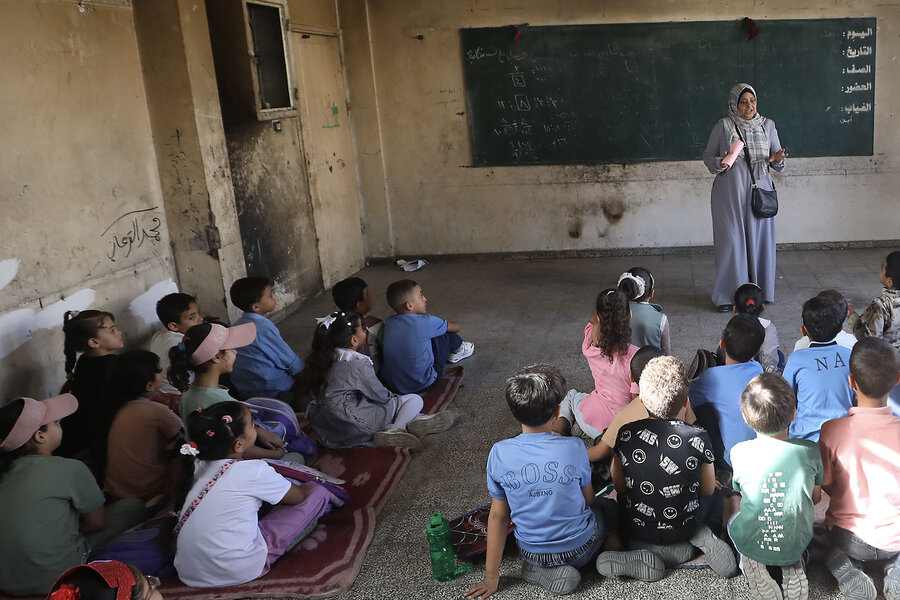
Gaza City, Gaza Strip | Sept. 25, 2026, 12:19 p.m. ET | 4 min read In Gaza City’s Jawazat camp, students brought little with them as they began a new school year this week. No uniforms, no backpacks, no packed lunches of cucumber, hummus, cheese and za’atar sandwiches. The fortunate ones had a single notebook and brisk instructions from their parents: Don’t skip any lines.What every child carried, however, were sharp, specific memories of what school was like before Israel’s October 2023 invasion. “A gray striped uniform ... a real lunch break, notebooks for each subject,” recalls Rozan Ziara, age 11. “There was a library.”Across the Gaza Strip, more than half a million students went back to school this week, most for the first time in three years. Since the war began, Israeli bombs have destroyed or damaged 98% of Gaza’s schools. Books and stationary, burned for fuel in times of starvation and now subject to Israeli import restrictions, remain in desperately short supply. But across Gaza, students and teachers are improvising with what is left, still driven by the promise of education. “I want to be a doctor,” says 12-year-old Mariam Helles, who started seventh grade this week. She feels lucky to be attending school at all, when “so many children ... don’t have the chance.” Ghada AbdulfattahThe library is what Rozan Ziara, age 11, misses most about school before the war. "I used to read all the short stories there," she says. A school without a roofIn Jawazat, a camp built from the wreckage of destroyed homes in the middle of Gaza City, education fits inside four hole-speckled canvas tents. Each one holds a tightly packed classroom, the sound of one teacher’s voice competing with the neighbors through flimsy nylon walls.Ahmed Abu al-Qombuz runs the school.When he fled to this camp in April 2024, the former civil society organization administrator immediately saw that his five children had nowhere to go to school. “They are smart and creative,” he remembers thinking. “Why don’t they have schooling?” Although Mr. al-Qombuz had no teaching experience, he decided to begin teaching them – as well as other children in the camp – outdoors. There were no chairs or chalkboards; he had no bell to ring each morning. The roof was the sky. Eventually, Mr. al-Qombuz moved his operation under a single tent borrowed from an aid organization.In September of last year, it became an official, government-accredited school, and this year, about 600 students are enrolled, spanning kindergarten through ninth grade. Ghada AbdulfattahJana, a student at the tented school in the Jawazat camp in Gaza City, says what she misses most from school before the war are her school supplies: a backpack, water bottle, and pencil case. Improvisation in the classroomEight teachers living in the camp cover the core subjects – Arabic, English, science, and math. But physical shortages still mark everything they do. Chairs and desks are scarce, at most five to a tent. The minimal furniture available is fashioned from wooden pallets that originally held aid parcels. Local carpenters converted them into makeshift desks and chairs.Science teacher Taghreed Faraj keeps spare paper on hand for the many students who can’t afford to buy notebooks, which cost three times as much as they did before the war. But that is only the start of her problems. “Science needs equipment,” she explains. Without it, Ms. Faraj must improvise. On a recent day, she found a video online of a chemistry experiment, then passed her phone around the class to let each student watch it play out on the screen.School here does not happen in isolation from the camp’s daily emergencies; it happens inside them. When the water trucks arrive, the children rush to the water tank midlesson. “I cannot tell them to stop. They have to go,” Ms. Faraj says.The same is true when the students hear the sputter and throttle of tuk-tuks outside, signaling that the tikiyya – a mobile communal food kitchen – has arrived. Ghada AbdulfattahMariam Helles, age 12, loves doing long division and dreams of becoming a doctor. Grief in the classroomLoss thrums through the school, both visible and invisible. “Some [children] fall apart outwardly, and some fold inward, becoming almost too still,” explains Rana Abu Qumboz, who teaches math and also helps run therapy sessions for students.Rozan, the seventh grader who dreams of her old school uniform, speaks plainly of the moment she lost her 13-year-old brother, Mohammed. It was May 3, 2025. He was waiting for their mother to heat water so he could bathe, and he decided to step outside for a minute. A drone strike killed him as he sat waiting.Mahmoud, age 12, lost his father in 2023, and later, two of his brothers, Hudhaifa and Ahmed. He has lost many years of his education, too – first to the COVID-19 pandemic, then to the war. But his grades are slowly climbing, says his mother, Irtifal Hamdiyya. And school brings another kind of comfort. Mahmoud can spend time with his friends chatting about the Hulk, Spider-Man, and why Ronaldo went to play in Saudi Arabia. (“For the money,” the Real Madrid fan declares.) Deepen your worldviewwith Monitor Highlights.Politics with respectGet political stories with respectful analysis.There‘s a world of new ideas in everyBooks newsletter.There‘s more to life, enrich yours withCulture & Learning weekly.Follow humanity‘s discoveries withScience & Nature stories in your inbox.Gain a spiritual perspectivefrom the stories in your inbox.Want to understand the deeper impact of critical events? Learn the Monitor‘s insight.Already a subscriber? Log in to hide ads. Other children, too, find joy and comfort in coming to school that extends far beyond what they are being taught in the classroom.“In the past, we used to push children to go to school,” Ms. Qumboz says. “They are not pushed anymore. They are running towards whatever is left standing.” ALREADY A SUBSCRIBER? LoginReal news can be honest, hopeful, credible, constructive.The Christian Science Monitor was founded in 1908 to lift the standard of journalism and uplift humanity. We aim to “speak the truth in love.” Our goal is not to tell you what to think, but to give you the essential knowledge and understanding to come to your own intelligent conclusions. Join us in this mission by subscribing.
For the first time in three years, Gaza’s students go back to school
Full Article
Original Source
Read the full article at Csmonitor →KhanList aggregates and links to publicly available news content. We do not host full articles from third-party sources. Always verify important information with original sources.