
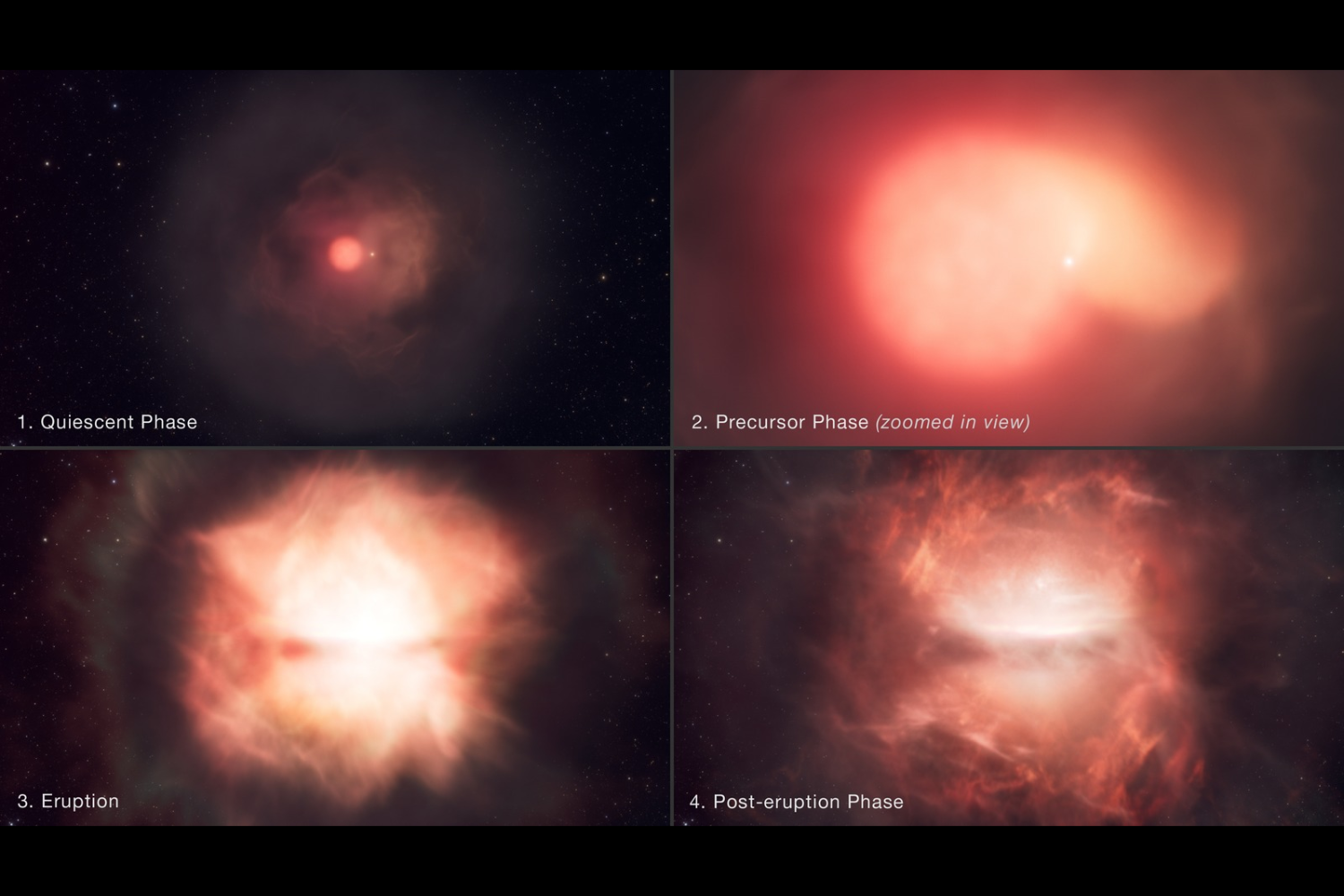
The merger caused an eruption in late 2025, which researchers rushed to document using several ground- and space-based telescopes. With older data and the help of computer simulations, the team reconstructed the entire astrophysical process November 20, 2026 2:21 p.m. An artistic representation of the steps of the recent stellar merger NASA / ESA / CSA / STScI / Leah Hustak (STScI); Science: Viraj Karambelkar (Columbia) In 2023, astronomers realized that a red giant star in our neighboring Andromeda galaxy was doing something strange. Sure enough, two years later, the astronomical object exploded. The researchers rushed to observe the phenomenon, and they sifted through older data to piece together what had happened. Analyses suggest the huge star had gobbled up its smaller stellar companion, marking the first direct observation of this kind of star merger. The findings were described November 18 in the journal Nature. The eruption, called AT 2025abao, occurred because the two stars shared what’s called a common envelope. Some stars approaching the end of their lives balloon to a huge size, entering a giant phase. As an object expands, its outer layer of gas—or envelope—engulfs anything orbiting it, resulting in odd interactions. However, common envelopes are tough to observe because they happen over relatively short timescales of months to years, and usually, just a few stars exist in this phase at a time within a galaxy, writes Jason Nordhaus, an astrophysicist at the Rochester Institute of Technology who did not participate in the work, in commentary accompanying the study. Quick fact: Common phenomenon Experts estimate that nearly a third of all stars go through a common envelope phase at some point during their lives, reports New Scientist. To investigate the strange event, which occurred in October 2025, researchers obtained data captured just 47 days later by NASA’s James Webb Space Telescope. They also had follow-up observations from other ground- and space-based instruments, as well as data from roughly the past 30 years, which revealed the big star had started brightening in 2018. Using all that data, the team was able to “reconstruct what happened with quite significant confidence,” Sven Buder, an astrophysicist at the Australian National University who did not participate in the study, tells the Australian Broadcasting Corporation’s Jacinta Bowler. Computer simulations hinted that the two stars had orbited each other for millennia. Before the eye-catching explosion, the primary star—dubbed “Big Bao” after the eruption’s name—had become enormous. It was seven times more massive, 350 times the radius and 18,000 times brighter than our sun. Its companion, “Little Bao,” on the other hand, probably contained 0.7 times the mass of our sun and was smaller and fainter. The smaller star spiraled into the bigger one’s envelope, and the two objects took about seven years to unite, which is quite quick in astronomical terms. The merger occurred when the red giant dragged its companion into its core, resulting in a dramatic event resembling “a bomb exploding inside a living star,” study co-author Kishalay De, an astrophysicist at Columbia University, says in a statement. Researchers studied the merger, which happened in the Andromeda galaxy, using data from several telescopes. NASA / ESA / CSA / STScI / Viraj Karambelkar (Columbia), Kishalay De (Columbia); Image Processing: Alyssa Pagan (STScI); Acknowledgment: DSS, Robert Gendler “We were able to see all different phases of this process—we were able to see the quiescent system, we were able to see the moment the stars touched each other, we were able to see the inspiral, and we were able to see the big outburst in 2025,” lead author Viraj Karambelkar, also an astrophysicist at Columbia University, tells New Scientist’s Leah Crane. “So we now know how this process works far better than we ever had before.” Now, however, the system is too dusty for scientists to observe the aftermath directly, and it will likely remain so for years, reports Science News’ Meghan Bartels. In the meantime, Karambelkar says they can work to “catch more of these systems even before they erupt.” You Might Also Like Get the latest stories in your inbox every weekday. More about: Astronomy Astrophysics NASA New Research Outer Space Physics telescope
For the First Time, Astronomers Witnessed a Giant Star Gobble Up Its Smaller Stellar Companion
Full Article
Original Source
Read the full article at Smithsonianmag →KhanList aggregates and links to publicly available news content. We do not host full articles from third-party sources. Always verify important information with original sources.