
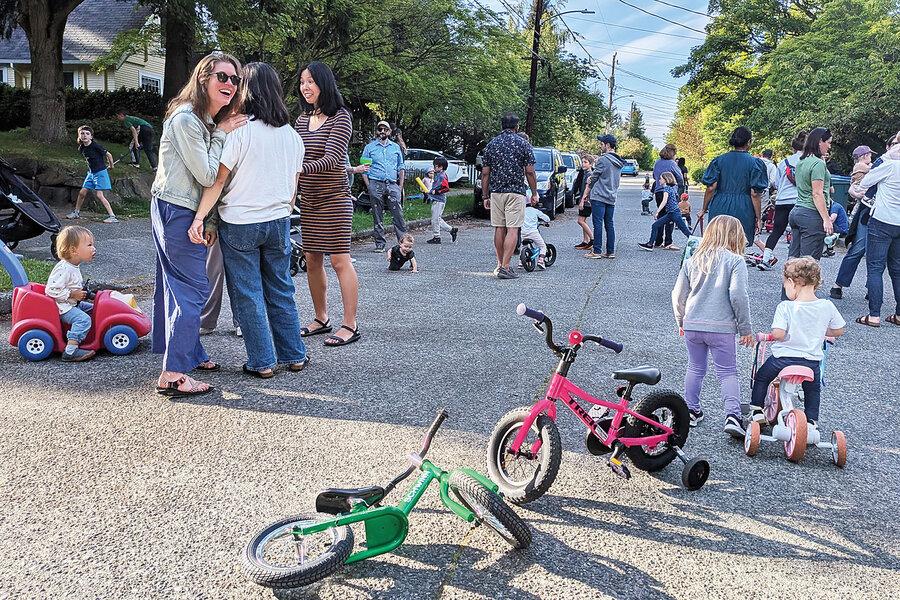
On a warm afternoon in the Licton Springs neighborhood of North Seattle, a homemade sign announces “STREET CLOSED.” Time for the area’s children to take over.Toddlers chase bubbles in the middle of the street. Tweens dangle from the branches of trees lining the sidewalk. Other kids show off their wheels as they whoosh by on skateboards, scooters, and bicycles.All are welcome – except cars. Why We Wrote This At a time when children are spending more hours indoors scrolling on their digital devices, Seattle has embraced a simple concept: Give the streets back to kids. At a time when children are spending more hours indoors scrolling on their digital devices, Seattle has embraced a simple concept: Give the streets back to kids.The city has become a national leader in the Play Streets movement, allowing residents to temporarily close a neighborhood block to vehicle traffic and give children the right of way. In 2025 alone, Seattle residents closed their streets more than 500 times for play, celebrations, and community gatherings. Joel Miller, public space manager for the Seattle Department of Transportation, helped streamline the permitting process for the program. While many cities – from San Diego to Washington – allow residents to close streets for block parties and similar events, Seattle has made such street closures free and routine. And this transformation did not happen by accident.Seattle’s public space manager, Joel Miller, has been instrumental in the city’s Play Streets movement as the head of a team at the Seattle Department of Transportation that has re-centered the department’s focus on people.“Public space is the front porch of the city; it’s how you see your neighbors, how you meet people,” he says. “It’s one of the few places left where you might run into someone who doesn’t look like you.”Play, he adds, “is all part of that.”Long before he was helping Seattle residents reclaim their streets, Mr. Miller was a kid playing on them. He grew up dribbling a soccer ball and hopscotching to friends’ houses up and down his sidewalk in Northeast Seattle.But that kind of childhood would soon disappear for many of the city’s residents. “By the time I got to college [in 1997], Seattle was a different city,” Mr. Miller says. In the late ’90s, as the city’s tech-fueled economy boomed, the streets he grew up playing on became chock-full of cars.His street wasn’t the only one. By 1990, most American households had two or more cars, according to the U.S. Department of Commerce. Childhood play never recovered.“The biggest disaster that’s cast a long, dark shadow over childhood is the growth of the car,” says Tim Gill, author of the 2021 book “Urban Playground: How Child-Friendly Planning and Design Can Save Cities.”“That’s why Play Streets are so interesting,” he adds. “They’re tackling at source this catastrophic threat to the kind of freedoms that children deserve.”“Getting people to change”Seattle officially launched its Play Streets program in 2014, but in the aftermath of the COVID-19 pandemic, when residents were hungry for opportunities to gather outdoors, the city expanded areas where children could play undisturbed by cars. Over several years, Mr. Miller and his colleagues simplified the Play Streets permitting process. Today, residents living on non-arterial streets can apply online for a free permit to close the road for up to three consecutive days. For neighbors who want to host regular events, the city also offers recurring permits that allow residents to organize weekly Play Streets gatherings without having to reapply. Children play on a residential street closed to vehicle traffic as part of the Play Streets program in Seattle. Residents print the permit themselves and can create their own barriers using traffic barricades, trash bins, or homemade signs. The city encourages organizers to notify neighbors in advance and even provides sample emails and flyers to help gather questions and feedback.But Mr. Miller wanted to ensure that one grumpy neighbor couldn’t stand in the way, so neighbors’ approval is not required.The system is not perfect. The city’s permitting software is difficult to navigate, some residents say. It is not uncommon for neighbors to complain about noise from the street closures and lack of parking options when the streets are barricaded, Mr. Miller says. Even with barricades and signs up, the restrictions function more like a yellow light than a red one; drivers who wish to pass through often do so.“If you’ve designed a city for cars, and people have designed their lives and their culture around cars, getting people to change is a big ask,” Mr. Miller says.“Collaborating on a generation”Even so, the low barrier to entry has transformed neighborhoods across the city. When Barbara Alfeo, a mother of four, launched a Play Streets event after the pandemic, all she had to do was notify her neighbors and tell the city when and where the closure would occur. The permit remained valid for a year.Today, as many as 100 people attend the Wednesday Play Streets event she started four years ago. Neighbors organize pizza delivery and food trucks so dinner is taken care of and play can continue uninterrupted as dusk falls.For Ms. Alfeo, the Play Streets event created the kind of close-knit community she remembered from her childhood in the late ’90s. “Now my kids would tell you we always run into someone we know,” she says. “It was the dream for us. We are not raising individual kids. We are collaborating on a generation.”For others, Play Streets provides a reason for neighbors to get to know one another. Alberto Vildosola, a father of two, wanted to give his kids the kind of childhood he had in Cuba in the early 2000s, when neighbors routinely relied on each other for everything from a cup of sugar to warding off crime. After the pandemic, he realized he didn’t know his neighbors in Seattle. “We needed a reason to hang out,” he said.Play Streets provided that common ground.Mr. Vildosola, a software engineer, built an app around the weekly Play Streets, and it quickly expanded to life beyond the street. Parents use it to plan park playdates, communicate about recent events, and create soccer leagues.That sort of community ownership is essential, says Mr. Miller.“We set the table; they bring the party,” he says. “If the city comes in and says we’re going to close your street so you can all hang out, that’s not a great look.”In many cases, Play Streets can become the foundation for adult friendships. Mehal Shah recently chatted with other parents on the sidelines of a Play Streets event he has attended for more than two years. His two children love it, but the gatherings have also helped him build relationships with other dads. As the children roam the streets, the adults discuss their favorite podcasts, give TV show reviews, and ask for babysitter recommendations.“Fatherhood can be isolating, especially for the first time, and especially for those of us who work remotely,” Mr. Shah says. “It’s good having people that you can navigate it with.”Mr. Shah now regularly plays video games with fathers he met through Play Streets. “The holy grail,” he says, “would be if one day we can all hang out as a neighborhood after all the kids go to bed. As grown-ups. Play Street after dark.”For Mr. Miller, this was always the hope: that conversations beginning through Play Streets would weave neighbors into a stronger community long after the barricades come down.
For Seattle’s public space manager, children’s playtime is serious business
Full Article
Original Source
Read the full article at Csmonitor →KhanList aggregates and links to publicly available news content. We do not host full articles from third-party sources. Always verify important information with original sources.