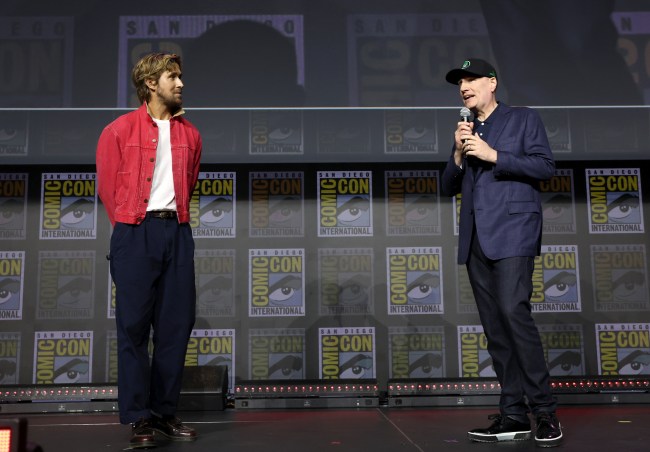
The following article is an excerpt from the new edition of “IndieWire’s The Lead Up,” a weekly newsletter in which our Awards Editor Marcus Jones takes readers on the awards trail, interviewing key figures responsible for some of the most compelling stories of the season, and offering predictions on who will win. Subscribe here to receive the newsletter in your inbox each week. Last week, the biggest news out of this year’s San Diego Comic Con was the casting of three-time Oscar nominee Ryan Gosling and BAFTA Rising Star Award winner David Jonsson as new members of the Marvel Cinematic Universe, as the new Ghost Rider and Black Panther, respectively. This week, the biggest new film out is “Spider-Man: Brand New Day,” which boasts a cast that includes three Emmy winners and a Tony nominee, all of them joining an established franchise group led by another BAFTA Rising Star Award winner and a two-time Emmy winner. Cue yet another wave of complaints about how we our “losing” our most promising actors to superhero franchise contracts. The idea of having portrayed a superhero as being somehow déclassé has even extended into recent awards conversations around “The Odyssey,” where much of the criticism around Tom Holland’s performance that disqualified him from Oscar buzz amounted to viewers only being able to see him as Spider-Man (though, funnily enough, the majority of his scenes are opposite a former Catwoman and “The Batman” himself). As we come up on two decades of the MCU, there has been a continued back-and-forth between the Disney-owned film franchise and the major awards bodies. Some of the actors who were early to the MCU, like Robert Downey Jr. and Mark Ruffalo, have since gone on to win their first Oscar or Emmy. As the cinematic universe grew, the next step saw breakout Oscar winners like Brie Larson and Mahershala Ali capitalizing off the momentum of Academy Award wins by accepting the roles of Captain Marvel and Blade, respectively. Those two actors are also examples of stars who have struggled to find new material on the same level as the work that garnered them awards attention in the first place. (And Ali’s “Blade” never even got off the ground after years of development.) That is the side of franchise filmmaking that makes Leonardo DiCaprio’s infamous advice to Timothée Chalamet understandable: “No hard drugs and no superhero movies.” The benefit has been the paycheck, of course, and the increased likelihood of being the face of a film that becomes a smash hit. But the cost is the time commitment and the idea still held by Oscar voters of DiCaprio’s ilk that to take one of those jobs is a version of selling one’s soul. In turn, there is a perception that the endeavor is one big cash grab, one that is not worth the risk of embarrassment if the film fails critically and/or commercially. But what I find most ironic is that many of those same actors who have had awards success, and have so far resisted the siren song of Kevin Feige, is that their good taste in projects (think: indies with less big-money backing) is often partially sustained by some mix of fashion, beauty, fragrance, and/or watch contracts. While some might argue that “Dune” is actually his superhero franchise (or even *gasp* “Wonka”), Timothée Chalamet inked a lucrative deal in 2023 to become the face of Bleu de Chanel. He has since been succeeded by fellow 2026 Oscar nominee Jacob Elordi, who has also had partnerships with luxury brands like Bottega Veneta and Tag Heuer. Throughout the years, actresses like Jennifer Lawrence and Kristen Stewart have had deals with fashion houses like Dior or Chanel, respectively, which have contributed to them having more creative freedom with the acting roles they choose. Jonathan Anderson, the newly-minted creative director for Christian Dior (who also happens to have been the costume designer for several of Oscar-nominated filmmaker Luca Guadagnino’s projects), has been collecting promising young talent like Pokémon, recruiting Greta Lee, Josh O’Connor, Mia Goth, and Oscar winner Mikey Madison as brand ambassadors. I would argue it’s more of a capitalist endeavor to shill for billionaire-owned brands from LVMH and Kering — brands that most of their fans can’t afford — than it is to get your reps in as an actor in a blockbuster movie. Yes, everyone wants to be part of projects that seem prestigious, but often prestige does not pay well, and the money it costs to maintain the perception that one is a “bankable star” has to come from somewhere. As “Euphoria,” “Mile End Kicks,” and “Faces of Death” star Barbie Ferreira, who has enjoyed brand partnerships with Levi’s, shoe brand Havaianas, Gap, and Summer Fridays, and lifestyle brand For Your Soul, told IndieWire earlier this year, “Brand deals allow me to do the movies that I want to do. Brand deals help me be able to be the actor that I want to be. If I didn’t have these brand deals, I would be having to take roles that I didn’t believe [in] and that I didn’t like, just to pay the bills. It’s really hard for a lot of people to make ends meet just being an actor, even people that we all know and love and we see all the time, the industry is not how it used to be.” The person who has done the best job of using both brand partnerships and blockbuster roles to their advantage is Ferreria’s “Euphoria” co-star Zendaya. As the former Disney Channel star was making the transition to more adult roles, she and her stylist Law Roach used her red carpet fashion to build her profile. Within a couple years, in 2017, she had the combo of “Spider-Man: Homecoming” and “The Greatest Showman” to launch her film career. “Euphoria” came shortly after, eventually making her the youngest two-time winner of an acting Emmy. In this photo from the ‘Spider-Man: Brand New Day’ UK premiere stands one Oscar nominee, one BAFTA winner, a two-time Emmy winner, and the winner of a Best Supporting Actress OscarTim P. Whitby/ Getty Images for Sony Pictures You could argue that she has been working the “one for me, one for them” formula, also taking on supporting roles in the “Dune” franchise and “The Odyssey,” which have both earned hundreds of millions of dollars at the box office. Then, when it is time for her to step in as the lead of a project, we typically find the star taking bigger swings, like “Challengers” or “The Drama.” Those films not only give her indie credibility, but prove she has enough star power to take a more “risky” film to $100 million at the box office. Meanwhile, her partnerships with brands like On, Louis Vuitton, and Bulgari play into the method dressing approach she and Roach take with press opportunities, causing viral fashion moments that, in turn, help promote her films. Stars who have not made headway in the luxury ecosystem often end up on some sort of entrepreneur route. For example, Miles Teller likely earned millions selling his stake in Finnish Long Drink, Glen Powell has his own condiment and snack brand, and Holland’s non-alcoholic beverage company Bero makes a cameo in “Spider-Man: Brand New Day.” Even Chalamet accepted money to do a commercial for prediction market Kalshi in the glow of his beloved New York Knicks winning the NBA championship. Ultimately, the film industry is not in a place where the check from a leading role in a major blockbuster is enough to fund a passion project more geared toward awards hopes. So, at the risk of caping for superhero films, I ask: why is it that barking for a brand is seen as a more respectable way to make money in the eyes of some awards voters than the act of making more movies, broad as they may be? If anything, it now takes both streams of income to establish oneself as a bankable lead. It’s was not a shock that the announcement of Jonsson as “Black Panther” arrived almost concurrently with the news that the British actor is now a brand ambassador for Loewe, another LVMH brand. As for what could earn him awards attention, Jonsson has the long-awaited “Scandalous!” on the docket, where he is set to play Sammy Davis Jr. opposite Emmy-nominated Armani brand ambassador Sweeney as Kim Novak, directed by none other than the Oscar-nominated and Emmy-winning Valentino brand ambassador, Colman Domingo. As a reminder, my email is majones@indiewire.com if you’d like to share any feedback.
For Rising Stars, Good Taste Comes at a Cost — Superhero Films Are Just One Way to Satiate It
Full Article
Original Source
Read the full article at Indiewire →KhanList aggregates and links to publicly available news content. We do not host full articles from third-party sources. Always verify important information with original sources.