
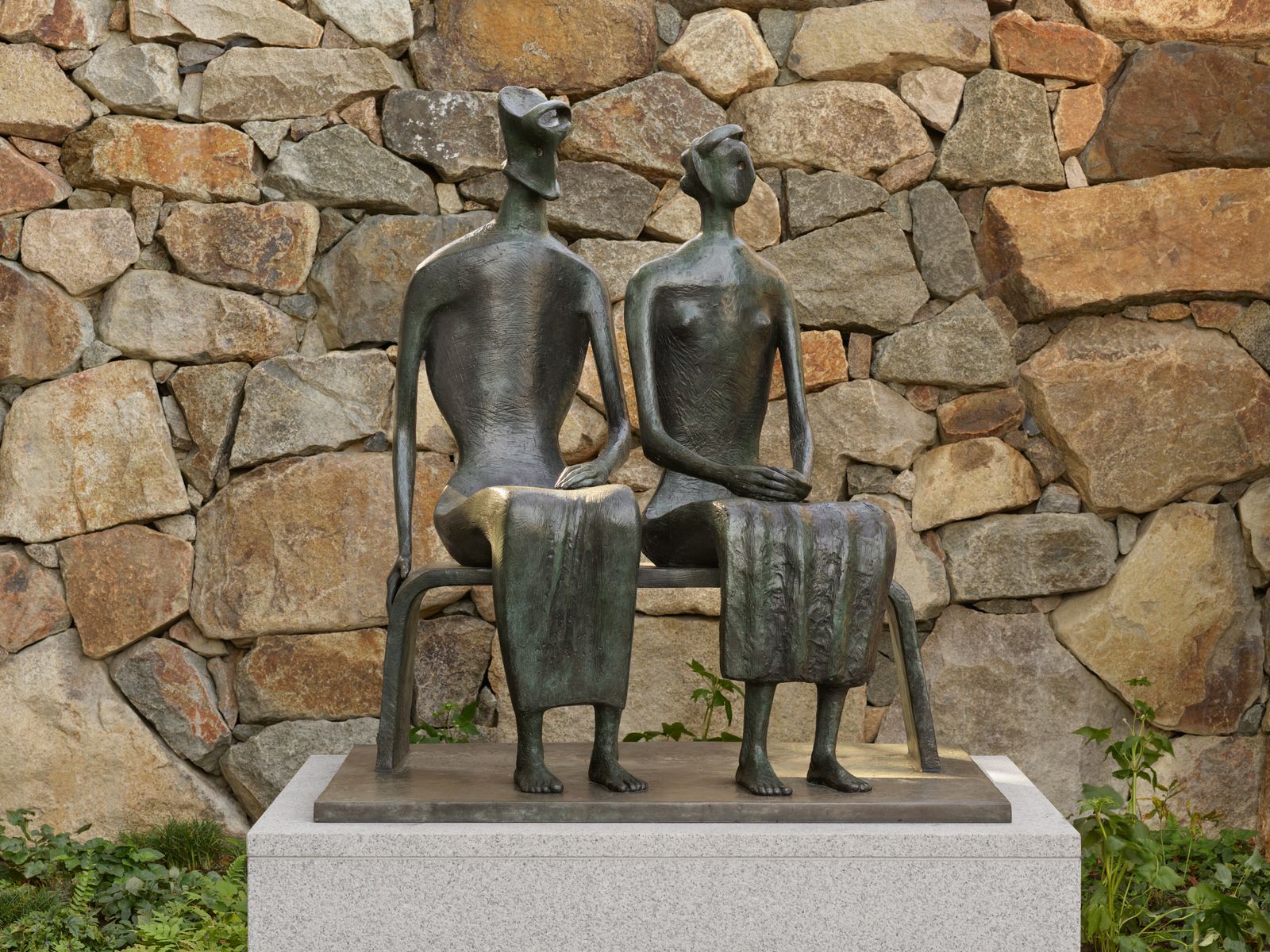
Newly refreshed by Japanese artist-architect Hiroshi Sugimoto, the sunken garden welcomes National Mall visitors with bronze masterpieces, contemporary stunners and a stage set for creative performances October 30, 2026 11:20 a.m. King and Queen, Henry Moore, bronze, 1952-1953 Rick Coulby / Hirshhorn Museum and Sculpture Garden We descend underground into a cavernous space, seeing our own distorted reflections in stainless-steel panels on the walls. Designed by Hiroshi Sugimoto, even this entryway to the newly renovated Hirshhorn Sculpture Garden is a work of art. “You’ll notice that the distortion kind of changes levels,” says the Hirshhorn Museum and Sculpture Garden’s acting head curator Marina Isgro. “It’s sort of at adult-height here, and then as you walk in, it kind of becomes child-height. Sugimoto is really welcoming visitors of all sizes to play with their reflections here in this space.” As we continue the journey into the sunken garden, we find ourselves in a play of light and shadows and stone and bronze, among flowers, trees and the occasional insect. A reflecting pool and a platform for stage performances sit in the middle of the grounds. The 1.3-acre plot underwent a multiyear transformation, following the 2022 groundbreaking of the revitalization project. It reopens to the public this Saturday, October 31. The revitalized Hirshhorn Sculpture Garden’s central galleries and pool, including Hiroshi Sugimoto’s Passage of Reflectance and Kuen’s Surface Rick Coulby / Hirshhorn Museum and Sculpture Garden A view of the newly refreshed Hirshhorn Sculpture Garden's west side, featuring the work of contemporary artists Rick Coulby / Hirshhorn Museum and Sculpture Garden The Hirshhorn opened in 1974 with the museum building’s famous “Brutalist doughnut” design, the creation of American architect Gordon Bunshaft. After half a century, the concrete ring is celebrated today. But the sculpture garden of 1974 was much different than the one of today, says Isgro: “At that time, it had one tree; it was sort of a very severe, unshaded space.” The garden was later redesigned by Lester Collins in 1981. By the late 2010s, it needed another revamp. National Treasure: The Hirshhorn Is Brutalism's Boldest Donut The Hirshhorn commissioned Sugimoto for the job in 2019. His relationship with the museum can be traced back to 2006, when he had a solo exhibition there as an artist. Then, as an architect, he completed a redesign of the museum’s lobby in 2018. The new sculpture garden is a serene place, one for contemplation and meditation. Sugimoto also incorporated greater accessibility into the area, with ramps for wheelchair users. Hiroshi Sugimoto in the Hirshhorn Sculpture Garden, March 2026 Greg Kahn / Hirshhorn Museum and Sculpture Garden The garden’s beacon welcoming visitors from the National Mall is a giant stainless-steel swimming pool sculpture weighing 55,000 pounds and standing 28 feet tall. The commissioned work by Berlin-based artist duo Elmgreen & Dragset is called Eight, named for its numeral 8 shape. “Something that I think these artists do so exceptionally well and to such strong effect is excerpt recognizable elements from our daily life and pull them into a different context,” says curator Anne Reeve, who recently left the Hirshhorn for New York’s Storm King Art Center. “Excerpting a huge form in the shape of a swimming pool and placing it empty on its end is another way of doing that. … This is a meticulously, almost maniacally, carefully crafted object.” Eight, Elmgreen & Dragset, steel, stainless steel, aluminum, concrete, lacquer and lights, 2026 Rick Coulby / Hirshhorn Museum and Sculpture Garden The piece had to be shipped to the Hirshhorn by sea, and a 300-ton crane helped install it, says Al Masino, the Hirshhorn’s director of exhibitions, design and special projects. It was “the largest crane that we’ve ever used at the Hirshhorn, that I know of,” he says. “For us, swimming pools can be synonymous with public access, togetherness and community—like the Hirshhorn,” Elmgreen & Dragset said in a September statement. The September installation of Eight, a new sculpture by artist duo Elmgreen & Dragset, at the Hirshhorn Sculpture Garden Donny Bajohr The sculpture garden’s east side is dedicated to the museum’s modern bronze collection, which belonged to founding donor Joseph Hirshhorn, and includes pieces by Barbara Hepworth and Henri Matisse, and one of British artist Henry Moore’s most beloved sculptures, King and Queen. “At the beginning of World War II, Moore began to work in a more figurative style,” says Isgro. “He would go underground and sketch people who were hiding during the Blitz.” King and Queen, an early 1950s sculpture depicting a man and a woman sitting together on a bench, was inspired “by observing people in the U.K. during that time, but also by his studies of Egyptian sculpture, so you’ll see those references there as well,” she adds. The curator notes that the piece has become an icon of British sculpture and likens it to the influence that the 1930 Grant Wood painting American Gothic has in the United States. Quick facts: The Hirshhorn’s namesake At age 8, the museum’s founding donor, Joseph Hirshhorn, emigrated with his family from Latvia to the United States, settling in New York. Then, at age 18, he purchased two etchings by artist Albrecht Dürer, the first pieces of art he collected. As the years went by and his collection grew, he would gift the nation nearly 6,000 pieces, which formed the basis of the Smithsonian’s Hirshhorn Museum and Sculpture Garden. Not far from King and Queen is a showcase of pieces by French sculptor Auguste Rodin, known as “the father of modern sculpture.” This is one of Isgro’s favorite spots in the whole garden. The central piece is an original bronze cast of The Burghers of Calais, now surrounded by chocolate cosmos flowers. Characteristic of Rodin, “You’ll see his surfaces are very worked, and often, you’ll find traces of the process still visible on his surface, whereas other sculptors at that time would’ve removed them,” she says. The Burghers of Calais, Auguste Rodin, bronze, 1884-1889, cast 1953-1959 Rick Coulby / Hirshhorn Museum and Sculpture Garden As Isgro explains, the sculpture shows six citizens (burghers) from the French town of Calais who offered their lives to the British during the Hundred Years’ War, to end the siege on their city. The town of Calais commissioned this from Rodin in the 1880s, and they expected a heroic presentation of these figures, the curator notes. But what they received, she says, was a work that “shows them exhausted and tired and tortured-looking.” After initially rejecting the submission, the town did accept it. “Though, they installed it on a very high plinth as was traditional at the time,” Isgro adds. “Rodin always wanted it installed low, and so that’s what we’ve done here.” Devoted to contemporary art, the west lawn will host a rotation of commissions from living artists. The first artist selected is Yoshitomo Nara, who, in Isgro’s words, depicts “children who are a little bit cute, a little bit creepy.” Three of his works, enlarged heads assembled as “Sentinels of Stillness,” support that assessment. Nearby artworks include Raven Halfmoon’s Dancing at Dusk, Liz Larner’s 6 and Lauren Halsey’s keepers of the krown (antoinette grace halsey). Dancing at Dusk, Raven Halfmoon, travertine, 2024 Rick Coulby / Hirshhorn Museum and Sculpture Garden While the garden is newly refreshed, familiar flora connect it to the space’s past. Yoko Ono’s Wish Tree for Washington, D.C., a staple of the previous iteration of the garden, has returned. This kousa dogwood “is one of several wish trees that she has created around the world,” Isgro says. “During the warmer months, there will be a box here with little tags; you’re invited to write your wish on the tag and tie it to the branches of the tree.” Hirshhorn staff then “harvests” the wishes and sends them to Ono’s Imagine Peace Tower in Reykjavik, Iceland. In the spring, other trees in the garden will fill out with leaves as the Wish Tree, Isgro says, “seems to bloom with all the wishes of everyone who visits.” You Might Also Like Get the latest on what's happening At the Smithsonian in your inbox. More about: Architects Architecture Artists Arts Contemporary Art England France Henri Matisse Hirshhorn Museum and Sculpture Garden Japan Sculpture
For Over Four Years, the Hirshhorn Worked to Revitalize Its Sculpture Garden. Today, It’s Home to a ‘King and Queen,’ a ‘Wish Tree’ and a 55,000-Pound Vertical Swimming Pool Artwork
Full Article
Original Source
Read the full article at Smithsonianmag →KhanList aggregates and links to publicly available news content. We do not host full articles from third-party sources. Always verify important information with original sources.