
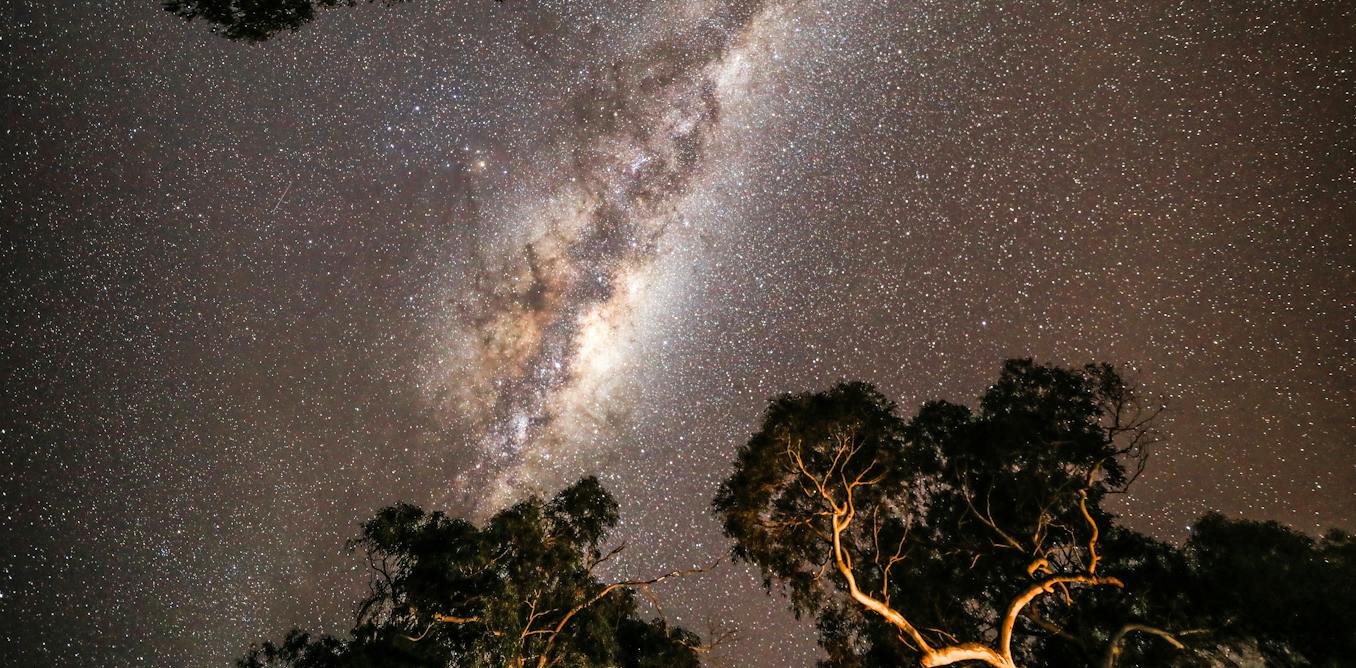
Australian Aboriginal people have seen the sky as an integral part of their world for at least 65,000 years. The Aboriginal sky is a world that reflects our Earth-bound world, so understanding the sky is an important part of understanding our place here on Earth. As a result, Aboriginal songs, stories and art show evidence of thousands of years of studying and understanding the sky. And in the ancient Aboriginal traditions, we see the traces of giant intellectual achievements. The stars and the planets In the clear black skies that predated streetlights and satellites, Aboriginal elders would look up at the sky night after night. They would see how all the stars rotate around us as if embedded in a crystal sphere, each night giving us a slightly different view. And they realised that not all stars are the same. While Western astronomers preached that the stars were constant in brightness, Aboriginal astronomers noticed that some, such as the famous Betelgeuse in Orion’s shoulder (in Western tradition) or at the front of his canoe (in Yolngu tradition, in Arnhem Land) brighten and dim over time. The Western Constellation of Orion is seen as the Djulpan constellation by the Yolngu people. The three bright stars of Orion’s belt are three brothers fishing in their canoe, having illegally caight a kingfish, represented by the Orion Nebula, or Orion’s sword in the western tradition. The bow of the canoe, at the bottom, is the star Betelgeuse, whose variability was noted by Aboriginal astronomers. drawn by author, CC BY Against that backdrop, Aboriginal astronomers saw the planets moving amongst the stars. They saw how most planets appear to move steadily along a path that modern astronomers call the ecliptic, and Wardaman people from the Northern Territory called “Yondorrin”. They understood how Mars would sometimes pause its steady travel across the sky, and backtrack a few steps, before resuming its forward march. They understood how Venus, as the Morning Star, always rose just before dawn, or as the Evening Star set just after sunset, but never appeared high in the night sky.. Modern astronomers explain these movements in terms of planetary orbits. But the ancient Aboriginal astronomers fitted them into their own cultural framework, with stories of creator spirits, their stories always staying true to their careful observational data. In Yolngu tradition, Venus, or Barnumbirr, never rises high in the sky because of the string that her sisters tied to her. We now see this string as ‘zodiacal light’, caused by sunlight reflecting off dust in the solar system. Ray Norris, CC BY Lunar and solar eclipses A solar eclipse, that rare spine-chilling apparition when the Sun goes dark during the daytime, is caused by the Moon passing in front of the Sun. Some Aboriginal groups had figured this out too, and explained it as the Moon-man covering the Sun-woman as they made love. The Aboriginal astronomers passed this knowledge on across the generations, even though only about one in ten generations would actually witness a solar eclipse. On the other hand, a lunar eclipse, when the Moon goes blood red at night, is caused by Earth blocking the sunlight that normally lights up the Moon. This happens when the Sun and Moon are on exactly opposite sides of the sky, which is not at all obvious to the untrained eye. What Aboriginal genius had that flash of insight, while watching a lunar eclipse, that this eclipse was caused by the precise juxtaposition of the Sun and Moon on opposite sides of the sky? That realisation was an important intellectual leap, and we won’t ever know the name of the ancient astronomer who first realised it. But we still see traces in the Aboriginal cultural legacy. Some Aboriginal groups explained a solar eclipse as the Moon-man covering the Sun-woman as they made love. Bernat Armangue/AP The movement of the tides We are all familiar with the rise and fall of the tides on the beach. But their cause eluded astronomers for years. Galileo failed to explain them, coming up with an entirely incorrect explanation which denied the Moon any role. In contrast, ancient Yolngu astronomers recognised the tides were caused by the Moon, and realised that you can predict the height of the tide from the phase of the Moon. Unfortunately we have no way of dating this knowledge. But given that other Aboriginal astronomical traditions stretch back many hundreds or thousands of years, it is likely that this Yolngu knowledge is far older than our modern Western understanding. This enabled Yolngu people to safely navigate the crocodile-infested waters of the Arafura Sea, where Galileo surely would have perished. So this understanding of the sky went beyond simply understanding how the sky worked. It also had practical applications, enabling ancient Aboriginal people to navigate across and around Australia, and build sophisticated calendars which would help them manage the land and their food supply. Bringing different knowledges together This ancient astronomical knowledge fits into the growing appreciation of the vast body of Aboriginal achievements in navigation, medicine and agriculture. By comparing modern science with Aboriginal culture, we can clearly see the depth and intellectual power of ancient Aboriginal cultures. This article itself, as well as our other work, is the result of bringing different knowledges together. One of us (Ray) has spent a lifetime studying the sky through astrophysics. The other (Bruce) observes the sky through Aboriginal eyes, and has learnt from traditional stories and paintings passed on by other Aboriginal people. When science meets Aboriginal culture, we enrich our understanding of both.
For millennia, Aboriginal astronomers have explained the movement of stars, planets, eclipses and tides
Full Article
Original Source
Read the full article at Theconversation →KhanList aggregates and links to publicly available news content. We do not host full articles from third-party sources. Always verify important information with original sources.