
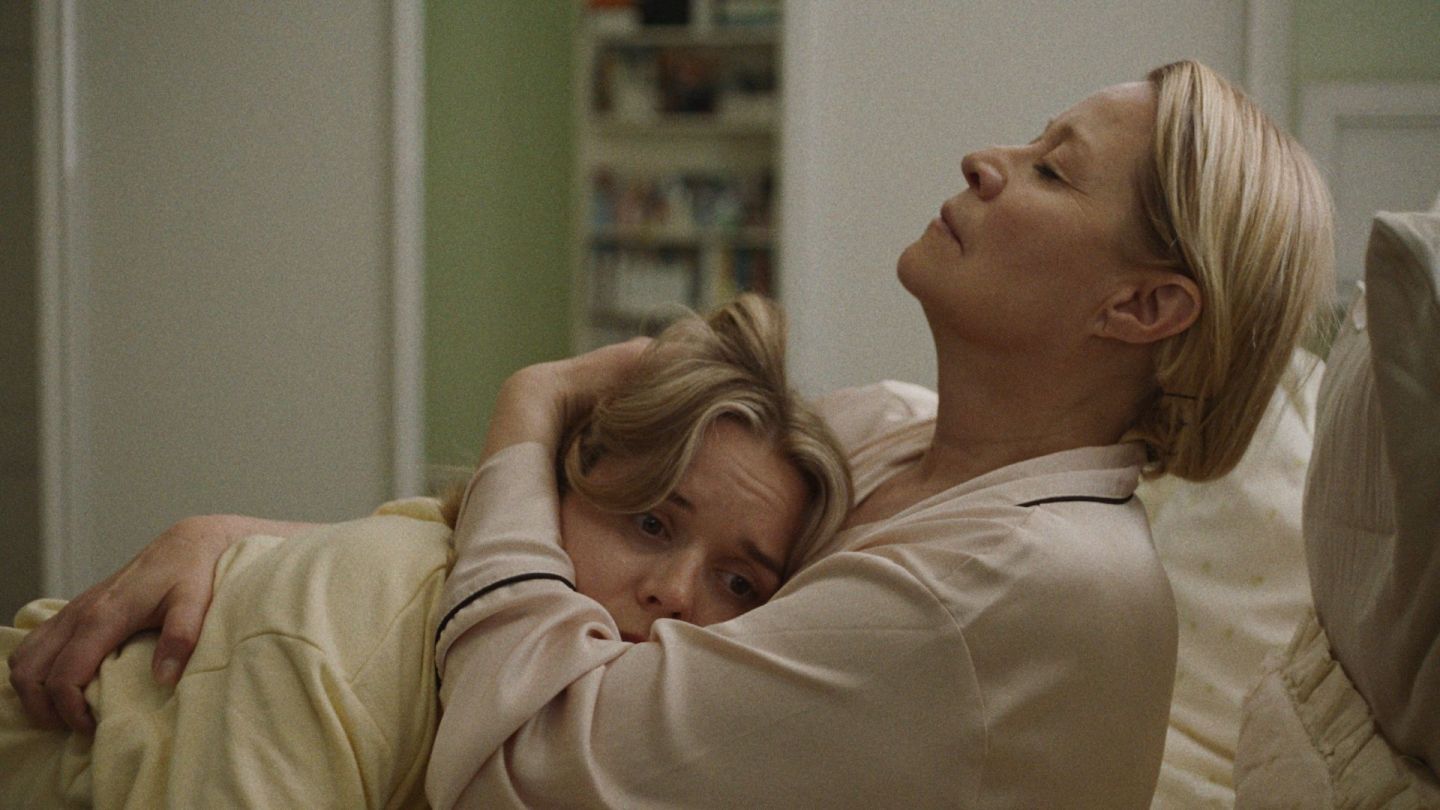
How’s this for a cinematic experiment? Bring together former cult members and celebrated actors. Ask the performers to recreate events or scenes from life in the sect with guidance and input from the ex-insiders. And then mix reenactments, behind-the-scenes exchanges and former cult members sharing memories and discussing what it was like to face traumatic experiences from the past. That was the process behind Father’s House, a new envelope-pushing hybrid documentary about the Danish Christian sect Faderhuset, or “Father’s House,” and its 1990s evolution into a tightly controlled community dominated by faith, manipulation and abuse. The movie gets its world premiere on Monday in the Doc@PÖFF International Competition program of the 30th edition of the Tallinn Black Nights Film Festival (PÖFF) in Estonia. The acting talent helping with the recreation of scenes includes Trine Dyrholm (The Girl With the Needle, Poison), David Dencik (Tinker Tailor Soldier Spy, No Time to Die), Laura Kronborg Kjær (The Sommerdahl Murders, The Girl From Athens) and Emma Sehested Høeg (Killjoy, The Stranger). Dyrholm portrays Ruth Evensen, who is now Ruth Kristiansen, who led the sect throughout the 1990s. It closed as a religious congregation in 2013, with various leaders and members then moving abroad. Dencik plays former sect member Jerry. The writers and directors behind the project are Adam Nielsen (The Letter Room, The Investigation), Andreas Koefoed (The Lost Leonardo, Music for Black Pigeons) and Eva Mulvad (The Good Life, Enemies of Happiness). Nielsen also edited the film, which features cinematography by Mia Mai Dengsø Graabæk and Adam Jandrup. Father’s House will be released in Danish cinemas via Camera Film on Nov. 19. DR Sales (Mr Nobody Against Putin) is handling sales on the film. “Moving between high-end dramatic reconstruction and the testimonies of those who escaped, Father’s House explores the fragile boundary between faith and control in an extraordinary world of exorcism, speaking in tongues and militant Christianity,” the PÖFF website says about the doc. “Intimate, deeply unsettling and formally inventive, the film reaches beyond one religious community to examine the mechanisms of manipulation that shape our relationships, our beliefs and the world around us. What makes us believe, obey and need to belong, and how do we recognize when influence becomes control?” Camilla Johnson, portrayed in the reenactments by Kjær, was a member of Faderhuset for seven years before leaving and setting up the NGO InsideOut, writing books and giving talks to help people leave cults. She and Koefoed talked to THR about how Father’s House came about, how they made sure to avoid triggering former cult members, the reaction they got from the sect’s representatives and why the deep dive into a Danish cult exposes universal mechanisms that audiences will find more timely than they may at first think. ‘Father’s House’ Courtesy of PÖFF For Camilla Johnson, the film is part of “a journey that started 10 years ago for me,” she tells THR. “When I first started to tell my story, I met Eva Mulvad, one of the film directors. When I wrote my second book, Eva contacted me and asked if I was interested in doing a documentary with her. So we talked about it for a long time. It takes time to build trust and all that.” After all, “it’s a vulnerable thing” for a former cult member, she shares. “I’ve held many lectures about my life. I’ve been doing podcasts, radio and all that. But it is one thing to talk about it, but another thing to see it. Because when you see things, you feel them in different way.” Mulvad talked to Nielsen, and they came back to Johnson with an unusual suggestion. “Camilla, could it be an idea that some of you who have been in there actually help direct the actors?” she recalls the proposal. “I was a little bit triggered and said, ‘I’m not sure I can do that because how would that be emotionally?’ Would I be traumatized? I [wondered how it would feel] for me to put the most shameful things in my life out there. Could I handle it? So it was a process.” But she ended up liking the idea and lauds the film team and the actors for being very respectful, open and thoughtful. “They took something so vulnerable and treated it with respect and care. That has been so big and important,” Johnson emphasizes. “And it was not only the film directors but also the actors who were treating us with real care and respect.” That helped her get through early caution. “I was very nervous the first time we started shooting. I was very nervous about my own reaction,” she recalls. “But as I was driving home from the set, I felt such freedom. And I felt so grateful for my freedom. It’s been 18 years since I left the cult. I don’t think about it that much anymore because I’m helping other people now.” And she realized that Father’s House was not really focused on her. “It was never about my story,” she tells THR. “It was about showing the mechanism. So, it’s been a very healing and beautiful process.” ‘Father’s House’ Koefoed joined the film as one of the directors when its concept had already been developed. “I thought it was a really genius concept,” he shares with THR. “I’ve tried before to work with past events and do reenactments and interviews. But there’s always a limit to how close you can get to the truth with reenactments because they are obviously fake. With a fiction film, you get engaged and accept that everything is fiction. But with reenactments, it’s always kind of artificial.” The process that the Father’s House followed was different. “With this method, you blend documentary and fiction, and you show very clearly what you’re doing when recreating moments and setting up scenes,” he explains. The approach to the film allowed the former cult members to really become co-creators. “One of the beautiful things in this process has been that we were allowed to be a part of writing the story,” Johnson highlights. “I was a part of choosing the scenes that meant something to me, and we discussed and them in a very close environment.” Indeed, early in the film, we see Johnson giving notes to Dyrholm, who then asks a follow-up question, creating a real dialogue about how to best portray the cult leader the actress plays. Narrowing down which experiences and scenes to show in Father’s House was naturally one of the key challenges. “We could have done a whole series, no problem,” shares Johnson. There is a particularly intense scene, in which Dyrholm as Ruth interacts with Kjær as Camilla in what the latter describes as “the birth scene.” It was an experience that she initially didn’t feel ready to bring to the screen. “When Eva first asked me about that, I said that’s not going to happen because that involved some of the worst abuse I experienced in there,” Johnson recalls. “But then, we talked about it, and as I was processing it, I started feeling that this was an important element. Again, this was not about me. This was about showing the mechanisms of losing yourself to that power when you put God on top of human control. I wanted people to see that and feel that.” ‘Father’s House’ Courtesy of PÖFF She and the directors hope to give audiences more insight into the cult experience in a way that isn’t condescending. “I think there is a [lack of] real understanding of the people who have been in cults,” Koefoed tells THR. “In society, there is a tendency to look down on them and say, ‘Ah, they are weak, or they are not smart, or whatever.’ What we actually experienced here was that the people in the film are super smart and actually strong. They might have had a vulnerable time in their life where they were seeking a community and answers to some things. But in general, they are just like anybody else.” He concludes: “We would like the film to achieve lke a better understanding of what it means to be in a cult, why some people enter cults, but also how hard it is to actually leave cults and to get back into society to find yourself again.” This message and the mechanisms explored in the film also go beyond borders. “Father’s House is a Danish cult, but this is a universal problem,” Johnson emphasizes. “When I traveled to America, when I lived in Jerusalem and Israel, I saw these same mechanisms. Not everybody is going to join a cult, thank God. But a lot of people know how it is to be vulnerable at a time in their life and seek community and fellowship.” Father’s House feels particularly contemporary and timely, she adds. “We’re living in a time right now where the world is insecure, and that’s why I think this film is super relevant,” Johnson tells THR. “People seek faith. People seek communities. They want to belong. And that’s why I want people to start questioning authority. Because the problem is when you mix religion and control like that, when questioning a human being becomes the same as questioning God, we’ve got a huge problem. And we see that in many places in the world right now.” So, what do representatives of Father’s House think of the film? “We sent the film to the Father’s House about a month ago, and we gave them two weeks to have a say, to have a comment,” Koefoed says. “They didn’t get back to us, and that was what we had expected.” Concludes Johnson: “That’s how it is.”
For ‘Father’s House,’ Former Cult Members and Lauded Actors Collaborated to Explore Mechanisms of Control in a Cinematic Experiment
Full Article
Original Source
Read the full article at Hollywoodreporter →KhanList aggregates and links to publicly available news content. We do not host full articles from third-party sources. Always verify important information with original sources.