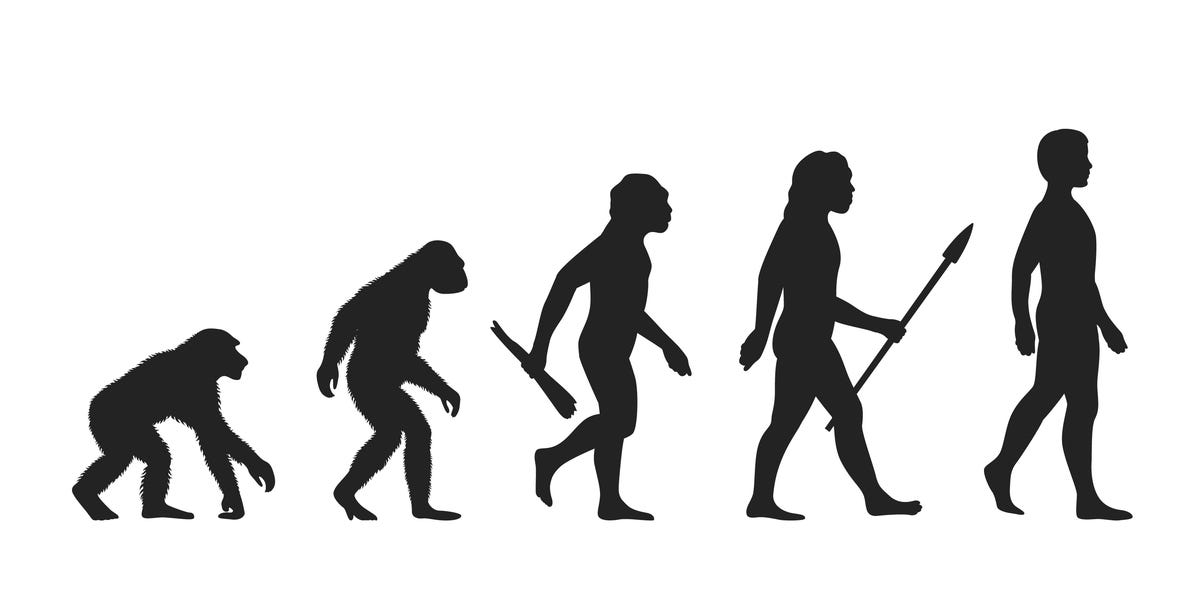
3 min readHere’s what you’ll learn when you read this story:Human evolution wasn’t a steady march toward bigger brains and better tools, a new study argues.Researchers compared 87 fossil skull fragments against six evolutionary models ranging from random change to punctuated equilibrium.Culture likely created a buffer against ancient evolutionary pressures, letting Homo sapiens shrink their jaws and grow calorie-hungry brains rapidly.The oldest fossils attributed to the genus Homo date to around 2.8 million years ago in Africa, where it evolved from Australopithecus, an extinct genus of early hominins. During the nearly three million years that followed, different species in that genus spread across much of the globe, including Homo neanderthalensis in Eurasia, Homo erectus from Africa to China and Java, and even the diminutive Homo floresiensis on the Indonesian island of Flores. Of course, the last surviving member of this genus, Homo sapiens, were relative latecomers, evolving in Africa some 300,000 years ago.It’s easy to think of this progression as linear. Homo habilis, the first species in the genus, featured a larger braincase (a process known as encephalization) than Australopithecines, but much smaller compared to modern humans. So over time, hominin species developed larger brains, smaller jaws, and better tools before eventually evolving into the eight billion modern humans on Earth today. But a new study in the journal Nature Communications by researchers at the University of Tennessee-Knoxville and the University of Tübingen in Germany say this “March of Progress” conception—a steady progression from archaic to modern—is an oversimplification.The study’s authors, Mark Hubbe and Katerina Harvati, analyzed 87 fossil skull fragments belonging to a variety of Homo species, including H. habilis, H. rudolfensis, H. erectus, H. heidelbergensis, H. neanderthalensis, and fragments of early and modern H. sapiens.“We compared this exceptional dataset with six different evolutionary models using statistical analyses to assess which model most accurately explains the observed changes in head and facial morphology within the genus Homo,” Harvati said in a press statement.Each model represented a different possible pattern: random change, steady directional selection, or punctuated equilibrium (long stretches of stasis interrupted by short bursts of change). The goal was to get a more accurate picture of how the genus evolved, and whether directional selection was really the primary driver. The results pointed to punctuated equilibrium, meaning brief periods of rapid change separated by long spans in which skull and facial anatomy barely budged. Since evolution doesn’t work toward a goal, earlier Homo species weren’t rough drafts on the way to H. sapiens. Instead, they were fully formed species shaped by the same forces of random mutation, genetic drift, and environmental pressure.In the case of Homo sapiens’ drastically smaller jaws and larger brain, the authors argue that human culture played a large role in the rapid development of those features compared to our cousins.“In many ways, culture acts as a buffer: It enables us to utilize new habitats and access more resources. This reduces the pressure on certain physical structures because they need to be less strictly adapted to environmental conditions,” Hubbe said. “In this way, periods of intensified technological and cultural innovation can trigger rapid evolutionary changes.”So what makes humans distinct from older Homo species is that culture eased many longstanding evolutionary pressures simultaneously. Easier access to food is a particularly important evolutionary factor because a large brain is a famously calorie-hungry organ, using roughly one-forth of the body’s daily caloric intake. Similarly, the ability to process food with tools decreased the need for powerful jaws, “mak[ing] the energetic investment in large faces disadvantageous,” the authors wrote.So directional selection appears to have played a smaller role than the March of Progress model assumes. What remains is the harder question: which specific cultural behaviors let Homo sapiens slip past constraints that had held for millions of years? Future studies will need to dig into those mechanisms, and into how a species shaped by the same forces as its cousins ended up spread across nearly every habitat on Earth.Darren lives in Portland, has a cat, and writes/edits about sci-fi and how our world works. You can find his previous stuff at Gizmodo and Paste if you look hard enough.
For Eons, Human Evolution Barely Budged—Then It Exploded. Now Scientists Know Why.
Full Article
Original Source
Read the full article at Popularmechanics →KhanList aggregates and links to publicly available news content. We do not host full articles from third-party sources. Always verify important information with original sources.