
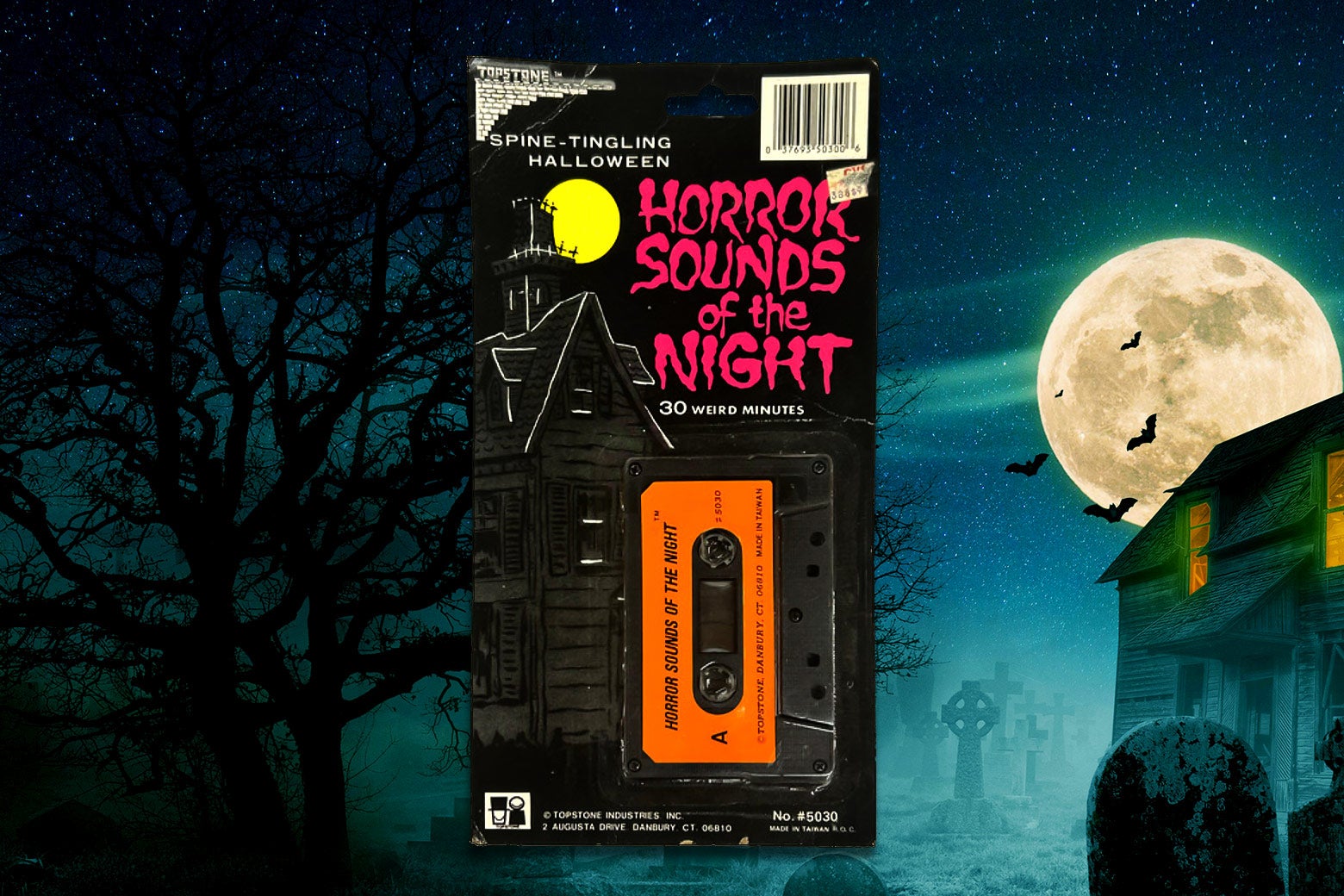
Downtime The Sound of Fear For decades, the soundtrack to haunted houses and costume parties was a single black-and-orange cassette tape. Photo illustration by Slate. Images via Topstone and Alones Creative/iStock/Getty Images Plus. Sign up for the Slatest to get the most insightful analysis, criticism, and advice out there, delivered to your inbox daily. Down the road from my childhood home, just outside Stewart Air National Guard Base, there was a small farm. I never met the family who ran this farm. I don’t even know what they grew. (Cabbage? Squash? Weed?) But, like so many farmhouses made infamous through horror, I will remember that place until I die. Every October, the farmer, in an act of wicked benevolence, turned his greenhouse into a free haunted house. He shrouded the transparent walls with opaque black trash bags and populated the darkened nursery with skeletons and scarecrows. It sounds quaint, and it was, but to a 10-year-old kid it felt like navigating the nine circles of hell. What helped elevate the greenhouse from mere creepy decorations to an indelible childhood anxiety was Horror Sounds of the Night, the black-and-orange audiotape of ambient scary noises: a creaking door, demonic laughter, thunder backed by a malevolent organ dirge. Released in 1986, the cassette and its gothic packaging were a reliable sight well into the ’90s at Kmart and dollar-store Halloween displays—right between the pumpkin carving kits and the Dracula blood capsules. To this day I can remember the sounds on that tape better than many of the era’s biggest radio hits. In the Dark Ages before YouTube or Spotify, when finding the media you sought was an act of faith, Horror Sounds of the Night was a mysterious visitor (unboxed and sold only once a year) that added ambience to a generation’s costume parties, Halloween displays, and other Black Masses. The cassette was recently on my mind after a friend revealed she’d not only listened to the tape, but kept it in rotation beyond the Halloween season, usually while cleaning her room, as unlikely background music. I was less surprised by her macabre choice of relaxation music (all my friends are odd) than I was to learn the tape lives on at all. I wondered why. Why do we have strong memories of a tape we encountered so infrequently? How did the curious musical subgenre of horror sounds first emerge? Above all, who made this thing? So began my deep dive into Horror Sounds of the Night. Appropriately, I discovered a fair share of the grim: masked monsters, money, murder, Creedence Clearwater Revival. But the tape also amplified the powerful, often beautiful role sounds play in memories, and even forced me to reevaluate my definition of what might qualify as “music.” Perhaps I should have let sleeping werewolves lie, but what was the worst that could happen? It’s not as if bad things ever happen to horror-movie characters who play mysterious tapes. I found a worn, old copy of the cassette in the internet’s ultimate Cabinet of Curiosities: eBay. A few days later I discovered Horror Sounds of the Night on my doorstep, waiting for me, like a copy of that evil book from The Babadook. Beneath the tape’s big title I spotted smaller text: “© topstone, danbury, ct.” Horror fans even older than I am may know Topstone as the 1950s manufacturer that sold mail-order rubber monster masks in the backs of comic books. In an Associated Press interview from the year of Horror Sounds’ release, Topstone president Mel Goldberg suggested the company had expanded its inventory to accommodate baby boomers who wanted to continue celebrating Halloween as grown-ups, noting his was the only company that “produces a full adult line” of monster masks. Horror Sounds, perfect for parties or front-lawn displays, offered grown-ups another way to get in the Halloween spirit. Even the cassette format itself, blowing up thanks to the Walkman, was well-timed for gadget-loving adults investing in the era’s new consumer electronics. (It certainly was for my dad and his beloved tape deck.) There’s a darker side to the 1980s Halloween marketplace. Goldberg also revealed that the industry had been struggling since 1982, which saw the high-profile murder of a child who’d taken poisoned Tylenol. The death (which helped introduce tamper-proof packaging) reignited fears of poisoned Halloween candy that had been in the cultural ether since the 1970s. “The Tylenol incident changed Halloween,” said Goldberg. Instead of trick-or-treating, “parents started having parties for their children.” Coming off a decade that ended with Michael Myers’ fictional murders and Ted Bundy’s real ones, anxious consumers could now enjoy Horror Sounds of the Night without actually stepping out into it. I popped the aged tape into my borrowed Panasonic RX-4955 boom box, closed my eyes, pressed play, and listened to some familiar frights. As a popular Halloween record, Horror Sounds of the Night is an outlier, and not just because it’s a collection of uncontextualized occult noises. It is an outlier because it was designed as a “Halloween record” at all. Very few of the biggest Halloween songs, your “Ghostbusters” or “Werewolves of London,” were conceived for the holiday. (Even “The Monster Mash” came out in the summer, which just feels wrong.) In 2024, Billboard published a list of the 100 best Christmas tracks. Of the top 10, nine had the word Christmas in their name. (One was Navidad, Spanish for Christmas.) When the magazine compiled a similar list the following year for Halloween songs, the word Halloween didn’t appear in any title on the entire list. Christmas music is created on purpose. Halloween music sneaks up on us. Instead, Halloween songs evoke a vibe, a spirit. Some use paranormal lyrics (“Thriller”), some use monsters as metaphor (“You’re the Devil in Disguise”), some are simply creepy (“Somebody’s Watching Me”). A surprisingly high percentage of the songs on Billboard’s list concern females sartorially evoking pagan tradition: Cher’s “Dark Lady,” Santana’s “Black Magic Woman,” the Eagles’ “Witchy Woman.” Horror Sounds of the Night is the ultimate distillation of this: It is nothing but vibes. Its low production value gives the audio effects an eerily intimate feel, and decades of tape degradation make once-goofy foley sounds feel unintentionally creepy, like walking through an abandoned carnival. The tape doesn’t list individual “tracks,” so the only place to discover what’s within the tape is … within the tape. Any track names would just sound like Halloween id, anyway: “Cackling Witch,” “Moaning Ghost,” “Shutters in the Wind.” It’s an odd recording. Not musical enough to be an album, but too much like an album to be anything else, Horror Sounds of the Night was trapped in a sonic purgatory. Exact sales numbers for Horror Sounds of the Night are difficult to find. But given the tape’s endurance into the 1990s, when I first heard it, combined with the number of other records that capitalized on the trend (Ghostly Sounds, Sounds to Make You Shiver, or an album of the sounds from inside Disneyland’s Haunted Mansion), it’s reasonable to assume that, at least by Topstone’s standards, it was a hit. But its digital footprint is eerily invisible. Even Discogs, the online catacomb of musical scripture curated by dedicated volunteer archivists, has limited information on Horror Sounds. Bloggers can only speculate why. (I enjoyed one fan’s theory that the tape’s creators, Brian Wilson–like, “collapsed under pressure to produce a follow-up” to their successful debut.) As I prepared to log off Discogs, dismayed, a lone comment caught my eye. The user handle “Burgmail” had posted a surprisingly comprehensive list of Horror Sounds’ sounds. The clips, the comment claims, were pulled from a variety of earlier LPs (including two Halloween records and a BBC sound-effects compilation). In other words: Horror Sounds of the Night is a mixtape. “I’ve been doing this kind of searching and researching throughout my entire life,” Burgmail told me from his home in Nova Scotia. His real name is Glen Bourgeois, and he’s a doctoral candidate in musicology at McGill University. Bourgeois, also a record collector, described tracking down original copies, cross-referencing credits, even “reviewing logbooks.” The man lit up when describing how a few tracks on Horror Sounds might be longer than on the albums where they’d originated. “If that’s the case, that means Topstone had access to either the master tapes or multitrack tapes,” he told me with a hint of archeological reverence. Bourgeois said he wasn’t sure if Horror Sounds of the Night qualified as “music,” but he also repeatedly praised Night of Terror, a similarly abstract record, for its narrative qualities. “It just sounds like a complete story,” he said. I had been interested in my cassette as a macabre novelty (and source of childhood trauma). But if it piques the interest of a legit musicologist, perhaps Horror Sounds doesn’t deserve to be in its sonic purgatory. I thought I’d unearthed all I was going to about Horror Sounds of the Night. Then an email landed in my inbox. It was from someone who’d worked with Topstone, and dealt directly with the album. The email, a response to an inquiry I’d sent out, came from Andrew Langsam, a copyright lawyer in Florida who’d spent years working with Topstone. He agreed to speak with me, and our brief talk shined a light on one of Horror Sounds’ most dramatic episodes. Shortly after the company released its cassette in 1986, Topstone was sued by a former associate claiming they’d stolen his idea for Horror Sounds of the Night. “They were accused of infringing on someone else’s preexisting horror-sounding cassette tape,” Langsam told me. It went to federal court in New Jersey. (The judge in the case was, weirdly, Maryanne Trump Barry, Donald’s sister.) Topstone hired Langsam, who in the ’80s and ’90s had become essentially the country’s foremost “Halloween lawyer.” Langsam represented costume companies, went to court with horror studios, and faced off against the toy giant Wham-O in a trial over Silly String, that most indispensable tool of Halloween vandalism. Around the time he was approached about the Horror Sounds case, Langsam was in court facing an especially nasty plaintiff: Freddy Krueger. His client had been accused of copyright infringement by New Line Cinema for selling a Freddy-like claw toy. “I think it was called ‘Nightmare Hand,’ ” Langsam tells me. “It was clearly meant to be …” Langsam briefly pauses, then continues: “… similar to and evoke the thought of Freddy Krueger,” he finally says, correcting himself lest he evoke the wrath of Freddy, or, worse, Freddy’s lawyers. For Horror Sounds, the court found in Topstone’s favor. “The sounds on our recording were individually created by Topstone in a different order and sounded different,” Langsam says, “albeit a wolf sounds like wolf.” But there was a catch; when Topstone alleged the lawsuit was frivolous (and demanded the filer pay additional attorney’s fees), that motion was denied. The case even found itself in the United States Supreme Court; Chief Justice William Rehnquist cited it in his decision for Fogerty v. Fantasy, a 1994 case brought, in one more sonic twist, by former Creedence Clearwater Revival musician James Fogerty. Horror Sounds of the Night had a way of sneaking up, like all the best Halloween albums. For all my modern preoccupation with this orange-and-black cassette of my youth, it’s the kind of record that probably couldn’t exist today. YouTube has thousands upon thousands of scary-sound playlists you can bring up at will (including full recordings of Horror Sounds itself). With such digital availability, I asked Bourgeois what compels him to collect, catalog, and research albums as arcane as a 40-year-old cassette of assorted creepy noises. As soon as I asked it, I worried my question would sound like I was questioning what he has devoted a considerable portion of his life to, but he didn’t miss a beat: “There’s a joy in being able to share information that you’ve discovered that other people have been looking for,” he said. “You know, when you’re in a forum and you feel like everybody is pretty much in goodwill for each other and you try to craft this, you know—try to find a solution.” “The thrill of being able to figure out these mysteries has always fascinated me.” Halloween History Holidays Music
For Decades, One Cassette Tape Supplied the American Soundtrack to Halloween. No One Seemed to Know Where It Came From. I Got to the Bottom of It.
Full Article
Original Source
Read the full article at Slate →KhanList aggregates and links to publicly available news content. We do not host full articles from third-party sources. Always verify important information with original sources.