
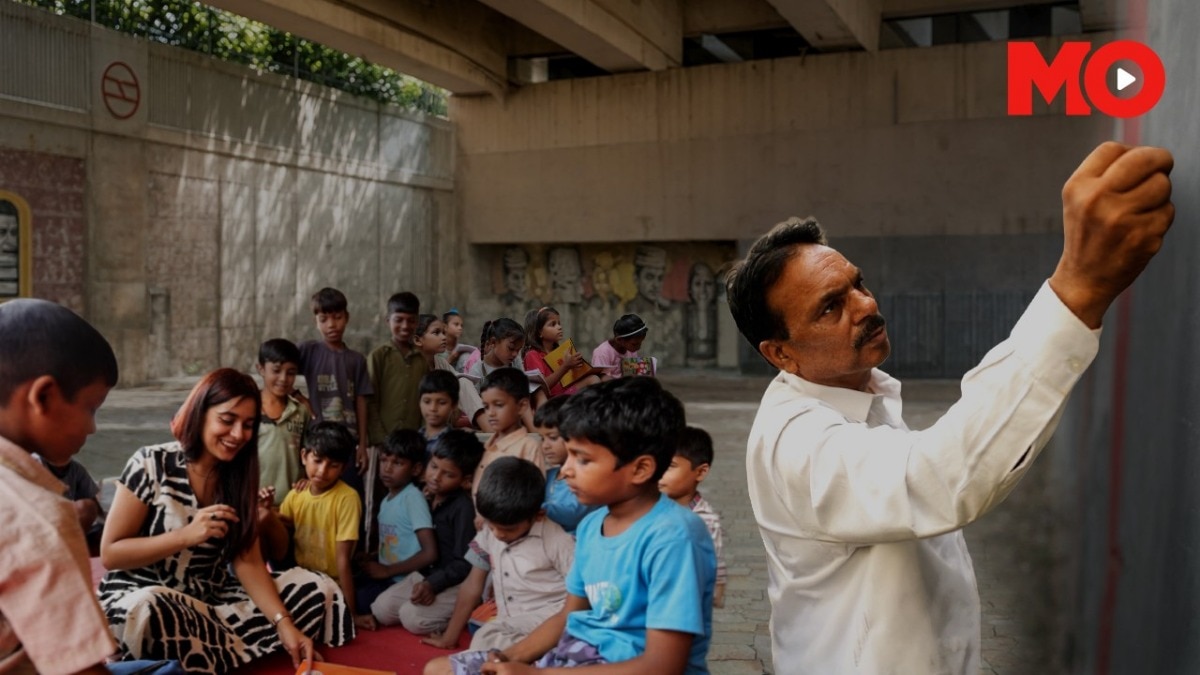
“Twenty minus eighteen?”“Two.”“Eighteen minus twelve?”“Six.” “Fourteen minus five?”“Nine.” The classroom is filled with children's voices and the sound of trains passing overhead.There are no conventional walls here. The ground is their floor, the bridge is their roof and the walls double up as a blackboard.For these children, this space is their school.IT STARTED WITH TWO CHILDRENRajesh never planned to start a school.In 2006, he was running a general store in Shakarpur and regularly visited the Yamuna Bank area, where construction work was underway. He noticed several children from poor families working at the site.“I asked them, ‘Why don't you go to school?’” Rajesh recalls.One child brought his father to meet him. When Rajesh asked why the children weren't studying, the father told him they would send them to school if someone was willing to teach them.Rajesh agreed, with one condition: there would be no fees.He cleared agricultural waste from a pit, had soil spread over it and began teaching two children under a eucalyptus tree.Within two to three years, the number had grown to around 140. Rajesh helped 70 of them get admitted to formal schools.In 2009, a flood forced him to look for another location. He found a space under a flyover where the children would be protected from rain and harsh sunlight.That became their classroom.WHERE DIFFICULT CIRCUMSTANCES MEET BIG DREAMSMany of the children live in small, makeshift homes with limited access to basic facilities. During the monsoon, rainwater can seep into their homes. Their parents work as labourers, car cleaners, metro cleaners, domestic workers and in other low-paying jobs.Yet their ambitions are no different from those of children elsewhere.Ask them what they want to become, and the answers include police officers, soldiers, teachers, doctors and engineers.Rajesh understands how easily financial hardship can interrupt a child's education. He himself had to drop out of his BSc course at Aligarh University after his first year because his family struggled to afford even his travel expenses.“I always felt that no poor child's education should be interrupted because of their financial circumstances,” he says.A SCHOOL BUILT ON TIME AND SACRIFICERajesh isn't alone. Over the years, other teachers have joined him, volunteering their time without a salary.The school also accepts books, notebooks, bags, uniforms and food instead of cash donations.Some former students have gone on to become doctors and engineers. One of them, Amrita, studied here around 16 years ago and is now a government school teacher in Bihar after clearing the BPSC examination.She remembers the school from when it had even fewer facilities.“I never imagined that my future would turn out this way,” she says.But keeping the school running for 20 years has come at a cost.Rajesh admits he could have earned much more had he invested his time elsewhere.Asked what he has lost over the years, he says, “The biggest thing I have lost is my time.” But he doesn't consider it wasted.“What I am investing here is not going to waste. It is growing,” he says.A CLASSROOM THAT KEEPS GOINGTwenty years have passed since Rajesh first taught two children under a tree.The city around Yamuna Bank has changed, but the lessons continue under the bridge.Every day, children gather to learn maths, English and everything they need to move towards a better future.For them, this is more than a classroom.It is a place where they are given something their circumstances could easily have taken away: a chance to learn, dream and build a future. - Ends
For 20 years, this man has taught underprivileged children under Yamuna Bank bridge
Full Article
Original Source
Read the full article at Indiatoday →KhanList aggregates and links to publicly available news content. We do not host full articles from third-party sources. Always verify important information with original sources.