
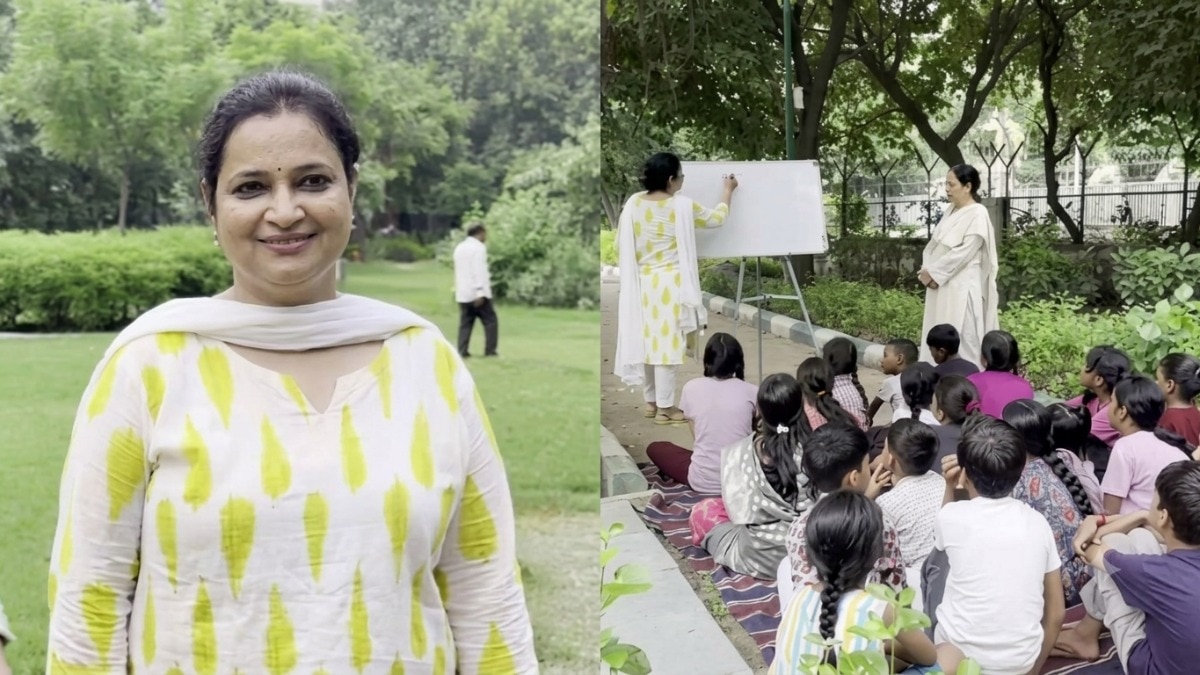
For 13 years, Namita Chaudhary has taught children of migrant workers and daily wage families in a Delhi park. What began with five children now reaches over 200, with former students graduating, finding jobs and returning as volunteers to teach the next generation.For 13 years, Namita Chaudhary has taught children of migrant workers and daily wage families in a Delhi park.For 13 years, a Delhi park has doubled up as a classroom for children whose parents work as labourers, rickshaw pullers and daily wage workers.At Balaji Park in Dwarka, Namita Chaudhary started teaching with just five children. Today, more than 200 children are part of the initiative, while over 100 women have also been reached through adult literacy and empowerment programmes.There are no fancy classrooms here. There are lessons, drawing sessions, English-speaking classes, and activities designed to help children discover skills beyond textbooks.For Namita, the idea started with a simple question: what should she do with her time that could make somebody else's life better? "When I leave this place, I want to have the satisfaction of knowing that I made at least one person smile and gave at least one child an education," she says.Her journey was also shaped by her earlier experience of visiting an orphanage. After moving to Delhi, she felt strongly that she wanted to do something meaningful with her time.FROM FIVE CHILDREN TO 200 PLUS The classes initially focused on children of migrant workers living around construction sites. As word spread, more families began sending their children.Namita says the team soon realised that education was only one part of what these children needed. Some struggled with learning because they had never had a supportive environment. Others had strong abilities in drawing, dance or communication that needed encouragement.So the classes expanded."We have dancers here whom we never formally taught dance. We simply told them to practise properly, and they came back showing us what they could do," she says.English speaking is another focus, particularly for children studying in Hindi-medium schools who may hesitate to speak in public.THE CHILDREN ARE NOW TEACHERSPerhaps the biggest sign of change is visible in the former students themselves.Namita says more than 100 children who studied through the initiative have graduated, with several now working or preparing for further careers. One former student works as a receptionist at JP Pant Hospital. Another completed teacher training and is working as a teacher. Others have found work in private schools and the travel sector.And some have returned to the same park.Komal first came here as a Class 3 student. Her father drives a rickshaw and her mother works as a helper. She says she once hesitated even to speak to people because of restrictions at home.Today, she teaches English to younger children at the park."I used to shy away from speaking to anybody, but right now I have learnt to speak and teach students," Komal says.For Namita, that is the real success story: children who once came here for help are now helping other children."This chain must not stop," she says. "People may change, but the effort to take education into these communities must continue."In a city filled with schools, colleges and towering buildings, this little park is offering something just as valuable: a place where children can learn, speak, create, dream and eventually return to open the same door for someone else.- EndsPublished On: Sep 4, 2026 09:00 IST
For 13 years, Delhi teacher has taught migrant workers' children in a park for free
Full Article
Original Source
Read the full article at Indiatoday →KhanList aggregates and links to publicly available news content. We do not host full articles from third-party sources. Always verify important information with original sources.