
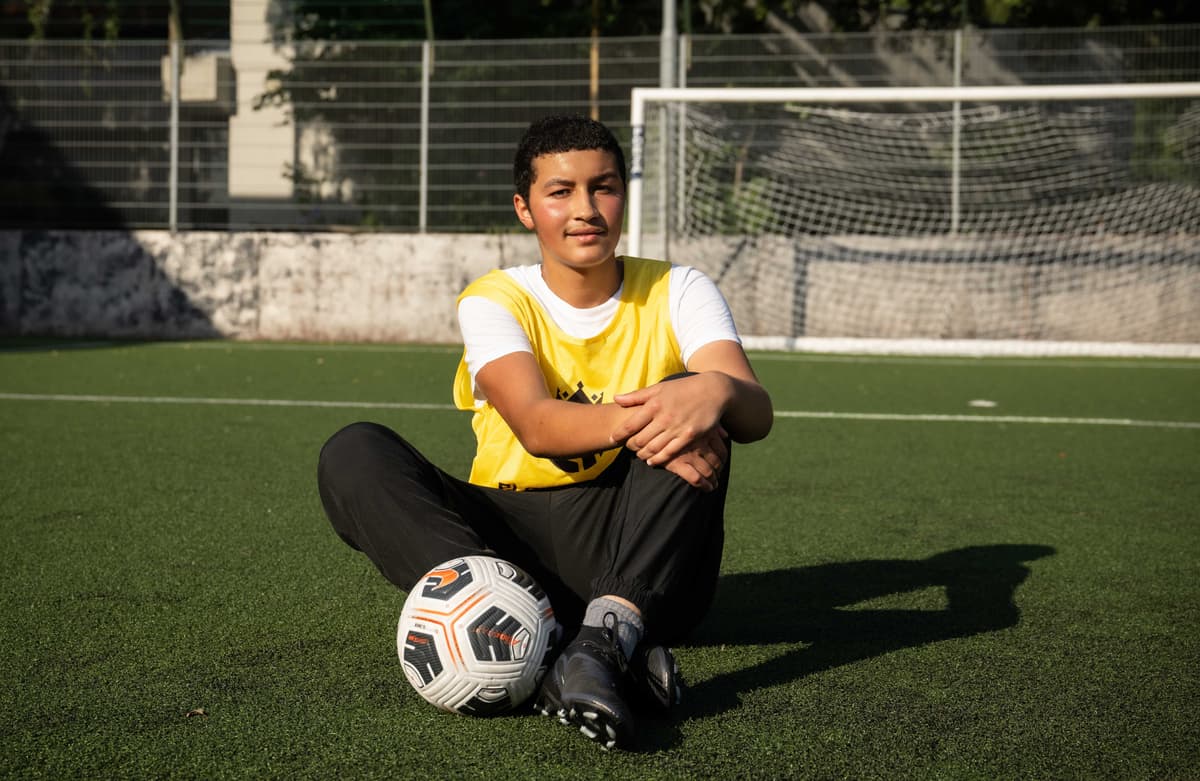
The date July 7, 2022 is seared in Alexia’s memory. That was the day, aged 14, she first arrived at Bloomsbury Football Foundation to try out for its competitive squad. She remembers it as the day her life changed.Alexia was the fastest in her year over 100 metres, beating both all the girls and boys, and dreamed of becoming a serious footballer. But at school, female sport was patchy and she was criticised by the other girls as “always the try-hard” for taking sport too earnestly.“The moment I came to Bloomsbury, I found kindred spirits,” says Alexia, now 18. “The coaches were professional, but everyone was incredibly welcoming and I found players my age who were prepared to work hard and become the best version of themselves. Becoming really good at something helped me on and off the pitch. I learned patience and how to express myself. For the first time, I realised my dreams were possible.”At around the same time, Ali, then 11, also started at Bloomsbury. But in his case, it was not football excellence he was after so much as a community. Ali was being home-schooled, partly to avoid being bullied because of a stutter, and he spent his days teaching himself, cooped up in the living room of the family’s flat on the 10th floor of a high-rise in north London.Ali is exceptionally bright — he has just taken his A-levels in Maths, Further Maths and Physics three years early — but although he found the academic side of home-schooling easy, “socially it was hard,” he says.Pictured is Ali who has been training with Bloomsbury Football and Alexia who is now a part-time coach for Bloomsbury FootballJohn Nguyen/JNVisuals“Without my football sessions to look forward to at the end of my school day, I would have been so lonely. It would have been a problem.”His father, Eyad, 51, goes further. “We found the football to be a saviour for our son,” he says. “Because he was not in school, football was the only place where he could socialise, make friends and find a community.”Sporting ChanceThe StandardCharlie Hyman, founder and CEO of Bloomsbury Football Foundation, says that since setting it up straight out of university in 2018, the charity has been “flying”, posting a compound annual revenue growth rate of 43 per cent in the three years to June 2025. He has ambitious plans for the future.“We started with four kids and a bag of balls at a community centre in Camden Town and now work with more than 6,500 young people a week across nine London boroughs. We plan to scale massively and aim to reach 40,000 children across five cities by 2030, starting with Leicester later this year.”He adds: “There are four million children growing up in poverty in the UK and more than half of them are into football. The beauty of football is that it’s a low-cost, scalable intervention that can be transformative. It improves mental and physical wellbeing, builds community cohesion, reduces crime, and fosters resilience, teamwork and confidence. I think what makes us different is the scale of our ambitions. We want to make a significant impact on social mobility using football as the hook.”6,500 Young people supported every week in London86% Eligible for financial support bursaries43% Female participantsThe contrasting journeys of Alexia and Ali illustrate the two strands of football run by Bloomsbury — competitive squad training for talented young players and more relaxed, inclusive sessions where the emphasis is on participation, enjoyment and personal development.For Ali, football was never about turning pro.“The Bloomsbury coaches made it lovely for him,” says Eyad. “At first, he wasn’t interested and couldn’t play very well, but there is hidden learning in football. When he took instructions from the coaches, he learned how to listen and what it meant to be part of a team. Football became his outlet, a place to release his energy. Without it, he would have been very isolated.”Eyad says home-schooling was not their first choice for Ali. But, after missing out on a grammar school place, and the alternative offer being a school where a family member had been previously bullied, they decided to educate him at home.“Ali has a stutter which gets worse under certain conditions, so we wanted to protect him,” says Eyad. “It turned out he handled the work easily, teaching himself at a faster rate than children his age in school, but we were worried about his social life. Luckily for us, the Bloomsbury coaches were outstanding. He connected with them and that helped his stutter because he relaxed with them.”How your money can help Greenhouse Sports£15 Could enable a young person to access their programme for a week£65 Could provide 4 weeks of sports coaching and mentoring, helping a young person build confidence, resilience and a sense of belonging£165 Could provide coaching and mentoring during school holidays£800 Could provide a full year of coaching and mentoring, ensuring they stay engaged with school and develop the life skills to fulfil their potentialAli has also improved on the pitch and proudly shows off by doing 20 keepy-uppies to Alexia, who is studying for a Level 3 BTEC in Sport at college and also coaches for Greenhouse Sports.Brimming with energy and confidence, Alexia does a few passing drills with Ali before stopping to describe what football has meant to her.“When I was younger, I was super energetic and loved being active, but the downside was that I was always the loudest and most obnoxious child in the class,” she says. “Football was critical for me because it soaked up my energy and gave my day purpose. It taught me that you have to be patient to become good at something and it taught me about leadership. I watched the Lionesses as a kid and idolised them, and last year I played for Fulham’s Under-18 squad. One day, I hope to turn professional.”Meanwhile, Alexia is now helping other young people use football to improve their lives.“I see my younger self in these kids,” she says. “I try to get them to pass to their teammates, but they hog the ball and try to do it all themselves. I teach them: football is not one-v-one, it’s 11-v-11, so don’t take too many touches. I’m trying to inspire them to become the best version of themselves, just as I was inspired by my coach four years ago.”The Standard has joined forces with Greenhouse Sports to deliver sports coaching and mentoring to young people in secondary schools across some of London’s most deprived boroughs. So far, £500,000 has been raised, with £250,000 going to Greenhouse Sports programmes in London and £250,000 to four other youth charities across the capital, including Bloomsbury Football Foundation. We are calling on corporations, foundations, philanthropists — and our readers — to donate. All funds raised will go to Greenhouse Sports programmes in London.
'Football has been a saviour for our son — without it he would have been isolated'
Full Article
Original Source
Read the full article at Standard →KhanList aggregates and links to publicly available news content. We do not host full articles from third-party sources. Always verify important information with original sources.