
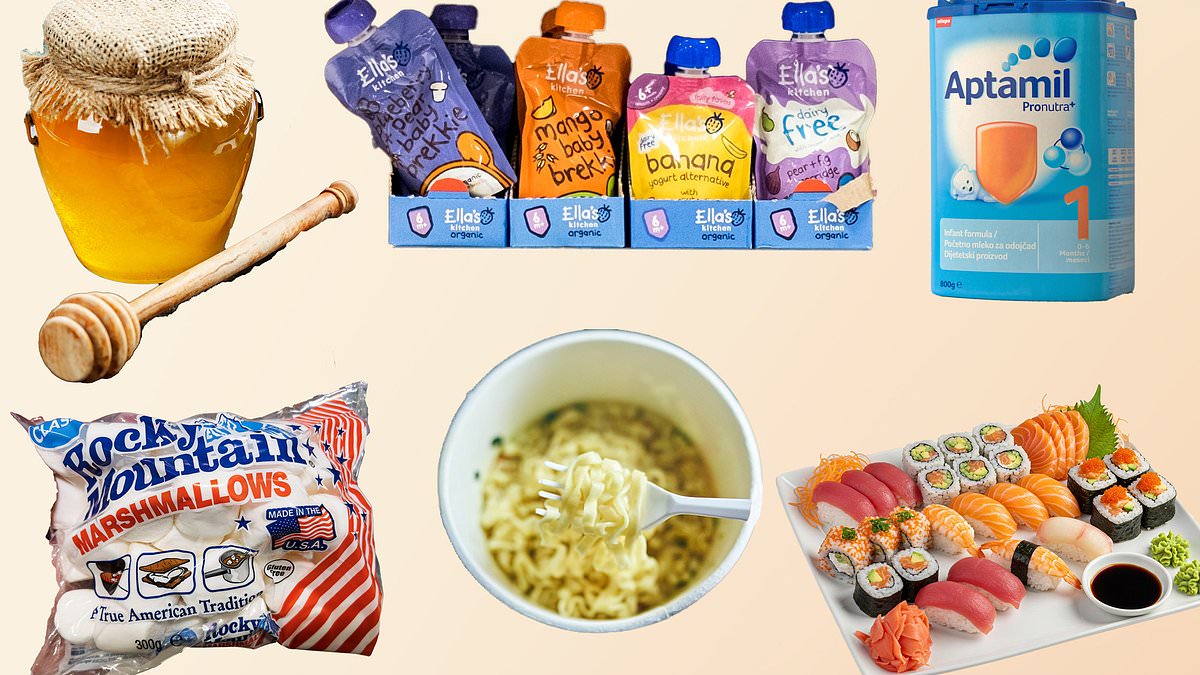
Everyday meals and snacks you feed your children and babies could pose hidden health risks if poorly manufactured or eaten in large amounts, an expert has warned.From a spoonful of honey to a seemingly innocent slushie, some everyday foods can carry mild to severe hazards for little ones that change as they get older.The latest warning centres on baby food pouches, which are routinely given to babies from around four to six months as they begin eating solid food.Researchers from the University of Glasgow examined wet commercial baby food (CBF) sold in six supermarkets and found some products contained surprisingly high levels of sugar - with certain pouches containing amounts 'equivalent to fruit smoothies'.With just under 9 per cent of these pouches meeting the NHS's desired health criteria, researches warned such products should not be given to children under one.But pouches are far from the only food or drink raising concerns.Young children have also been warned against drinking slushies containing glycerol, with the sweetening agent linked to multiple hospital admissions over the years, with symptoms including decreased consciousness and a sudden drop in blood sugar.And while some of these foods may seem like harmless treats, experts say parents and grandparents need to know exactly what is safe, what should be consumed in small quantities, and what should be avoided - at every stage of childhood.So which foods should you keep away from babies and young children, what are the risks, and what should they be eating instead?Baby food pouches and jars Baby food pouches, produced in the UK by popular brands (pictured), may be convenient for parents, but experts have warned they should not become a daily staple for babies as they may contain high levels of sugarBaby food pouches, produced in the UK by a plethora of popular brands, may be convenient for parents, but experts have warned they should not become a daily staple for babies as they may contain high levels of sugar. Containing blended purees of fruits, vegetables, meat or yoghurt, these products are marketed as healthy and nutritious 'first foods', but a recent study says otherwise. A recent University of Glasgow study found some wet commercial baby foods contained high levels of sugar, with some products containing levels comparable to fruit smoothies. Lab tests carried out by the BBC on 18 commercial baby food products from major UK brands also revealed inadequate iron and vitamin C levels alongside sugar contents exceeding daily limits for a one-year-old.And in a recent Which? investigation, which looked at 789 baby food products - including pouches, ready meals and finger food for toddlers - sold in supermarkets, it found one in five contained excess sugar that puts children's health at risk.Major brands were found to contain high sugar levels that could put infants at risk of tooth decay and obesity. In addition, the consumer group suggested that more than half of fruit and vegetable finger foods like strawberry puffs or apple crisps were in breach of voluntary industry guidelines introduced by the government last year. Although these guidelines were brought about to encourage manufacturers to reduce sugar and salt and end misleading marketing by February 2027, the Which? report said they 'had no meaningful impact on the overall healthiness of commercial baby food.' Only three products had been reformulated, while 11 new products had been put on sale that exceeded the guidelinesOn occasion, manufacturing mishaps can also prove to be a serious risk to children with allergies, as seen in April with the urgent recall of a jar of popular baby food. HiPP Organic UK recalled its 7+ Months Vegetable Lasagne (190g) jars after it emerged the product contains celeriac (celery) that was not properly highlighted on the label.The error meant the allergen was not emphasised in bold within the ingredients list, as required by law - potentially putting babies with a celery allergy at risk. In general, the NHS says shop-bought pouches, jars and pots should only be used occasionally rather than as an everyday food. Aaliyah Nelson, nutritionist at independent online pharmacy The Family Chemist, told the Daily Mail: 'Regular reliance on smooth purées can also mean babies have fewer opportunities to experience different textures and learn the skills needed for chewing. Instead, the expert encourages parents to offer babies a variety of mashed and finger foods, like banana, avocado, porridge and steamed vegetables, as they progress through weaning. Raw honey Honey might seem like a natural and harmless sweetener, but it is one food that should be completely off the menu for babies under one.Aaliyah said: 'Honey can occasionally contain Clostridium botulinumspores, which can produce toxins in a baby's immature gut and cause infant botulism. 'This is particularly serious because babies under one have not yet developed the same gut defences as older children. 'Pasteurised honey is also not safe for infants under one as the spores are heat resistant.'According to the NHS, parents are advised not to give honey to children until they are over 12 months old. This includes honey added to foods or drinks, rather than just giving it to a baby directly. Instead, for sweetness, parents should use naturally sweet foods, such as mashed ripe banana, cooked apples.Unpasteurised dairy or juices Young children should also be kept away from unpasteurised milk as it carries a greater risk of food poisoning. In June, the UK Health Security Agency (UKHSA) said more than 60 babies in the UK became ill this year after drinking contaminated infant formula like Aptamil (pictured)Young children should also be kept away from unpasteurised milk as it carries a greater risk of food poisoning. Raw milk can contain harmful bacteria, including E. coli, Salmonella and Listeria, which can be particularly dangerous for babies and young children, with the NHS specifically advising that young children should not be given unpasteurised milk. Parents should also be cautious with unpasteurised juices, which can also carry harmful bacteria if they have not been treated to kill them. Pasteurised dairy products are a safer option, while babies under 12 months do not need fruit juice or smoothies at all. As for parents of babies and infants on formula, while the breast milk substitute is generally considered safe for consumption, it can become toxic or dangerous during rare manufacturing contamination events. In June, the UK Health Security Agency (UKHSA) said more than 60 babies in the UK became ill this year after drinking contaminated infant formula with experts warning 'hundreds more' may have been affected.Multiple batches of infant formula products made by Danone and Nestle, including Aptamil, Cow & Gate and SMA brands, were recalled in the UK in January and February after a worldwide contamination alert. The issue was later traced back to an added ingredient made by a third-party Chinese supplier. As an alternative, Aaliyah suggests choosing 'pasteurised full-fat milk, yoghurt and cheese from around six months, with whole cows' milk suitable as a main drink from 12 months.'For drinks, water and milk are preferable to juice. Fruit juice isn't necessary for babies and young children, and whole fruit provides fibre and a wider range of nutrients.'Regarding formula, she added: 'The potential risk comes from storage, contamination risk and risk of recall. 'Parents should follow the preparation instructions carefully, including using freshly boiled water that has cooled for no more than 30 minutes, so it is still at least 70°C when mixed with the powder. Bottles and feeding equipment should also be properly sterilised.' Dried fruitDried fruit can look like a healthy snack for children because it contains many of the nutrients found in fresh fruit, but it can have a downside for young teeth.When fruit is dried, its natural sugars become concentrated and can stick to the teeth for longer, meaning frequent snacking on dried fruit can increase the risk of tooth decay, particularly in younger children. Therefore, parents should therefore avoid allowing children to graze on dried fruit throughout the day and instead offer it as part of a meal.According to Aaliyah, fresh fruit like banana, berries, pear, peach or melon is generally a better everyday option, particularly for babies and toddlers. She added: 'If giving dried fruit, keep portions small and ideally offer it alongside a meal rather than as a frequent snack.'Marshmallows and thick layers of nut butter Brands that product extra-large marshmallows, like Rocky Mountain Mega Marshmallows (pictured) and Sweetzone Mighty Giant Mallows, should be especially avoided in children, or at least cut into smaller pieces for safe consumptionSome foods that seem soft and easy for young children to eat can actually pose a serious choking risk. Marshmallows are specifically listed by the NHS among foods babies and young children should not have because of their texture and shape. Brands that produce extra-large marshmallows, like Rocky Mountain Mega Marshmallows and Sweetzone Mighty Giant Mallows, should be especially avoided, or at least cut into smaller pieces for safe consumption, as reported by the Sun.Additionally, thick, sticky blobs of peanut butter or other nut butters can also become difficult for a young child to swallow if given on their own. The NHS says nut butter can be introduced from around six months, but it should be spread thinly onto something such as toast rather than given by the spoonful. Aaliyah added: 'The sticky texture and sugar content of these foods can also lead to tooth decay.'Nut butters can be a nutritious food for babies from around six months and provide healthy fats, protein and other nutrients. The key is how they're served. 'Insure that when serving only thin layer is spread, or small amount is stirred into foods like porridge.'Parents should also make sure children are sitting upright and supervised when eating.Raw or undercooked eggs, meat and fishRaw or undercooked animal products can expose children to bacteria that cause food poisoning, so extra care is needed when preparing meals for babies and young children. Raw eggs can contain harmful bacteria, while undercooked meat can carry infections including Salmonella and E. coli. The NHS advises avoiding raw eggs unless parents can confirm they are British Lion-stamped eggs, and raw shellfish should not be given to babies because of the risk of food poisoning. Meat and fish should be properly cooked before being given to young children, with parents also taking care to remove any bones from fish. Good kitchen hygiene, including washing hands and avoiding cross-contamination, is also important.Aaliyah added: 'Well-cooked eggs, chicken, beef, turkey and fish can all be excellent sources of protein, iron and other nutrients. 'Fish is particularly valuable during childhood, so parents shouldn't avoid it altogether because of concerns about contamination, choosing the right types and preparing them safely is key. Insure it cooked thoroughly and cooking services are sterilised properly.'High-mercury fishFish can be an important source of protein and nutrients for children, but certain species contain higher levels of mercury and should be avoided. The NHS advises that babies and children under 16 should not eat shark, king mackerel, swordfish or marlin because mercury can affect the development of the nervous system. Mercury can build up in the body over time, which is why the warning is particularly important for children whose brains and nervous systems are still developing. As an alternative, Aaliyah said: 'Salmon, sardines, trout and other lower-mercury fish can be excellent choices. 'The NHS recommends children continue eating fish because the nutritional benefits outweigh the risks when recommended amounts are followed.' Slushies At high levels, glycerol in slushies like Slush Puppies can cause headaches, nausea, dizziness and low blood sugar, while severe exposure can lead to confusion, loss of consciousness and even shockSlushies may be a summertime favourite, but parents have long been warned about the flavoured ice drinks containing glycerol, an ingredient used to stop them freezing solid. At high levels, glycerol can cause headaches, nausea, dizziness and low blood sugar, while severe exposure can lead to confusion, loss of consciousness and even shock. The warning follows a number of cases involving children becoming seriously unwell after drinking slushies, including hospitalisations reported across the UK. In 2025, researchers issued a stark safety warning over the drinks after reviewing the medical notes of 21 children who became acutely unwell shortly after drinking one, with four year-old Marnie Moore, from Lancashire, rushed to hospital after being left left 'floppy and unconscious' from consuming a slushie. And in 2024, two-year-old Arla Agnew 'turned grey' before falling unconscious after drinking a Slush Puppie, arguably the most popular of all slushy brands in the UK, resulting in urgent treatment at Dumfries and Galloway Royal Infirmary. The advice has since been strengthened - the FSA now says children under seven should not consume glycerol-containing slush ice drinks, while those aged seven to 10 should have no more than one 350ml serving a day.Aaliyah added: 'On a hot day, offer chilled water, milk or age-appropriate whole fruit instead. Homemade fruit ice lollies made from blended whole fruit and water can also be a more suitable option.' Instant noodles Experts warn instant noodles are generally not considered safe or healthy as a regular meal for young children and toddlers for a variety of reasonsExperts warn instant noodles are generally not considered safe or healthy as a regular meal for young children and toddlers for a variety of reasons. The seasoning packets often included in packs or pots of noodles contain excessive amounts of sodium that can overburden a toddler's developing kidneys, while the product itself lacks essential protein, fibre, iron and vitamins needed for growth. An isolated case in July saw over one hundred people fall ill with salmonella in the past twelve months, including dozens of children, with officials tracing it back to instant noodles and processed chicken.Infections were reported in 14 European countries including the UK - with children and young people 'disproportionately' affected.The first case was detected in November last year, with 106 salmonella cases confirmed as of 27 June. As many as 29 of these were in the UK.According to health authorities, chicken flavoured instant noodles from a specific brand are the most likely source of infection - but they did not name the products. Aaliyah suggests: 'Try plain noodles with a homemade sauce or broth, adding soft cooked vegetables and an age-appropriate source of protein, such as egg, beans, lentils, chicken or flaked fish. 'This gives parents the convenience and familiar texture of noodles while allowing them to control the salt content. For babies, noodles can be served as part of a balanced meal from around six months when prepared to a safe texture, as noodles themselves are listed among suitable weaning foods.'
Foods the experts wouldn't give their own children: Amid warnings over baby food pouches, the everyday meals and snacks you might want to avoid
Full Article
Original Source
Read the full article at Dailymail →KhanList aggregates and links to publicly available news content. We do not host full articles from third-party sources. Always verify important information with original sources.