
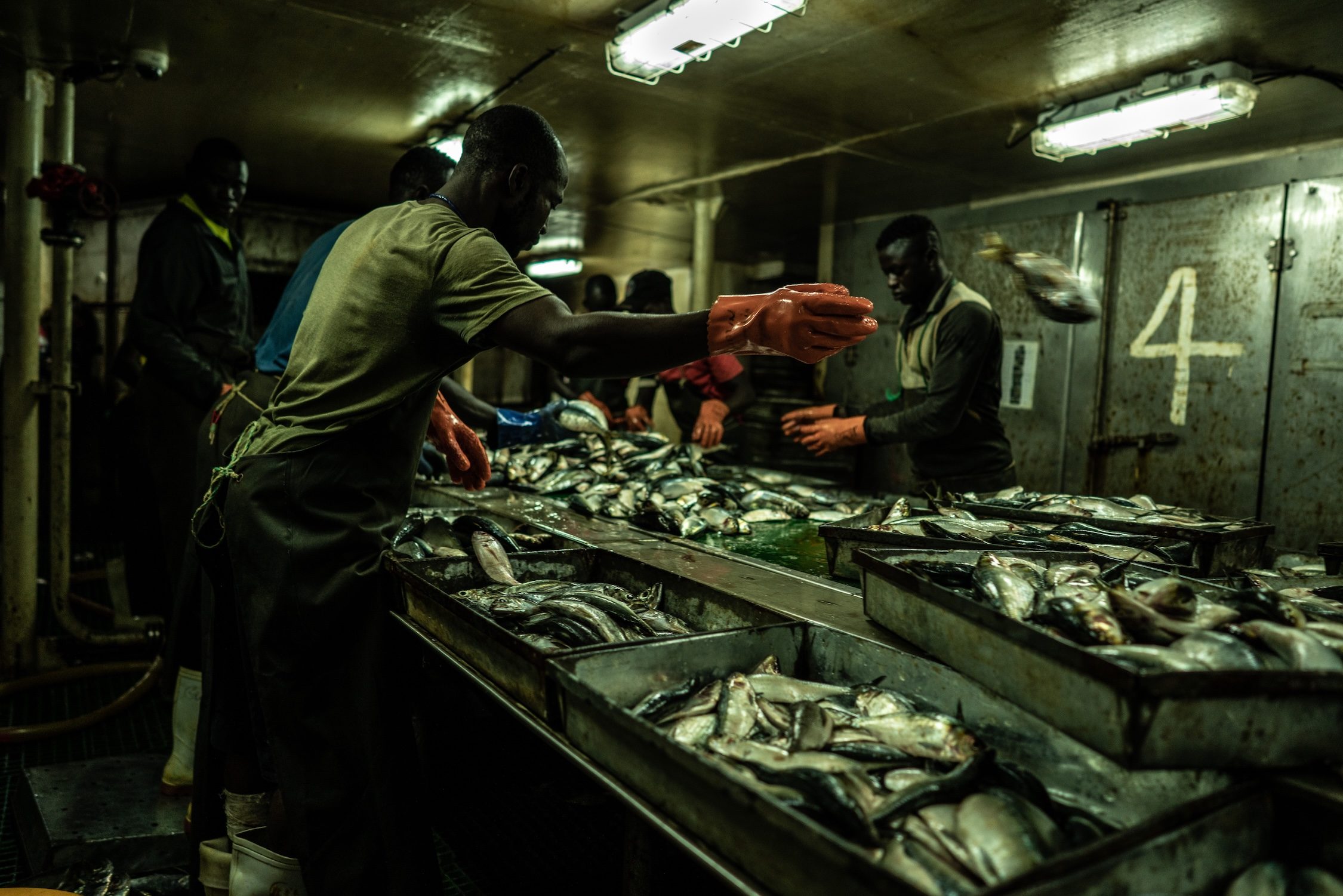
PART 1 | Food for feed: The price paid beyond the plate An archipelago nation consisting of more than 7,000 islands, the Philippines has at least 22,000 miles of coastline and a fishing fleet of roughly 5,000 commercial fishing vessels. Seafood — especially wild-caught, more than farm-raised — is the most popular form of animal protein, above chicken, beef, and pork. Small species like sardines and scad have always been staples in poorer Filipino households. In the past few decades, however, overfishing and climate change have made these fish less accessible, and Philippine seafood companies have aimed to reroute seafood for export rather than domestic consumption. Experts say this is cause for concern because the need for more affordable sources of protein has never been greater. By 2050, the Philippines’ population is projected to reach at least 150 million, increasing demand for fish by more than 1.6 million tons annually, according to a 2023 study in The Philippine Journal of Fisheries. Many of the fishers who supply the country’s fishmeal plants work in exploitative arrangements. The majority of the crew on tuna handliners and purse seiners in the Philippines, for example, worked under some form of debt bondage to pay back cash loans or advances, according to a study by Safe Seas. Companies avoided minimum wage laws by hiring fishers as contractors rather than employees, or changed their flags, meaning that Philippine laws no longer applied. They then illegally dismissed and blacklisted fishers who attempted to unionize. Fishers were among the most impoverished groups in Mindanao as of 2022, and their families experience high rates of childhood malnutrition, according to a study by Mrag Asia Pacific. Many fishers based on the island were locked into unfair profit-sharing schemes with ship owners and only retained a fifth of the profits for the fish they landed. The compensation did not account for the level of risk they faced; globally, fishing is ranked as the deadliest profession, with more than 100,000 fatalities annually. Crew members supplying the fishmeal industry in Zamboanga lacked formal training in occupational safety and health, telling inspectors that they learned their first aid skills from online videos, according to a 2023 paper by the Institute for Labor Studies. When they needed to be taken to shore for formal treatment, workers said they paid for the medical expenses by taking cash advances from their employers, leaving them with up to $1,700 worth of debt. Climate change and overfishing, among other factors, have led to a decline in fish stocks in the waters near the Philippines, worsening matters further for workers in the fishing and seafood processing industries. Indian mackerel, one of the species targeted for fishmeal, was first declared overfished in the Philippines by a 2020 study in the International Journal of Fisheries and Aquatic Research, which found the fish had been caught at a rate exceeding their capacity to reproduce. In some areas, fishers have also observed a decline in tuna catches. The depletion of this species in nearshore waters forced General Santos fishers farther from shore to find rich fishing grounds and turn a profit, exposing them to harsher conditions, longer working hours, and maritime conflicts, according to the Safe Seas study. The fishers’ boats were often not equipped for long voyages at sea and lacked any supplies for medical emergencies. The rising costs of diesel also took up a significant portion of the workers’ monthly earnings. Sustainability checks In the Philippines and elsewhere, many seafood companies have turned to certification programs to show customers that they take labor rights and environmental sustainability seriously. Critics question the validity of these programs. As the production of seafood has grown more globalized, its supply chains have stretched longer, and it has become tougher for consumers to know whether it was harvested sustainably or legally. Most grocers who sell seafood are in the dark as well because tracking is difficult and costly. Robert Stumberg, professor at Georgetown Law and supply chain expert, said this is partly because grocers typically buy from wholesalers and rarely track their suppliers. He said that the other reason may be plausible deniability, adding “Companies can escape blame or the need to fix problems if they’re unaware of them.” Where government regulators have proven lacking in ensuring that supply chains are free from unsustainable, illegal, or unethical practices, industry-led certification programs have sought to fill the gap. Critics say these programs serve more as a sustainability smokescreen, giving downstream customers a way to avoid looking deeper into their supply chains. The programs generally focus on environmental crimes, while mostly overlooking labor abuses on ships. Allie Brudney, a senior staff attorney at the strategic litigation nonprofit group Corporate Accountability Lab, said that on land — at processing plants or on farms — certification programs rarely conduct true spot checks to authenticate the reassurances given by managers at the factories. Instead, the programs frequently alert companies before inspectors show up, which gives them a chance to clean up the scene so there are no violations. PROCESSING. A fish processing plant in the far east of Russia in 2024. Photo courtesy of Federal Agency for Fisheries At sea, these programs also often rely on self-reported information from ship captains rather than having auditors directly visit and check conditions offshore on vessels, where crimes are most common. Devan Meserve, a spokesperson for the Global Seafood Alliance, which runs a program called Best Aquaculture Practices, said that her organization represents the “most comprehensive program for farmed seafood,” partly because it covers the “entire aquaculture production chain.” Protecting workers on the fishing vessels that supply feed mills is, however, an “immense challenge,” she noted, because audits occur strictly at port and do not witness harvest conditions. Meserve added that her organization helps the industry counter illegal and overfishing by requiring feed mills to source most of the fish they use in fishmeal or fish oil from fisheries accredited by certification programs like MarinTrust and Marine Stewardship Council. Assessing marketing claims Partly bolstered by these certification programs, seafood companies routinely make marketing claims about the ethics and sustainability of their seafood. Often, these claims fail to reckon with crimes or social concerns further up their supply chains, including on the ships or plants that produce the feed for the fish farms. This disconnect is creating growing legal risk for seafood companies and grocers. Since 2020, at least nine lawsuits alleging false advertising have been brought against six seafood companies across six US jurisdictions. The legal complaints focused on a common pattern: marketing claims that portrayed products as sustainable or ethically sourced, paired with supply-chain evidence that suggested otherwise. Plaintiffs challenged language such as “sustainable,” “eco-friendly,” “all-natural,” “wild-caught,” and “from the coast of Maine,” as well as claims of superior worker-safety standards. In at least four cases, the use of fishmeal or fish oil and their link to industrial fishing and ecosystem depletion were central to arguments that the products were not environmentally sustainable. Additional allegations included forced labor on fishing vessels and reliance on harmful pesticides and antibiotics. During this same period, seafood companies have paid more than $2 million in settlement fees to resolve false-advertising cases. The Outlaw Ocean Project investigation assessed more than 800 seafood companies that made marketing claims comparable to — or stronger than — those cited in the lawsuits and found that over half of the companies had documented crimes or concerns within their supply chains. Dana Cleaveley, a research consultant formerly with SeaChoice, a Canadian sustainable seafood group, said that many industries have already had to begin reckoning with the human rights and environmental abuses buried in their supply chains. She cited sweatshop garments, blood diamonds, and fair-trade coffee as examples. Seafood has been slower to face that kind of scrutiny. But as the world searches for more protein and leans further into aquaculture, that may change, Cleaveley said, particularly if more governments begin restricting imports tied to illegality or unsustainable practices. She added, “That’s when investors will begin to see material — not just reputational — risk, and companies will have to adjust.” Gaps in fisheries management Meanwhile, problems persist. The pressure to turn a profit has led to illegal fishing by Philippine vessels. These boats caught at least 500,000 tons of fish per year by using banned fishing techniques or illegally entering other countries’ waters or other prohibited zones, according to the US Agency for International Development in 2024. Philippine handline fishers traveled as far as Indonesia, Papua New Guinea, Fiji, Palau, and Australia for better fishing grounds, risking arrest by foreign governments. Thousands of fishers also poached from the Philippines’ municipal waters, including on the coast of Mindanao. Because local governments lack the funding to police municipal waters, “compliance is essentially voluntary,” according to a Food and Agriculture Organization (FAO) study. The government in the Philippines has taken steps to better control the industry and police its waters. Since 2011, it has imposed a closed season on sardine fishing in Zamboanga to protect the population of the stock, as well as the livelihoods of those who depend on the industry of catching and processing the small fish. Every year, between December and March, industrial sardine fishing around the Zamboanga peninsula is closed. Some fisheries experts have applauded the closed season policy as a success. It has helped preserve the stock with minimal impact on working hours or jobs among processing workers, according to a 2020 study by University of the Philippines Los Baños. This was partly because the government prevented the loss of income by providing workers with loans to support them through the off-seasons. “More large-sized fish have been observed recently, which implies recovery of fish stock from intensive exploitation,” found the study. But the FAO classified sardine stocks in the Sulu Sea off the coast of Zamboanga as overfished one year later. Researchers warned that sardine stocks in other areas of the country were likely in a similar situation and pointed to “a lack of political will to enforce laws, and a lack of coordination” among municipalities, leading to gaps in the management of the fishery. To support impoverished fishers while also protecting the oceans, the Philippine government has created opportunities for them to enter the aquaculture business. During a “blue economy” roundtable that brought together a variety of seafood workers in April 2025 to discuss the future of the industry, Roberto de Ocampo, former finance chief of the Philippines, emphasized that sustainable aquaculture could “give fisherfolk alternative sources of income while reducing pressure on wild fish populations.” But any proposals to expand milkfish or tilapia aquaculture in the Philippines face an obvious challenge. “It is mathematically impossible to provide enough fishmeal for the aquaculture industry,” said feed mill executive Norberto Chingcuanco in 2022. Unless the Philippines scales up its own fishmeal industry or imports more from countries where the business is tied to a slew of hidden costs, it will struggle to meet growing demand for food and employment through aquaculture alone. – Rappler.com The reporting for this story was part of a larger investigation conducted by an international team of journalists based at The Outlaw Ocean Project.
Food for feed: Fish farming and the struggle to police seafood supply chains
Full Article
Original Source
Read the full article at Rappler →KhanList aggregates and links to publicly available news content. We do not host full articles from third-party sources. Always verify important information with original sources.