
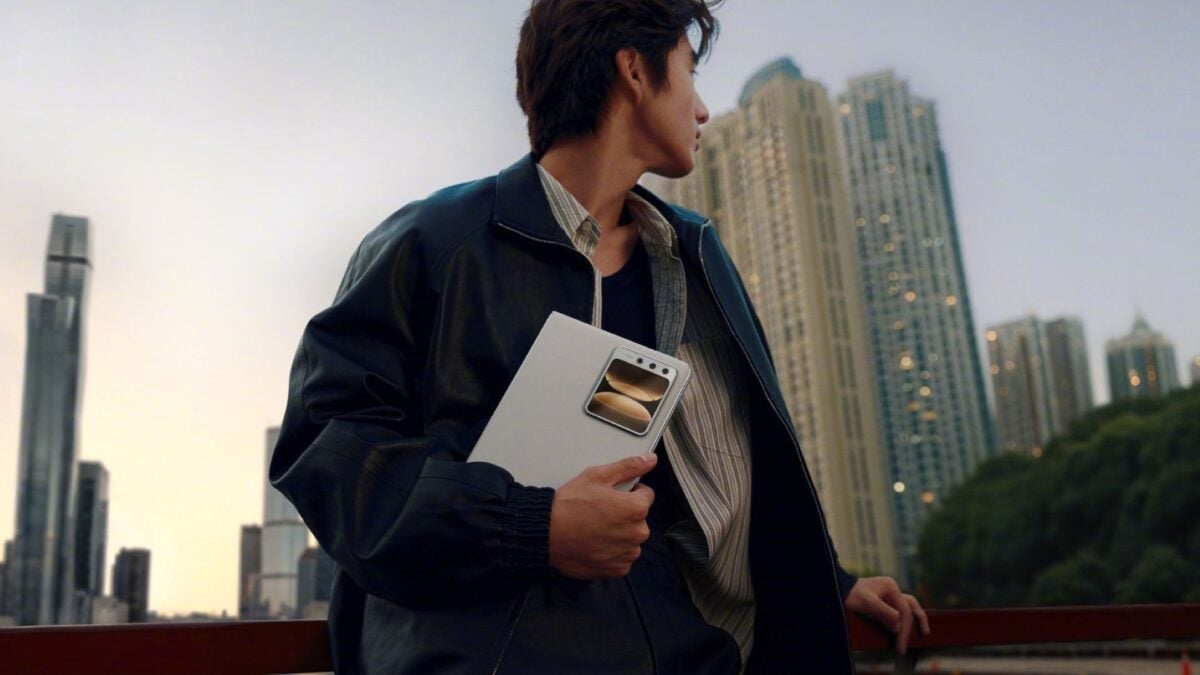
Sure, Apple finally caved on creating a foldable phone, but how long do we have to wait for the biggest players in tech to start thinking about new laptop form factors, such as ones with squashable screens? China-centric tech giant Huawei is making concepts abandoned by the U.S. market, like folding laptops, and is offering more zany devices that the U.S. shouldn’t just ignore. You can see the whole teaser of this Huawei Matebook Fold S through the Chinese social media site Weibo. The folding laptop concept isn’t entirely new, but the way Huawei is pushing it certainly is. For one, it’s a relatively small 14.7-inch folding display, according to ITHome (read with machine translation). That means when folded up, it may appear more like a miniature 11-inch laptop on your desk. What’s more, the device has an exterior camera bump and screen that seems to crib its design directly from many Chinese-centric smartphones. © Huawei; screenshot by Gizmodo This 14.7-inch model is a miniaturized version of the 18-inch MateBook Fold the company launched earlier this year. That device was already incredibly thin at 7.3mm, so we expect the new MateBook Fold S to match it. What’s more, Huawei doesn’t describe either the MateBook Fold or MateBook Fold S as a folding tablet. This is a laptop, even if the only way you’re incentivized to use it is with a virtual keyboard or stylus. You’ll just have to keep that travel keyboard in your bag for those moments you need something more than a touchscreen. Is it actually usable in your day-to-day? Who knows. Multiple other companies have tried to bring folding laptops to the U.S. with mixed results. Lenovo quietly abandoned its ThinkBook X1 Fold 16 to the bad idea pile, while HP’s Spectre Fold was an awkward laptop that didn’t do the job of a laptop or tablet all that well. Laptop makers have had more success with concepts like the rolling screen on the ThinkBook Plus Gen 6 Rollable and the hinged screen concept of the Asus Zenbook Duo. But those drab and boring laptop designs aren’t the statement pieces like the MateBook Fold S will be, especially with its two-tone design. The company plans to share the full details on its next laptop on Nov. 14. © Huawei; screenshot by Gizmodo What I want to know is whether its actually possible to create a full laptop experience without a physical keyboard. Huawei, one of those companies that pushes many strange concept laptops you will not find in the U.S., doesn’t tend to play by Western conventions. It has also crafted ultra-thin laptops that have a Samsung Galaxy S26 Ultra-esque privacy display. Somehow, the MateBook Pro S isn’t the company’s wildest design in its portfolio. These devices use HarmonyOS, a Linux-based operating system distinct from the Windows PCs you’re used to. Only a few months ago, I was trying to wrap my head around the fellow Chinese tech monolith Alibaba’s QwenBook. That’s an AI-forward laptop that proposes you’ll give up all your local compute potential to let AI handle all your needs across any operating system as a kind of all-in-one virtual machine. We’ll have to wait and see what kinds of concepts the world’s biggest players bring to CES 2027 in January. Let’s hope they’re willing to get wacky with it and—better yet—actually make them products we can buy.
Foldable ‘Laptops’ Are Getting Too Wacky for Apple to Ignore
Full Article
Original Source
Read the full article at Gizmodo →KhanList aggregates and links to publicly available news content. We do not host full articles from third-party sources. Always verify important information with original sources.