
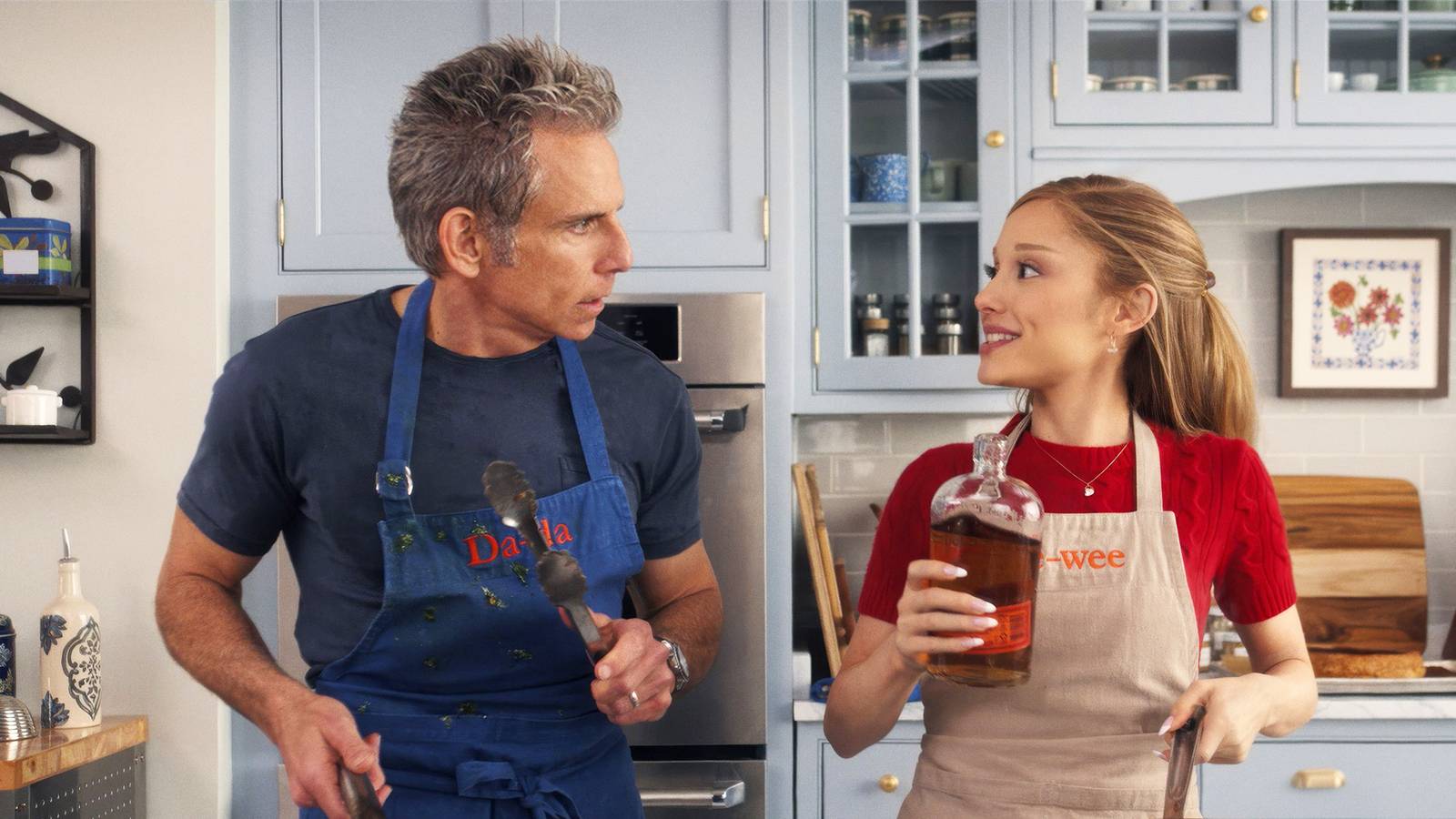
Published Nov 23, 2026, 4:33 PM EST Gabrielle Moss has been writing about pop culture for over a decade, for publications including The New Yorker, GQ.com, Slate, Bustle, New York Magazine, and many more. Her book, "Paperback Crush: The Totally Radical History of '80s and '90s Teen Fiction," was released in 2018, and she was featured in the 2023 documentary "Judy Blume Forever." We all either die a hero, or live long enough to see ourselves become the villain — even, it seems, Greg Focker (Ben Stiller), the human humiliation-magnet at the center of the Meet the Parents franchise. After three films that hinged largely on subjecting the good-hearted-but-inept Greg to comedic torments that fell somewhere on the spectrum between Charlie Brown to Wile E. Coyote, Focker-in-Law, the series' fourth volume, attempts to introduce a twist: it's now Focker, rather than his judgmental father-in-law, Jack Byrnes (Robert De Niro), whose devious plot to keep a young couple apart drives the film. It's a risk to make such a left turn in a well-established series, so one has to give credit to John Hamberg, who penned the three previous Meet the Parents films and tackles both writing and directing duties here, for taking it. A little more credit would be due if it worked. But the film collapses under its competing impulses — it wants Greg to now be the horribly controlling parent who attempts to ruin his son Henry (Skyler Gisondo)'s relationship with his buttoned-up girlfriend Olivia (Ariana Grande), but it also still wants us to like him. It briefly seems like it might want Olivia to deserve Greg's ire, before backing off and making her kind and likable. Perhaps most confusingly, it wants Greg to take on the role of meddling manipulator, while still torturing him like a living cartoon — within the first hour or so, we see him almost choke to death on gristly beef, burn himself in a cook-off, and accidentally defile the corpse of the beloved Byrnes family cat, all while still scheming to drive a wedge between Henry and Olivia. This isn't to say Focker-in-Law is free of laughs; it has a few very good bits, most of which pop up after Greg's eternal rival Kevin (Owen Wilson) shows up on the scene. But because the movie can't decide if Greg Focker is good or bad, but wants us to love him anyway, Stiller and Grande never generate the joyful friction that Stiller and DeNiro produced in the original film. Instead, it only really takes off once it drops its pretensions of exploring new territory, and resigns itself to rehashing the series' greatest hits. What is 'Focker-in-Law' About? Image via Universal Pictures/Courtesy Everett Collection 16 years after Little Fockers, the series entry that saw Greg and wife Pam (Teri Polo) parenting fraternal twin toddlers, those twins are all grown up . . . kinda. Samantha (Beanie Feldstein) is now a failure-to-launch slacker who not only still lives at home, but has also brought her equally helpless boyfriend Eduardo (a scene-stealing Eduardo Franco) to the Focker homestead, where both are enabled by Greg's constant babying (one early gag sees him still packing Samantha's luggage). But Henry (Gisondo) has pursued a more adult life, moving away from the Fockers' hometown of Chicago and attending medical school in California, where he met Grande's Olivia. When the group convenes at the Byrnes family home in New York to celebrate patriarch Jack's birthday, Greg learns that Henry has dropped a previous plan to conduct his medical internship back in Chicago; instead, he'll stay in California to further develop his life with Olivia, an FBI hostage negotiator-turned-life coach whose severe, by-the-books personality echoes ex-CIA agent Jack's. When he realizes that Henry intends to propose to Olivia, Greg unfurls a plan to undermine their relationship, which, naturally, leads to Greg engaging in humiliating acts that run the gamut from injuring himself on a bike ride, to serenading Jack with John Legend's "All of Me," to once again running afoul of airport security (a running joke in the films). Is Olivia actually a threat — an icy control freak who could be manipulating Henry, as a few odd moments in the film subtly suggest? Or is Greg just a smothering, off-putting father who can't accept that part of being a parent is allowing your children to grow up, as many, many more moments in the film suggest? Focker-in-Law doesn't drag too much tension out of this question, or of whether Olivia will eventually become an accepted member of the Focker clan. Instead, it backburners these issues for most of its second half, leaning more into jokier bits that almost distract from the weirdness of Greg's mission . . .almost. 'Focker-in-Law' Tweaks the Recipe Without Understanding the Ingredients The Meet the Parents series is built on a simple, endlessly repeatable conflict: the mean uptight guy hates the sweet goofy guy; the sweet goofy guy tries and fails to impress the mean uptight guy. Much like a Looney Tunes bit or a classic slasher franchise, it can undergo various mutations (now there's three goofy people! Now there are some babies!) without any changes to its essential dynamics. Focker-in-Law disrupts the formula, replacing it with something more complex and confusing: the goofy guy, now not-so-sweet, hates the uptight lady . . .wait, why does he hate the uptight lady? Is the goofy guy some kind of weirdo? The film is, essentially, Meet the Parents from the De Niro character's point of view, and therein lies its fatal flaw: Jack Byrnes is supposed to be unrelatable. He had the good fortune to be played by Robert De Niro, the greatest practitioner of sympathetic villains that the big screen has ever known. But he is a controlling, judgmental monster. Greg, meanwhile, serves as the audience surrogate, his terror and desperation offering a heightened version of how vulnerable and idiotic any of us have felt trying to impress the family of a person we love. Rolling both of those parts into a single character creates a mess: we're supposed to relate to Greg . . .but who could relate to running around, trying to passive-aggressively ruin your adult son's seemingly very happy relationship? Yet since we've spent three movies investing in him, fully making him the villain doesn't work, either. We're left with a half-baked mix that sometimes tries to get us to see things from Greg's point of view (which is essentially impossible, because his point of view is absurd), and other times makes him simply a villain with no real motivation except an inability to quit helicopter parenting a 26-year-old. The situation is made messier by the fact that the woman he's trying to run off is, well, Ariana Grande. The pop star has a seemingly irrepressible level of charm, interrupted only by a brief and strange sequence in which she uses FBI interrogation tactics to shake down a party store employee. The moment is supposed to nudge us a bit to Greg's side, but given that nothing like it ever happens again in the entire film, its hint that there's a secret dark side to Olivia goes nowhere. A bolder film would have taken a stronger stance, giving Olivia a genuinely difficult personality — or making Olivia perfect and making the entire issue entirely Greg's problem. Grande is funny; she's done great work hosting SNL, and deserved her Oscar nod for Wicked. But Focker-in-Law's attempt to play both sides sucks a lot of the comedic momentum out of her comedic antagonism with Stiller. What comedic momentum there is belongs to Owen Wilson's Kevin, who revives the film after a lackluster first half. When the action transplants to Kevin's multi-millionaire compound — now also inhabited by two eerily perfect children he is single-parenting — it feels like a weight is lifted off the film's shoulders. Wilson is in peak form, with his expertly relaxed presence helping loosen up the entire film. His every moment on screen makes Kevin such an absurd joy — why is he studying Judaism? Why did he decide to have children on his own with a surrogate? The sheer silliness of his bits, and his absolute commitment to them, is the strongest reminder of why this series was once such a sensation. Wilson has just enough screen time — something that cannot be said about Gisondo, one of the most talented comedic actors of his generation, who is a minimal presence despite being the ostensible focus of the plot. Feldstein and Franco are also only briefly in the film, though its funniest moment arrives via Franco's time hooked up to the series' infamous lie detector. Speaking of people with a minimal presence in the film: Robert De Niro, the man whose deadpan villainy made the franchise, only pops up periodically. Which is understandable — the man is 83 years old! We should be letting him nap until the next time Scorsese needs him! But Focker-in-Law truly suffers for it. While the pair weren't quite Gene Wilder and Richard Pryor — or even Jay and Silent Bob, for that matter — these films were built on Stiller and De Niro's chemistry. Without it, even this very talented group of people can't salvage things. To borrow from the franchise's most famous joke, there's just not much left to milk here. Focker-In-Law Release Date November 25, 2026 Runtime 105 Minutes Director John Hamburg Writers John Hamburg Pros & Cons Owen Wilson is in peak comedic form. A few moments harken back to the silliness that made the original films fun. An extremely talented supporting cast makes the most of their moments on screen. The script is muddled, giving characters unclear personalities and hazy motivation. Stiller's character's transformation from kindhearted dork to unnerving helicopter dad is off-putting.
'Focker-in-Law' Review: Meet the New Focker, Same As the Old Focker
Full Article
Original Source
Read the full article at Collider →KhanList aggregates and links to publicly available news content. We do not host full articles from third-party sources. Always verify important information with original sources.