
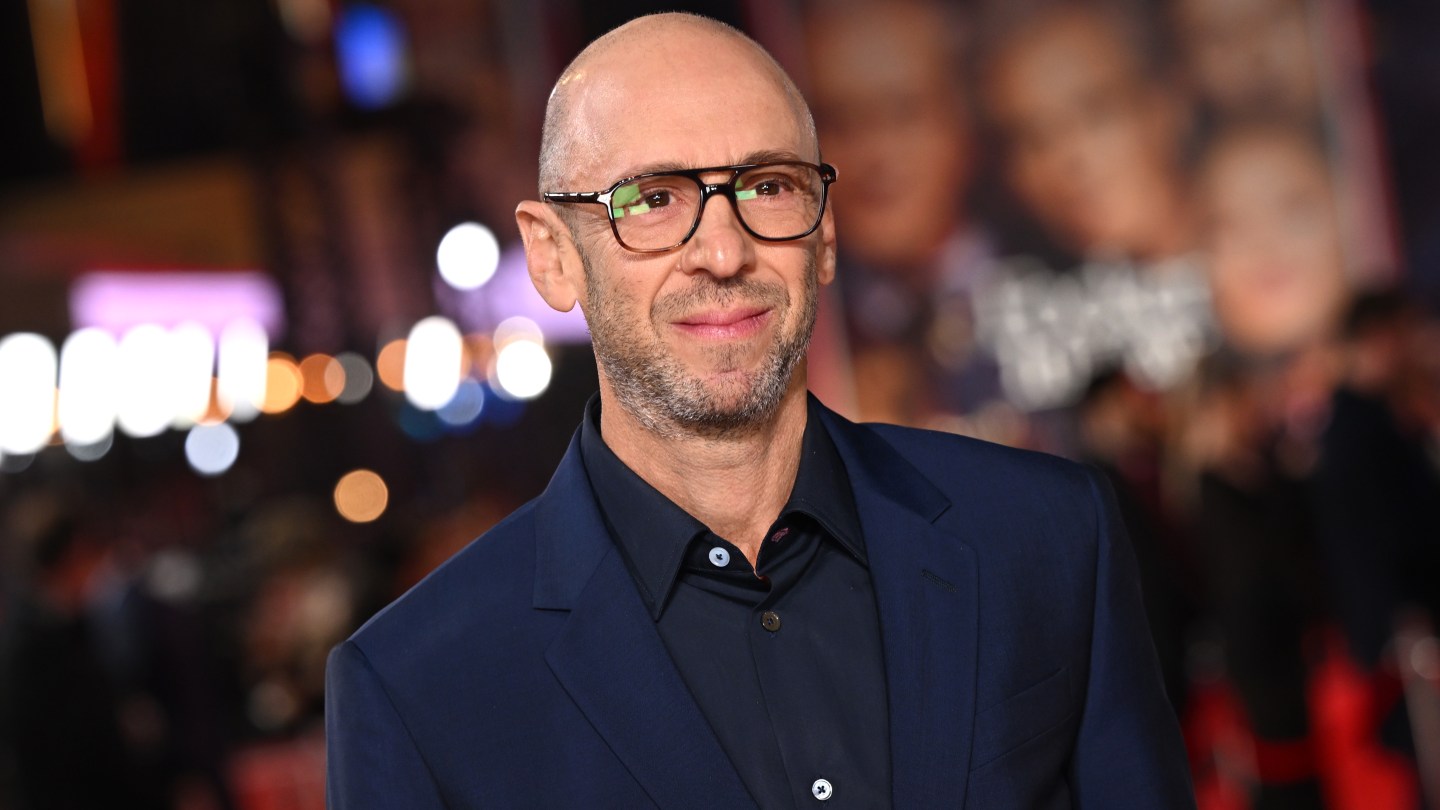
It’s been 26 years since Universal Pictures introduced Greg Focker to his girlfriend Pam’s parents, Jack and Dina Byrnes, and audiences responded in kind — to the tune of $330 million worldwide. A franchise was born that year, and it has since produced 2004’s Meet the Fockers, 2010’s Little Fockers and the latest, Focker-in-Law, due in theaters Wednesday ahead of the Thanksgiving holiday. John Hamburg, who has been with the franchise since the beginning as a writer (and later as a producer), jumped into the director’s chair on Focker-in-Law to direct a cast that includes returnees Ben Stiller, Robert De Niro, Teri Polo, Blythe Danner and Owen Wilson with new additions Ariana Grande, Skyler Gisondo, Beanie Feldstein and Eduardo Franco. The Hollywood Reporter caught up recently with Hamburg on Zoom to talk about landing a global pop superstar for the cast, his writing process and who makes Stiller laugh the hardest on set. In 2020, you spoke with one of my colleagues who asked about the possibility of another movie. At the time you said, “I’ll refrain from answering, but I love everyone involved, we’re all still in touch, and that’s all I’m going to say.” An obvious follow-up: What happened? I’m still asking myself that question. The core group has been making these movies for 26 years, and we check in from time to time. We only wanted to revisit these characters we love so much if we had a story we needed to tell. It wasn’t worth doing for the sake of it. Then we had a nugget: Ben Stiller is roughly the same age Robert De Niro was when we made the first movie, which is insane, but it gave us a way in. The first movie had an organic setup many people can relate to [bringing a significant other home to meet your parents], and it lead perfectly into the second. You met one set of parents, now it was time to meet the second set of in-laws. I don’t think we had that clean of an idea for the third movie, which is maybe it was not quite as strong as the first two. For this movie, we looked inward and came to the conclusion that we wanted to get back to the simplicity of the original Meet the Parents. We had themes and ideas that we liked but it wasn’t until we created the Olivia Jones character that everything came together. Were you coming up with ideas and then taking it to the team, or brainstorming during meetings? We did a little development when I was only producing. Once I came on as a writer, I explored different directions and we met over Zoom with the team — Ben, De Niro, Jane Rosenthal, Jay Roach and John Lesher — to talk things through. Then I went off into to a dark room to figure it out. I had the idea that Greg Focker’s nemesis could be his son’s girlfriend: a powerful, complex, formidable woman who is the opposite of Greg in every way he was 30 years ago. That felt compelling. I pitched to Jay Roach early on and asked what he thought. In our conversations, Jay suggested different jobs she could have. I think that’s how we landed on the idea of her being a hostage negotiator. That clicked for me because suddenly I saw the central conflict: She thinks Greg is holding his son emotionally hostage by being such an overly involved parent.I got excited and pitched the team again. They liked it. I wrote a treatment of about 20 pages, telling the story and coming up with the pieces. After that, I had to fill everything in: Where is De Niro in his life? Who is Samantha, Beanie Feldstein’s character? Who is Henry, his son? But it all started with that idea. Hamburg on the set of Focker-in-Law. Atsushi Nishijima/Universal Pictures and Paramount Pictures I’m curious about your “dark room” strategy and how it’s changed over the years. When you need to lock yourself away and be productive, what does that look like for you? I write in 25-minute increments. There’s a productivity technique called the Pomodoro Technique. You shut everything off for 25 minutes and focus completely, then take a five-minute break and do the next one. If I get six of those in a day, I can be pretty productive. When I was rewriting the script during pre-production, I did 13 or 14 Pomodoros a day. There’s also a lot of hand-wringing and walking around my neighborhood. There are tears and moments when I think, “I can’t figure this story out. I don’t know what to do.” It was challenging. Once I got the Olivia Jones character, the rest flowed quite smoothly. Did you write with anyone in mind? At what point did Ariana Grande come into the mix? If people are attached, I write with them in mind. I knew I was writing for Ben Stiller, Robert De Niro, Owen Wilson, Blythe Danner, Teri Polo and the others. But when I’m writing a script or early drafts, I usually want to make the characters real to me first. It’s almost like a police sketch of different people. I knew the energy and vibe, but wasn’t sure who would play the roles. Once I finished and put on my director’s hat, I started thinking about who it could be. We landed on Ariana and said, “That’s it. She has to be the one.” I just hoped she would say yes because she was the only person I could think of, for a variety of reasons. There are many wonderful actresses, but Ariana is such a force. The fact that she hasn’t been in a million movies makes her almost mysterious, which appealed to me. I’d watch her on Saturday Night Live and marvel at her incredible comic timing and think, “She’s hilarious. She gets it.” I also liked that she could be surprising. She has a twinkle in her eye and isn’t physically imposing, but the idea of someone who looks like Ariana Grande completely destroying Ben Stiller felt like a conflict we could really exploit. Greg Focker (Stiller) and Olivia Jones (Grande) in Focker-In-Law Universal and Paramount She pulls it off amazingly well. What was it like to direct her? She’s unbelievably smart, had a great handle on the character and pushed me to do more and try different things. As a writer, that’s what you want: someone who will challenge you and push you in the best ways, always in service of the story and character. She certainly did that. It’s hard to believe she’s been in so few movies because she’s so skilled and has such a big toolbox. She can dial it up or down and give me so many different levels. That’s great as a director: In the editing room, you can craft the performance and dial it up or down. She announced that she was stepping away from public life. How did you respond to that news? I love Ariana and have so much affection for her as a human being. When I heard the news, I also heard she was going to support the movie. We talk, and I know she loves it. I want whatever’s best for her. At the end of the day, this is a business about human beings, and I adore her. I got to see her in concert in London this summer. It was moving to watch how her audience responds to her. She’s so powerful and gives so much. I thought, “My God, I can’t imagine what it’s like to give so much of yourself night after night.” The key thing is that she said yes to the movie, and I know she’ll support it in whatever way feels right to her. I got the chance to interview Skyler Gisondo for his recent Bonobos campaign and he told me that while he was shooting your movie with Ben Stiller, he didn’t realize until he was on set how much he had borrowed from Ben during their first collaboration on The Night at the Museum franchise. What was it like to direct Ben and Skyler together? It was amazing. Skyler is one of those actors I’ve wanted to work with. You see someone like him in his movies, whether it’s Booksmart or Licorice Pizza, and think, “I’ve got to work with that guy.” I really liked the idea of Skyler as Henry Focker. I didn’t think it was a problem that he’d played Ben’s son before becuase it had been so long. I thought they’d have a shorthand, and they fell into it so quickly and were perfect. They both work hard and want to try different things. They push themselves to find nuance in the characters. I definitely saw Ben’s influence on Skyler. I could tell Skyler wasn’t just on set; he’d been taking it all in like a sponge. When you have someone like Ben Stiller — unbelievably funny and smart, and one of the hardest workers — that’s a great person to learn from. A lot of the movie’s heart comes from the father-son relationship. There’s a really sweet moment between them at the end, and their real-life affection and long connection helped. Jack Byrnes (De Niro), Pam Focker (Polo), Henry Focker (Gisondo), Samantha Focker (Feldstein), Olivia Jones (Grande) and Eduardo Villalobos (Franco) in Focker-in-Law. Universal and Paramount You’ve worked with Ben Stiller for years. When you’re on set, what’s the rhythm like? One of the great things about our long relationship is that it’s a real collaboration — a back-and-forth, a push-pull. He can pitch me things, and I can pitch him things. It’s always about the character, the story and making it better. One thing I learned from Ben very early on, probably when we were working on Zoolander a thousand years ago, is never to settle. Keep pushing and trying things because they can always evolve and get a little better. He still has that ethos today. Stiller, De Niro and Hamburg at a Berlin photocall at Soho House Berlin on Nov. 17, 2026. (Photo by Sebastian Reuter/Getty Images for Paramount) What about De Niro? Directing Bob was truly one of the great joys of this experience. I’d directed Ben before and collaborated with him on many projects. I’d known Bob for years, primarily as a writer on the Meet the Parents movies. I’d helped him on a couple of other movies, uncredited, and was a writer-producer on the third one. But to direct him was a joy. He’s Robert De Niro; his talent and filmography are second to none. What inspired me was that, at 82, he still had so much passion and enthusiasm. He’d call me late at night to pitch ideas, or share ideas constantly by email or text: “What about this for this scene?” How incredible is that? He has great instincts for Jack Burns and for how to humanize him. You’ve also worked closely with Owen Wilson, who makes a fun return in this movie. Can you talk a bit about writing those scenes and working Owen? I love Owen so much. I had the best time directing him in Stick. There’s no one like him: He has such a unique rhythm in the way he speaks and moves through life. It’s so much fun to write a character who can say the most absurd things with a smile and no self-awareness. I can’t have every character lack self-awareness, but Owen can parachute into the movie for a stretch and play that kind of character.In this movie, I thought about where he’d be in life. He has twins and thinks he’s parenting them one-on-one, with no help, while there’s an army of nannies and caretakers everywhere. In his mind, he doesn’t believe he has any help; he’s raising the kids by himself. It’s so much fun to write. One of the other great joys is that no one makes Ben laugh like Owen Wilson. They’re so different, so close, and have made so many great movies together, but they live life as total opposites. Owen cracks Ben up; he just has his number. It’s so much fun to watch them enjoy each other’s company between takes. When the camera’s rolling, there’s a tension that’s fun to film and explore. Hamburg, Jennifer Aniston and Stiller at the L.A. premiere of Along Came Polly on Jan. 12, 2004. (Photo by Kevin Winter/Getty Images) What was the most challenging nut to crack? It started with figuring out who Greg Focker’s adversary would be, which I’ve touched on. But the most challenging scene was probably the bike race. In my early drafts, it was on a tennis court, and that didn’t work for a variety of reasons. I also knew Ben was into the Tour de France and cycled himself, so I thought he might like it. A director friend who read it said, “Why’d you do a bike scene? They’re so hard to shoot.” It was a nightmare, but we had the right team in place, and it went smoothly. Set pieces can’t be there just for their own sake; they have to be about character and the tension between the characters. I had to figure out the setting and the sport. The Meet the Parents movies have a tradition of a sport going wrong — pool volleyball in the first movie, football in the second — so I knew I’d have a sports scene. I just didn’t land on it until later in the process. In an interview, Barbra Streisand revealed that she was still upset over her salary for the Fockers. Were you close to getting her for this movie, or were there conversations? Barbra and Dustin are such a part of the Fockerverse, and I’m grateful every day that they were in those two movies. With this movie, I really wanted to return to the simplicity of the original Meet the Parents. Sequels can get bigger, with more and more characters, so I set this movie in the Burns family home, where the original took place, and tried to keep it contained. I love Dustin and Barbra. We did talk about it, of course, because they’re part of our Focker family. But with so many new characters in this generation, it ultimately felt right to focus on the characters we ended up with. People keep talking about the challenging landscape for feature film comedies in theaters. How hard is it to be a comedy writer and filmmaker in the business right now? Do you feel the pressure? When these movies are made well, there’s nothing better than sitting with 400 people who are all laughing and cringing. That’s why I got into this business: I loved going to the movies and laughing my butt off. I mourned the fact that comedies disappeared from studio film slates and theaters. They moved to streaming, which is great, but it’s not quite the same for a movie like this. That also sets up all the different ways people will see the movie later. I’m hopeful. I just wrote and directed a movie that’s being released in theaters, so of course I have some skin in the game. But I do think people are realizing that we need to be together. Watching things alone at home or on our phones is great for some things, but it isn’t everything. I’m optimistic this genre can come back. As for pressure, my comedy-director friends are constantly asking, “How did the movie test? Is it good? Is this movie going to work?” I tell them it tested great. I don’t know how it will do, but I feel good about it. I do feel some pressure because I love this genre. It’s given me everything in my career, and I’m hopeful we can get back to a place where these movies are seen in theaters again. When was the last time you saw something and reached out to say, “God, that was funny,” or “I loved that”? Literally the other day. I saw an ad Ben Stiller did for his soda brand, Stiller Soda. He goes to Canter’s Deli, gets it wrong, and is dressed like he’s in the cast of Andrew Lloyd Webber’s Cats. It was hysterical. I texted him a crying-laughing emoji. It was pretty damn funny. And my God, the Nathan Fielder and Lance Oppenheim movie — the first half had me thinking, “Wow, there are big laughs in this. Huge laughs.” It’s so awkward, but it was really funny. I don’t know those guys, so I didn’t text them, but I’m a fan.
‘Focker-in-Law’ Filmmaker John Hamburg Talks Ariana Grande’s Comedic Timing and the Actor Who Made Ben Stiller Laugh Hardest on Set
Full Article
Original Source
Read the full article at Hollywoodreporter →KhanList aggregates and links to publicly available news content. We do not host full articles from third-party sources. Always verify important information with original sources.