
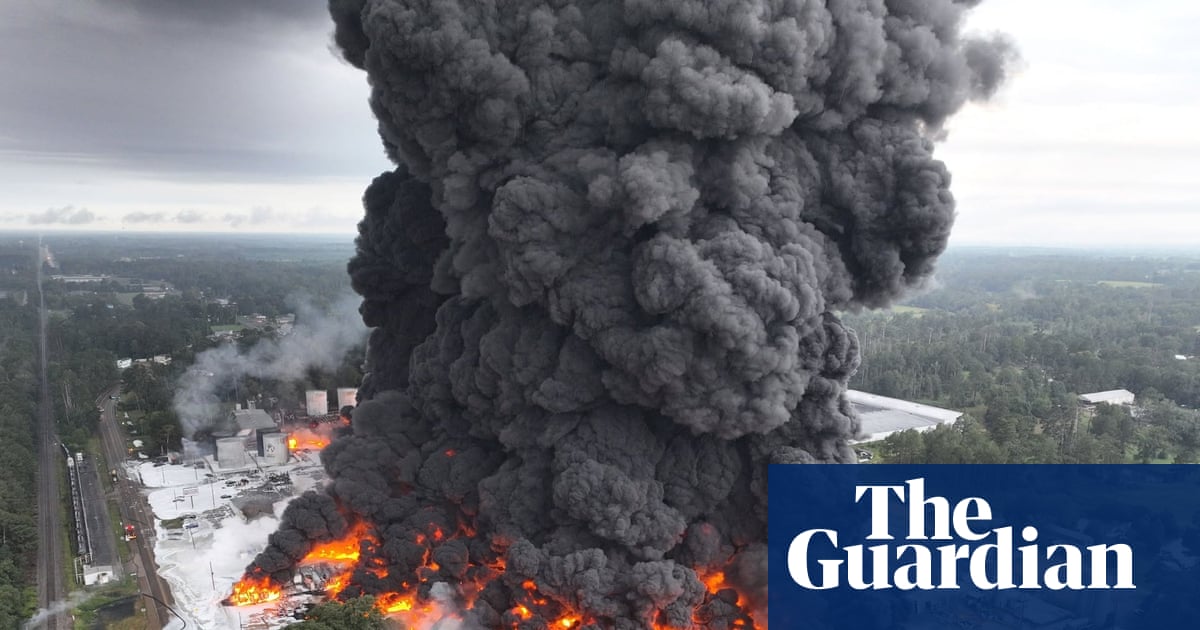
When an ammonia leak outside a hotel in Weatherford, Oklahoma, injured 74 people last November, the federal government’s chemical-detection plane stayed on the ground. It also sat idle during a March fire at a Valero refinery in Port Arthur, Texas, and when blasts at a Toledo, Ohio, recycling plant killed two workers in August.“Ten years ago, it would have gone to all of them,” said Mark Thomas, a former EPA official who managed the program for 18 years.Known as Aspect, the plane was designed for emergencies involving toxic chemicals, oil spills and radiation. For two decades, it flew over disasters from Hurricane Katrina to the Deepwater Horizon oil spill.But since early 2021, the single-engine Cessna has responded to just seven emergencies. Former Aspect scientists told the non-profit newsroom Floodlight that two of those missions – the 2023 East Palestine derailment and the 2025 Smitty’s Supply fire in Louisiana – were badly mismanaged.The EPA Aspect plane, designed to fly over chemical emergencies and quickly identify pollutants in the air. Three former program insiders told Floodlight the program has deteriorated to the point where it is now of little use. Photograph: Eric Vance/EPAAt Smitty’s, the EPA declared the air safe, but a former Aspect scientist later found toxic chemicals the agency had missed. At East Palestine, the EPA’s inspector general is now auditing the agency’s response to the derailment, including the data behind its public assurances about air quality.In June, the EPA inspector general found a more fundamental problem: the plane could no longer identify chemicals within minutes, as designed. Instead, the data had to be analyzed by hand, a process that takes about a week. That’s far too long to help anyone on the ground who’s deciding whether to evacuate.The EPA said the plane’s chemical sensors are wearing out and expects replacements to be working by mid-2027.But three people who helped build and run Aspect – Thomas, longtime Aspect scientist Robert Kroutil and former program manager Rick Turville - told Floodlight that the agency is fixing the wrong problem. They say the old sensors still work, but the EPA lost the expertise and initiative that made the program effective. They warn that replacement sensors could leave the agency even less capable of detecting hazardous chemicals.“I fear that the public is at risk,” said Kroutil. “It’s such an important program, and they’ve allowed it to waste away to nothing.”The EPA did not respond to Floodlight’s questions about the program’s decline, emergency responses or replacement sensors.The decline of a promising programAfter the September 11 2001, attacks, the Department of Defense transferred its airborne chemical sensing program to the EPA for use in civilian emergencies.Over its 25-year history, the plane has flown more than 80 emergency missions – an average of more than three a year.But during an EPA reorganization in 2019, the agency told Aspect staff they had to relocate to Texas, where the plane was based, or face termination, an internal EPA memo shows. Thomas retired rather than uproot his family. Other key staff left. One accepted a demotion to stay in Kansas.Kroutil and former colleagues said the EPA failed to replace them with scientists experienced in airborne chemical detection. Former managers said they once tracked emergencies and urged emergency response coordinators to deploy the plane; after they left, the EPA waited for coordinators to request it.In October, hundreds were evacuated – and more than 50 were treated at hospitals – when an industrial tank in Toledo leaked glycidyl methacrylate, a chemical used in making plastics that is a likely carcinogen suspected of causing genetic defects. It was one of at least 80 chemical emergencies this year that the plane did not respond to.Missed chancesWhen a Norfolk Southern freight train carrying vinyl chloride and other hazardous chemicals derailed in East Palestine on 3 February 2023, responders feared an explosion. They vented and burned five railcars of vinyl chloride, sending a toxic plume over the town.Aspect was not requested for more than two days and missed the vent-and-burn operation. When it finally flew over East Palestine on 7 February, Kroutil said, it collected just eight minutes of chemical data.The National Transportation Safety Board later said the vent-and-burn operation was unnecessary. An EPA office of inspector general investigation found the agency had poorly documented its procedures and had failed to adequately inform emergency responders of the plane’s capabilities.Portions of the Norfolk and Southern freight train that derailed in East Palestine, Ohio, in February 2023. Photograph: Gene J Puskar/APMore than 1,000 miles south, an explosion ripped through Smitty’s Supply in Roseland, Louisiana, on 22 August 2025. The fire burned for two weeks, prompting a one-mile evacuation. The EPA dispatched Aspect – its first emergency deployment in 19 months.Three miles away, Ronnie Polezcek and his family heard something hitting their roof. Outside, he said, “it was raining oil”. Residue covered the family’s farm. Polezcek said he burned his hay, moved his cows to Mississippi and replaced a metal roof that couldn’t be scrubbed clean. A veterinarian found arsenic in one cow after two miscarried.Nine days after the explosion, the EPA publicly posted its findings from the Aspect flights: ozone and three other air pollutants at levels far below those expected to cause health effects.But a later analysis of raw flight data told a different story.Kroutil said it took four weeks to analyze the data by hand, doing what the plane’s software was designed to do in minutes.He identified high concentrations of toluene, a neurotoxicant, and the carcinogens trichloroethylene and naphthalene. He concluded that the levels of toluene were so high they could have put nearby communities at risk.More than a year later, Polezcek said, residue still coats much of his property. When his grandchildren play outside, they return with “little black feet”.“What is it doing to them?” he asked.The wrong fix?After the inspector general findings about the Aspect program’s declining detection speed, the EPA bypassed competitive bidding to award Canadian company Telops a $1.7m contract for replacement sensors, procurement documents show. Integration is expected by early to mid-2027. Until then, the plane will likely remain unavailable for chemical emergencies.Three people formerly involved with Aspect told Floodlight that the new sensors will be less capable than the old ones at detecting hazardous chemicals during industrial emergencies.Telops’s parent company, Exosens, told Floodlight that the systems use fundamentally different technologies. It said its sensors can identify hundreds of chemicals with additional analysis, while imaging helps distinguish plumes from surrounding objects.Chris Manning, an independent spectrometer expert, said the new sensors could complement the old ones but would be a poor replacement. They are slower, less sensitive and less suited to moving targets, he said.Kroutil, Thomas and another former manager told Floodlight they doubt the new sensors will solve the problem.“Unless major changes are made at EPA and with the Aspect program, it is not going to get any better,” Kroutil said in an affidavit submitted to the Government Accountability Project, a nonprofit that advocates for whistleblowers. “And EPA will be flying blind.” This story is from Floodlight, a non-profit newsroom that investigates the powers stalling climate action. Sign up for Floodlight’s newsletter here
Flying blind: inside the decline of the EPA’s chemical-detection plane
Full Article
Original Source
Read the full article at Theguardian →KhanList aggregates and links to publicly available news content. We do not host full articles from third-party sources. Always verify important information with original sources.