
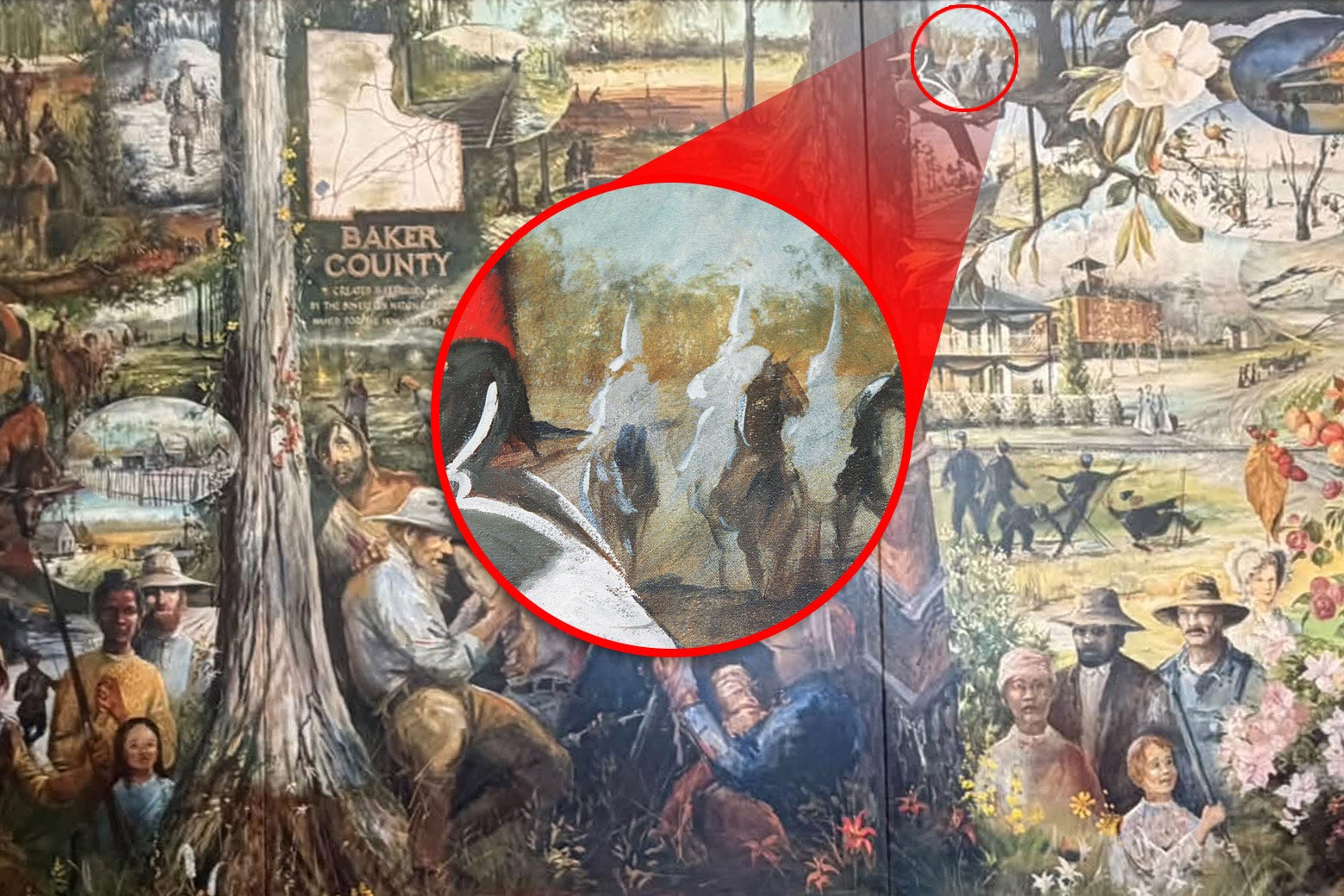
Jurisprudence The courthouse in Baker County still displays a mural with three Klansmen on horseback that commissioners had the chance to remove in 2020 and chose to keep. Photo illustration by Slate. Painting by Eugene Barber/Baker County Courthouse. Sign up for Executive Dysfunction, a newsletter that highlights one under-the-radar story each week about how Trump is changing the law—or how the law is pushing back. You’ll also receive updates on the latest from Slate’s Jurisprudence team. On Monday, Nov. 16, longtime friends Jamarian Byrd and Travis Roberts Jr. walked out of the Baker County Detention Center in Macclenny, Florida, a little before 10 p.m. For the first time in 17 months, they were able to hug their families and friends, who had spent the whole time fighting for their release. After six hours of deliberation, a Baker County jury had found them not guilty on six counts, including first-degree murder, aggravated battery, three counts of shooting into a dwelling, and discharging a firearm in public, each connected to the shooting that killed 19-year-old Devin “D.J.” Powers Jr. The not-guilty verdict vindicated the self-defense claim Byrd and Roberts made after the 2025 shooting. It also exposed a justice-distorting conspiracy by the Baker County Sheriff’s Office, Judge Denise Ferrero, and State Attorney Brian Kramer, who sought to falsely depict them as violent perpetrators in a deadly encounter instigated by Powers and his armed 14-year-old companion, Ayden Perkins. The trial exposed a manipulative and hypocritical legal regime designed to criminalize Black self-defense while exonerating racist aggression. At each step of the investigation, exculpatory evidence was discarded, ignored, or destroyed. Hospital staff disposed of Devin Powers’ bloody clothing before anyone thought to check his pockets for shell casings, the lack of which allowed the state attorney to claim “Devin Powers never fired his gun.” The bullet that actually killed Powers was never recovered. Perkins had time after the incident to go home, change his clothes, and dispose of his own firearm before investigators arrived. Neither Powers’ nor Perkins’ hands were swabbed for gun powder residue. The police conducted only a cursory search of Perkins’ home, accepting the firearm his caregiver handed over and failing to search for more. When deputies arrived, Perkins was caught on a body camera directing them to “go get the [N-words].” State crime lab analysts collected 52 shell casings at the scene. Forty-seven were matched to Byrd’s rifle and Roberts’ handgun. The remaining five came from a 9 mm handgun that was never identified, never matched to anyone, and never explained, a loose thread Baker County has had 17 months to investigate. In his closing arguments, Assistant State Attorney Ralph Yazdiya insisted, “It does not matter whose bullet killed Devin Powers.” Months before trial, Circuit Judge Denise Ferrero denied Byrd and Roberts access to “Stand Your Ground” immunity outright, in the same order where she acknowledged they had established a prima facie claim of self-defense. Her order found that Byrd and Roberts “outnumbered” Powers, without counting Perkins, who was standing beside Powers when the two approached Byrd and Roberts. What State Attorney Brian Kramer’s office took to trial was a theory built on that same denial. To convict Byrd and Roberts of premeditated murder, prosecutors had to prove the two men planned, in advance, to kill Powers. But Powers and Perkins had no prior relationship with their targets. Perkins told police that Powers “wanted to kill someone” in the wake of an earlier confrontation with a different Black man. For the state’s theory to hold, Byrd and Roberts would have had to know that the two were planning an armed attack and then decide, in that same impossible window, to kill them for it. That is not premeditation. It is asking a jury to believe Byrd and Roberts were clairvoyant, that they could lie in wait for an ambush that had not yet happened. Crucially, no one knows who fired the fatal shot. The medical examiner testified the bullet passed through Powers and was never recovered, so it was never matched to Byrd’s rifle, Roberts’ handgun, or anyone else’s gun. The Florida Department of Law Enforcement’s own crime scene analyst put Byrd and Roberts roughly 82 yards from Powers, a distance that contradicts the medical examiner’s conclusion that the lethal shot was fired from close range. The state’s theory did not survive the jury. It took six hours for 12 jurors to conclude what the state had never proven in 17 months of holding two young men without bail: that Byrd and Roberts acted exactly as they said they had, and as Florida law allows; they acted in defense of themselves and their community when two white teens apparently approached them with guns drawn. Why, then, did Jamarian Byrd and Travis Roberts Jr. spend 17 months locked away, on the public’s dime, for surviving an armed attack? Baker County is a documented case study in racial bias. A 2013 Tampa Bay Times analysis of Florida’s “Stand Your Ground” cases found that 73 percent of people who killed a Black person faced no penalty at all, compared with 59 percent of those who killed a white person. Baker County did not need a statewide study to prove the point; it already had Dominic “D.J.” Broadus, killed in February 2018 in an act of premeditated intimate partner violence. Gardner Fraser, a white man, shot and killed the Black man he had been secretly involved with for months, then told police Broadus had attacked him. Officers took Fraser—son of a retired sheriff’s deputy—at his word. They treated him as the victim and Broadus as the aggressor, even though the evidence pointed the other way. Broadus was unarmed. He was found wearing slide sandals, with no mud or grass on his clothes despite a damp, bare yard; nothing about the scene looked like the violent struggle Fraser described. The medical examiner concluded Broadus was shot twice in the face while standing, then twice more in the neck at close range after falling, a sequence that reads more like an execution than self-defense. None of that stopped Baker County from bending its investigation—led by Lt. David Mancini, the same detective who led the investigation into Devin Powers’ death—to fit Fraser’s story. His own account of a “practical joke gone bad” changed every time he told it, and investigators never pressed him on the inconsistencies. Instead, they spent more time digging into Broadus’ past than they spent examining Fraser’s documented history of racist violence. Fraser resigned from his nursing job at Northeast Florida State Hospital in December 2017—two months before he killed Broadus—after an internal investigation found he’d punched a Black patient hard enough to break the man’s eye socket and nose. Fraser was not arrested until 2019, for tampering with evidence after deleting text messages between him and Broadus and disappearing Broadus’ phone. Fraser served nine months. To this day, despite killing an unarmed man and hiding vital evidence, Fraser has never faced homicide charges, the same charges that Baker County used to hold two innocent men, Jamarian Byrd and Travis Roberts Jr., in prison for nearly twice as long as Fraser. Broadus’ family is still fighting for a grand jury to hear his case. There are structural explanations for these legal hypocrisies. The Baker County Sheriff’s Office doesn’t just police the county; it runs the Baker County Detention Center, a $45 million, 512-bed facility far larger than the county’s roughly 27,000 residents could ever fill on their own, built partly on the expectation of revenue from housing federal detainees at roughly $104 a day per bed, more than $38,000 a year. An institution with that kind of incentive to keep its cells full is not a neutral arbiter of who belongs in one of them. In 2018, when the facility ran short of ICE detainees to bill the federal government for, it took out a $35 million USDA loan, repaid through future tax revenue, that the Vera Institute has described as effectively bailing out the jail’s own investors. Byrd and Roberts filled two of those beds for 17 months, forced to wear the red jumpsuits that distinguish alleged murderers from the rest. To the people who run that facility, two more bodies in two more beds meant crucial revenue. For more than 160 years, Baker County has feasted off the lives of people like Jamarian Byrd and Travis Roberts. The county was founded in 1861, with 212 enslaved people among its residents, valued at $7,100 and taxed as property. The pattern continued at the Civil War Battle of Olustee, where Union troops, including Black soldiers of the 54th Massachusetts and other Black regiments, were driven back and killed by the hundreds, their bodies left to rot where they fell. After slavery’s formal end, turpentine operators like the infamous Knabb family used vagrancy laws to sweep up Black men and force them to work in a form of debt bondage one survivor’s family called “slavery in every sense of the word.” In October 1920, a mob of some 50 white men stormed the Baker County jail, dragged out Fulton Smith, Rayfield Givens, and Benjamin Givens, tied them to trees, and shot them to death; a fourth Black man, Duncan Sam, was murdered in a field the same night. The Equal Justice Initiative later ranked Baker County as having the 10th-highest per-capita lynching rate of any county in the American South between 1880 and 1940. No one has ever held Baker County to account for its sins against justice. On Nov. 3, this county helped send Brian Kramer’s boss, Attorney General Ashley Moody, to the U.S. Senate, with 83.16 percent of the vote (she won with just 51 percent statewide). We get what we vote for. The courthouse in Baker County still displays a mural with three Klansmen on horseback that commissioners had the chance to remove in 2020 and chose to keep. But earlier last week, something finally interrupted Baker’s historical arc. The men’s skilled defense attorneys walked the jury through the state’s distortions, point by point. Journalists and advocates filled the courtroom, providing the kind of scrutiny Baker County has spent more than a century avoiding. Twelve jurors, without a profit motive, set Jamarian Byrd and Travis Roberts Jr. free. Judge Ferrero could not mask her anger as she read the verdicts, threatening the men’s anxious families that “emotional outbursts” would not be tolerated. The Klansmen in the mural on the courthouse’s first floor were probably seething too. In a final act of unwarranted cruelty, Byrd and Roberts were prevented from hugging their families and sent back to the detention center for processing. They had to endure one more hour in custody before being freed to the arms of their loved ones. Yet freedom is not the same thing as justice, and vindication is not the same thing as being made whole. Walking out of a cage they should never have been placed in is not restitution for the 17 months stolen from Byrd and Roberts, and from their families and friends. The Baker County Sheriff’s Office, Judge Ferrero, and State Attorney Brian Kramer owe them more than an acknowledgment that they got their case wrong. They owe them a public apology, and they owe them real financial and social reparations for what was stolen from them. Baker County has spent 160 years deciding whose fear counts and whose freedom is worth taking. It is long overdue for a full reckoning. Criminal Justice Florida Guns Jurisprudence
Florida’s Historically Most Racist County Nearly Outdid Itself
Full Article
Original Source
Read the full article at Slate →KhanList aggregates and links to publicly available news content. We do not host full articles from third-party sources. Always verify important information with original sources.