
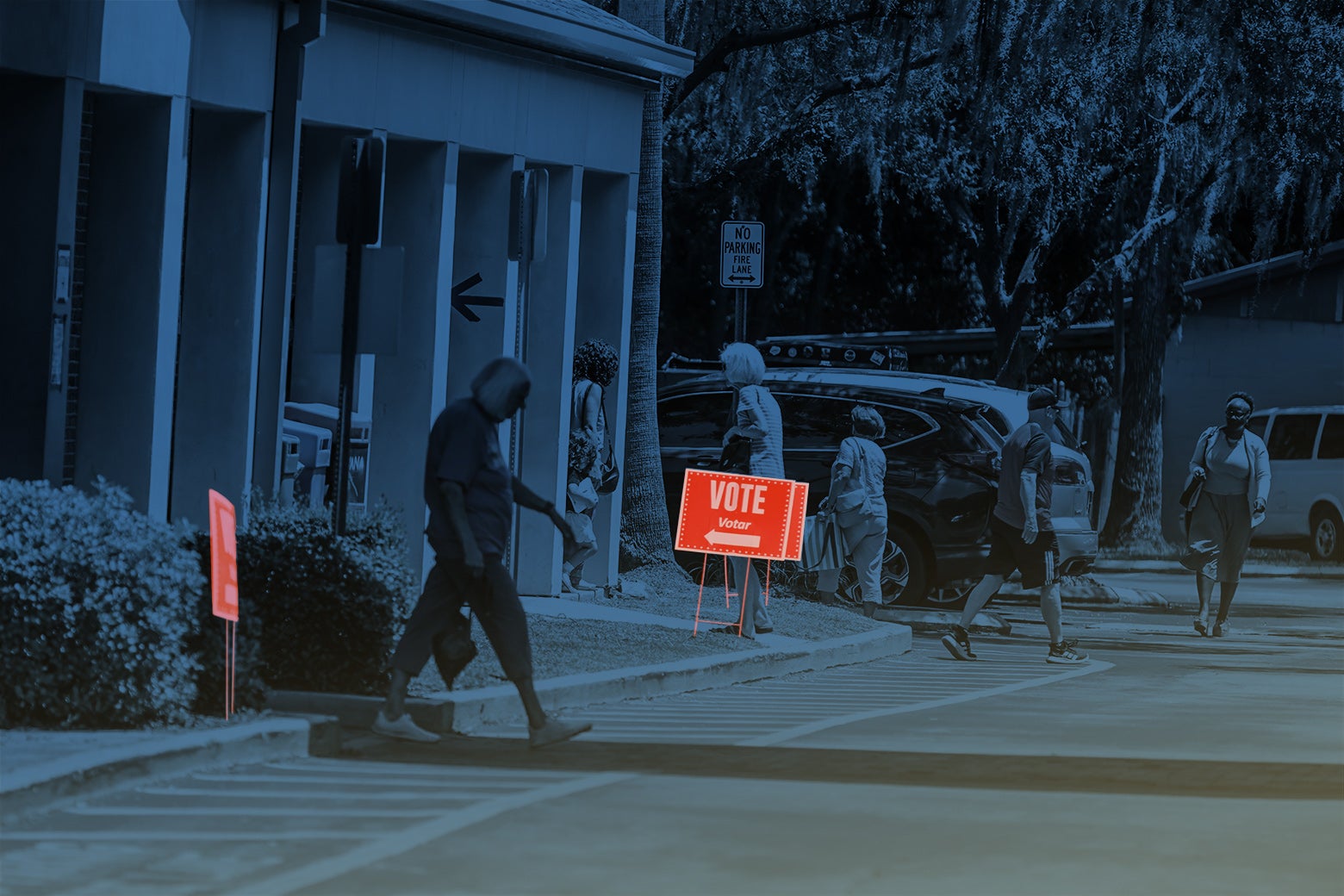
The Slatest The nation’s third-largest state held its primaries last night. Believe it or not, things got weird. Photo illustration by Slate. Photo by USA Today Network via Reuters Connect. This story is adapted from the Slatest newsletter. You can sign up here to get it in your inbox every day. Florida, that perpetual source of meme-worthy headlines and deep political disappointment for Democrats, held primary elections for both parties last night. The results were, frankly, a bit confusing. Democrats rejected an establishment-backed Senate contender in favor of a progressive—and simultaneously picked a former Republican to be their champion in the governor’s race. Republicans, meanwhile, voted down a string of ultra-extreme candidates in favor of candidates who are merely extreme. Let’s make sense of a head-spinning night. We’ve heard a lot about Democrats’ tug-of-war between the party’s centrist and progressive wings. Did either one win yesterday? Yes—they both did. Progressives scored their most impressive win of the night in the Democratic primary for U.S. Senate. Angie Nixon, a state representative who joined the Democratic Socialists of America this year, beat Alex Vindman, an Army veteran who testified during Donald Trump’s first impeachment hearing. Despite a 16-to-1 fundraising advantage and support from prominent senators, Vindman lost by 12 points. Nixon, a union organizer who supports Medicare for All, will face Republican Sen. Ashley Moody, who was appointed to the seat last year, in November. That sounds like a pretty big coup for the left! It was. But as with earlier Democratic primaries, Nixon’s win wasn’t a knockout blow in the party’s insider–outsider civil war. For one thing, Vindman moved to Florida just three years ago. For another, establishment candidates elsewhere in Florida easily fended off lefty rivals last night. Democrats’ nominee for governor, David Jolly, is so moderate that he wasn’t even a Democrat until last year. (He left the GOP in 2018, after criticizing Trump.) Meanwhile, Reps. Jared Moskowitz, a pro-Israel Democrat, and Debbie Wasserman Schultz, the former Democratic National Committee chairwoman, both beat democratic socialists in U.S. House primaries. So, as we wrote last week, the struggle for the party’s future seems set to continue. What about Republicans? You can squint at last night’s results and wonder if Trump is losing his grip over the GOP electorate. Rep. Cory Mills, whom Trump endorsed even though the House Ethics Committee is investigating him for alleged sexual misconduct, lost his primary. (Trump, as is his wont, claimed today that he’d actually advised Mills “to get out of the Race, but he wouldn’t listen” and promptly endorsed the former TV anchor who beat him.) On the other side of the state, a former Trump official named Catalina Lauf also lost her bid for Congress despite the president’s endorsement. Rep. Byron Donalds, the president’s preferred nominee for governor, did win his primary, but with less than 50 percent of the vote. In some ways, these results fit a pattern. Other scandal-ridden Republicans and Trump-backed gubernatorial candidates have also struggled in or lost primaries this year, even in deep-red states. You mentioned more extreme candidates going down too? In a few notable races, Florida Republicans seemed to have lost their appetite for the far right. James Fishback, an alt-right, antisemitic troll whose gubernatorial campaign got oodles of national media attention, finished a dismal third. Dan Bilzerian, a manfluencer who blames Jews for America’s problems and posted an A.I.-generated campaign video praising Hitler, lost to Rep. Randy Fine (more on him in a minute), whom Bilzerian had called a “fat Jew.” And former Rep. Madison Cawthorn, who moved to Florida after North Carolina voters booted him from Congress amid sexual misconduct allegations and possible insider trading, lost his comeback bid. OK, but are the candidates Florida Republicans did nominate any less extreme? That depends on your point of view, but it’s true that several of them also hold some pretty-out-there (and often ugly) views. Donalds, who’s poised to become Florida’s first Black governor, is a former tea party activist who tried to help Trump overturn his 2020 defeat. Fine is an unrepentant Islamophobe who has called Palestinians “evil,” had his name inscribed on an artillery shell Israel planned to fire into Gaza, and labeled prominent Muslim Democrats terrorists. A spiral into ever-greater extremism doesn’t have to be the GOP’s future, but it’s also possible that voters are simply delaying the inevitable. Fishback, who has described Donalds using terms like DEI hire and slave, won precincts close to major college campuses, which suggests that his Groyper candidacy appealed to young conservatives (even as the number of people who voted Republican in those places was relatively small). Last night might not be the last we see of him. But does any of this infighting on both sides really matter? Florida seems to have swung pretty far to the right lately, so shouldn’t we still expect Republicans to dominate in November? It’s a fair question. No other state this century has so consistently let Democrats down. In 2000, the Sunshine State cost Al Gore the presidency (with an assist from the Supreme Court). Barack Obama won Florida twice, but it bucked the blue wave of 2018, narrowly rejecting Democrats for Senate and governor, and sped further rightward in 2022. Its voters thrice opted for Trump, giving him greater margins of victory each time. What does all that mean for this fall? Republicans aggressively gerrymandered Florida’s congressional map earlier this year, redrawing districts in a bid to eliminate four Democrats. Political observers also expect two of the Democrats running statewide this year, Jolly for governor and Nixon for Senate, to lose. But under the hood, Democrats got some signals that they’re entering peak campaign season on stronger footing even in this onetime swing state that has repeatedly given them false hope. The party flipped multiple school board seats and a Jacksonville City Council seat from Republicans last night. So, despite the GOP’s clear advantages in this year’s marquee races, 2026 could be Democrats’ best chance in a while to claw back at least some power in the nation’s third-most-populous state. Tolga Akdoğan With another Election Day gone, it’s time to turn your attention to tonight—specifically, how to enjoy it. My colleagues recommend: Bad news for Trump: If the current state of American politics is getting you down, this one might cheer you up: Gen Z voters are souring on the president—and 23-year-old podcaster Adam Mockler sees a prime opportunity there for Democrats. He spoke to Slate’s Mary Harris about the lessons the party should be learning right now. (You can also watch a video version of this interview on YouTube.) Historical brain teasers: Do you know which pharaoh the Great Pyramid of Giza was constructed for? How about which U.S. president was nicknamed “His Fraudulency” by critics who believed he had stolen the election from Samuel J. Tilden? Test your knowledge of historical trivia with our daily quiz. A defense of yelling in restaurants: It’s a forbidden behavior in today’s restaurants—but Amanda Albee spoke to chefs who say it massively improved their careers. Fans of Gordon Ramsay shows and The Bear might be especially interested in this one. A deep dive that might change how you see bar soap: The humble bar of soap used to define the American way. Now it’s dying. In a sweeping, very entertaining investigative account, Dan Kois delves into the history and benefits of bar soap and why it’s worth fighting for. If you, too, have abandoned bars of soap in your bathroom, Dan’s spirited and incredibly thorough reporting might just make you think twice the next time you stock up. And on that squeaky-clean note, I take my leave. See you tomorrow! Elections Florida Republicans
Florida Man Loses. Florida Woman Wins.
Full Article
Original Source
Read the full article at Slate →KhanList aggregates and links to publicly available news content. We do not host full articles from third-party sources. Always verify important information with original sources.