
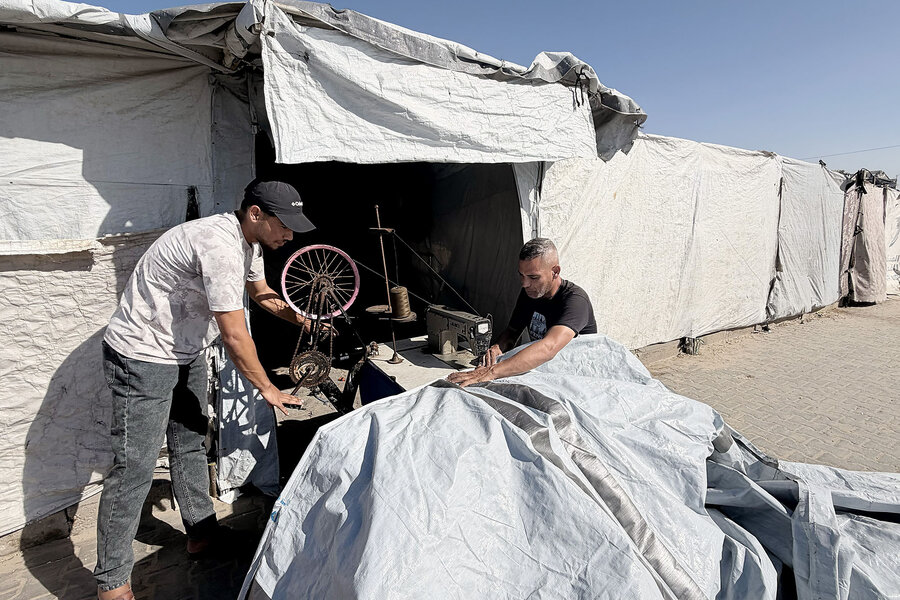
Gaza City, Gaza Strip | Nov. 24, 2026, 2:20 p.m. ET | 4 min read In his narrow workshop, Khalil Al Madhoun bends over his pedal-powered sewing machine, where he has spent two decades sewing and repairing clothes. These days, however, people mostly bring him shreds of their informal shelters – damaged tarps, nylon sheets, and torn tents – asking Mr. Al Madhoun to patch them up so they can offer better protection from Gaza’s lashing winter rainstorms.Winter has come to Gaza for the fourth time since the war began in 2023, and for the second time since an October 2025 ceasefire between Israel and Hamas promised to improve living conditions here.Instead, 65% of Palestinians still live in tents or informal shelters, at least 40,000 of which have already been damaged or destroyed in the season’s first rains, according to the U.N. Office for the Coordination of Humanitarian Affairs. Aid agencies say much of the unfolding crisis is man-made, and in recent days, world leaders and the U.S.-led Board of Peace – which is tasked with overseeing Gaza’s peace plan – have condemned Israel for restricting the import of tents, water pumps, generators, and other supplies necessary for the strip’s residents to survive the winter. Ghada AbdulfattahKhalil Al Madhoun shares a tent with his wife, who is nine months pregnant. "I am afraid for her to give birth in such conditions," he says. “Repairing tents, ensuring people don’t have to live in sewage, and providing warmth to freezing children is a basic human obligation,” wrote Democratic Sens. Jeanne Shaheen of New Hampshire and Brian Schatz of Hawaii on Monday, in a letter to U.S. Secretary of State Marco Rubio.Cold and floodsAs the temperature drops after dark on a November evening, Rasha Miqdad lays her 10-week-old son, Ismail, against her chest. “They told me this way he keeps warm,” she says. Her husband, Mohammad, holds their 4-year-old daughter, Masa, on his lap. “Her hands get like ice,” Ms. Miqdad says. Ghada AbdulfattahRasha Miqdad kisses her son Ismail inside their tent. She had to borrow warm clothes for him until a cash grant from an aid agency allowed her to purchase winter supplies. A tent on the Gaza seashore has been their home for three years. Last week’s rains came straight through, as the family scrambled to fill empty flour sacks with sand to hold back the water. “That was not enough,” she says. UNICEF, the United Nations’ agency for children, has warned that cold weather, heavy rain, and flooding pose life-threatening risks to displaced children across the Gaza Strip as winter sets in. The danger is not hypothetical. At least 11 children – including infants – died from hypothermia last winter.Already this year, on Nov. 12, 9-month-old Kinan Ahmed Raqiq died from a severe drop in body temperature, his father told Agence France-Presse. He woke in his tent to find that his child’s skin had turned blue. And at least four other children have died this month when their tents flooded during rainstorms.Rewaa Bakr had put two layers beneath her children, but in early November, the water came in from one side and reached the mattresses. Her son woke up to find everything wet and multiple leaks over their heads. The bedding, the blankets, and the mattresses were drenched from the ground and from above. “We were soaked through,” she says. Now, all eight members of the family curl up at night under a few blankets. Ghada AbdulfattahRewaa Bakr sits inside her family's tent with her three youngest children. They are among the 65% of Palestinians in Gaza who live in tents or informal shelters and struggle to protect themselves from winter rains and flooding. Her daughters Rafeef and Ranwa still wear summer clothes. One recently asked for a warm, long-sleeved shirt. Rewaa told her she must wait.“For three years now, we have lived this way, in a tent,” Ms. Bakr says. The children “are worn out now.”Shifting blameHumanitarian groups are sounding the alarm that Israel is severely restricting the import of tents and other items desperately needed to protect Gazans against inclement weather. The International Organization for Migration says it has brought 90,000 tents into Gaza in the last 2 1/2 years, of which it estimates some 60,000 have already exceeded their six-month lifespan and are in urgent need of replacement. However, as of Nov. 17, some 100,000 tents were stalled waiting to enter Gaza, according to Karl Baker, head of the IOM’s Gaza program. Ghada AbdulfattahRasha Miqdad stands at the entrance of her family's tent. The slowdowns are related to Israel’s classification of certain items as “dual use,” meaning they have both civilian and military uses. The import of these items is severely restricted, and even when they are allowed in, the import process is far slower than for other goods. In early November, the Board of Peace issued a rare critique of Israel when it wrote in a statement that its restriction of supplies at the border had “exacerbated the consequences of a foreseeable humanitarian challenge.”For its part, the Israeli government says it is allowing tents and other crucial aid in, and blames Hamas for delays resulting from added security checks.Winter in Gaza was not always like this.Before the war, Ms. Bakr adored the season. “We used to gather around the stove,” she says. The family roasted chestnuts, grilled meat in the evenings, and made sahlab, a thick, warm milk drink. Deepen your worldviewwith Monitor Highlights.Politics with respectGet political stories with respectful analysis.There‘s a world of new ideas in everyBooks newsletter.There‘s more to life, enrich yours withCulture & Learning weekly.Follow humanity‘s discoveries withScience & Nature stories in your inbox.Gain a spiritual perspectivefrom the stories in your inbox.Want to understand the deeper impact of critical events? Learn the Monitor‘s insight.Already a subscriber? Log in to hide ads. She laid out scarves, hats, and wraps until the floor was covered with warm things. Her house in eastern Shujaiya – since destroyed by Israeli attacks – had carpets.“We didn’t feel the winter at all,” she remembers. Bring news welcomed in any home into your home45% off$110/year → $60/yearJournalism that gets above the fray and brings perspectives you won't get anywhere else.Already a subscriber? Sign in
Flooded tents and blocked aid: Gaza waits for relief as winter arrives
Full Article
Original Source
Read the full article at Csmonitor →KhanList aggregates and links to publicly available news content. We do not host full articles from third-party sources. Always verify important information with original sources.