
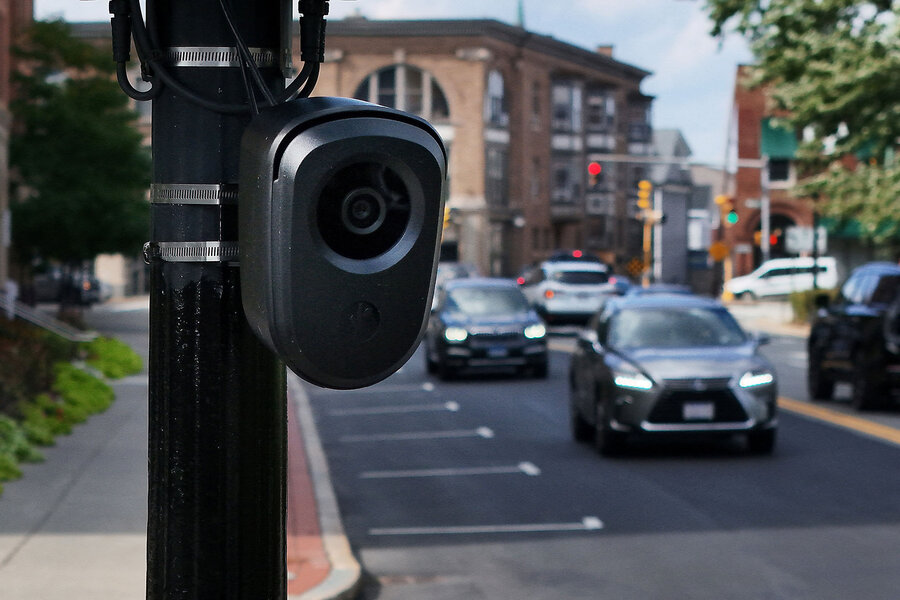
In just seconds, a Flock Safety camera can take six to 12 snapshots of your car as you drive past, capturing the license plate and other details, and storing that information in a database.Flock is one of several companies that sell automatic license plate readers to law enforcement and others, and says it has more than 120,000 cameras in use across 49 states. Flock says law enforcement can use the data to help investigations – and it touts successes on its website.But across the country, the collection and storage of that data is raising concerns about mass surveillance, privacy, and potential abuse. Some states and agencies are responding: On Aug. 31, the Florida Department of Transportation cut use permits for the cameras on the state’s highway system, citing “concerning reports of misuse, data privacy concerns, and surveillance schemes.” Texas Republican Gov. Greg Abbott recently froze state funding for the devices. The mayor of Tempe, Arizona, said on Aug. 26 that his city ended its contract with Flock and turned off cameras in the area. Why We Wrote This Technology gives law enforcement new tools, such as automated license plate readers, to help them investigate crimes. But sometimes, that technology can threaten the balance between public safety and privacy, prompting a discussion of how much government agencies should know about people’s lives. Flock declined to answer questions about its technology. A spokesperson directed a reporter to the company’s website, which details steps it took in August to address public concerns. Those steps include reducing the default for data storage from 30 days to seven, a requirement that law enforcement customers must use a system that detects abnormal use, and a lockout feature that will suspend access “when activity meets criteria for abnormal behavior.”The issue has now reached Congress. GOP Sen. Josh Hawley of Missouri, who chairs the Judiciary subcommittee on crime and counterterrorism, recently launched an investigation into Flock’s data collection policies. And independent Sen. Bernie Sanders of Vermont pledged to soon introduce legislation to halt Flock and other similar companies.What are Flock cameras?Flock Safety operates on a subscription model, allowing customers such as government agencies and private businesses to rent cameras, which are installed on roads in neighborhoods, cities, and along highways. Law enforcement can use data captured by the cameras to create a timeline of a vehicle’s whereabouts.Using artificial intelligence, the cameras scan license plate numbers, characters, state names, the vehicle model, even visible damage, and timestamp when a vehicle passes the camera. A motorist passes a Flock Safety camera mounted on a pole in Commerce City, Colorado, Aug. 5, 2026. Police can choose to share information from the database with other law enforcement agencies.Flock’s founder, Garrett Langley, says he created the business in 2017 after his neighborhood in Atlanta faced a string of car burglaries. He was frustrated that police often had no leads.The company says that, in 2025, the cameras helped police in more than 1 million criminal investigations and public safety mishaps, and even helped locate nearly 10,000 missing people.What are the concerns about Flock cameras?Privacy advocates say the cameras’ indiscriminate collection of every driver’s vehicle information basically creates a nationwide surveillance network that invites misuse by law enforcement.Kade Crockford, the director of technology and justice programs at the ACLU of Massachusetts, says Flock’s policy means “police are pushed to share as widely as possible, because if they share with the nationwide network, then they can access data from all of the other police departments that have shared with the nationwide network.”Torin Monahan, a professor of communication at the University of North Carolina and co-editor in chief of the academic journal Surveillance & Society, says people might be uncomfortable when government authorities gather information that is “deeply revealing of our lives.”“The more cameras you have, the more information you could glean about a person. But you can detect what neighborhood someone lives in, where they go to work, where they go to school, where they seek healthcare,” Dr. Monahan says.Automatic license plate readers have been used for years by law enforcement, says John Shjarback, an associate professor in the Department of Law and Justice Studies at Rowan University. By 2009, roughly one-third of U.S. police departments used them, and by 2020, two-thirds did, according to his research.Flock cameras are receiving backlash after reporters and nonprofits requested audits and found discrepancies in data searches from users such as police officers. Some used Flock technology to track current or former romantic partners – such as an officer in Revere, Massachusetts, who tracked his former girlfriend and family’s whereabouts, according to the Boston Globe.That has raised concern around the lack of regulation of automated license plate readers.“It’s the Wild West,” Mx. Crockford says.What are the allegations of misuse of Flock cameras?In one case, a Kentucky police officer allegedly tracked his ex-girlfriend more than 2,000 times; authorities said Flock’s system to detect abnormal use led to the allegation.The Institute for Justice, which describes itself as a nonprofit public interest law firm that works to “end widespread abuse of government power,” cites multiple reports of innocent people being detained or wrongfully jailed as a result of law enforcement actions based in part on Flock camera data that turned out to be inaccurate.Some groups have raised concern that people who attend political protests or rallies could be subject to surveillance. Electronic Frontier Foundation, a nonprofit that defends civil liberties, reviewed millions of searches from agencies including law enforcement, and found hundreds of searches related to demonstrations such as the “No Kings” protests that took place in 2025 and this year.“Americans, ordinary people who are driving around, simply cannot trust that police are not misusing their access to these systems,” Mx. Crockford says.But Mr. Shjarback notes that automatic license plate reading is a tool to aid officers in investigations, and it has a track record of doing so. He acknowledges the technology can be abused, but notes this could happen with different forms of surveillance like closed-circuit camera footage or debit or credit card records.Mr. Shjarback advocates for more training and supervision for officers when using any surveillance measure, to get the benefits of the technology while minimizing privacy and mass surveillance issues.“Police already have vast access to vast networks of both private and public surveillance cameras, and so the cat is already out of the bag,” says Mr. Shjarback. “This is really a bigger, broader issue that has implications for privacy, surveillance and public safety.”
Flock cameras: How a police tool sparked a surveillance revolt in the US
Full Article
Original Source
Read the full article at Csmonitor →KhanList aggregates and links to publicly available news content. We do not host full articles from third-party sources. Always verify important information with original sources.