
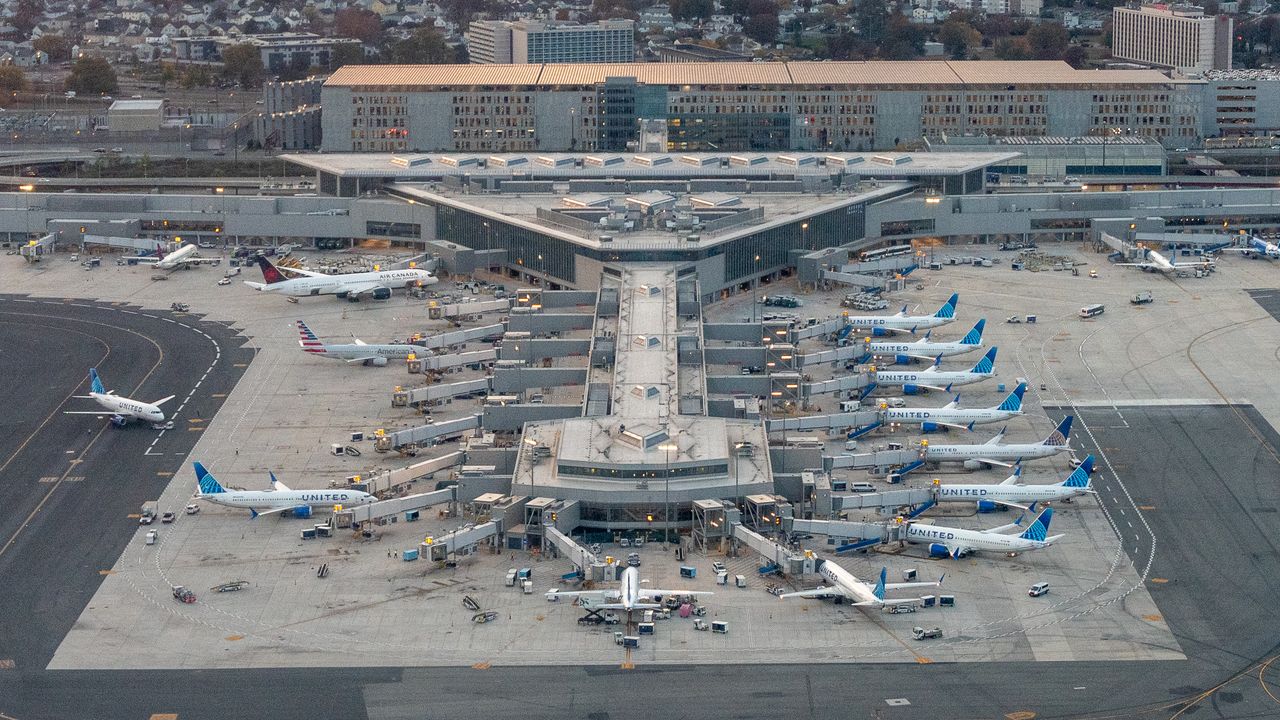
Flights have resumed again across the Northeast after a telecommunications failure at a Federal Aviation Administration facility disrupted air travel for hours on Monday, September 21, grounding arrivals at several major airports and triggering thousands of delays and cancellations around the country.The outage has been repaired, but the disruption may not disappear quite as quickly. Travelers flying through Newark Liberty International Airport (EWR), John F. Kennedy International Airport (JFK), LaGuardia Airport (LGA), Philadelphia International Airport (PHL), and Boston Logan International Airport (BOS) could continue to see delays and cancellations as airlines work to get aircraft, crews, and passengers back where they are supposed to be.“The telecom lines have been repaired, and all airport operations in the Northeast are resuming,” Transportation Secretary Sean Duffy wrote on social media Monday evening. But, he added, “It will take some time to clear all existing delays.”By the end of Monday, roughly 7,000 flights around the United States had been delayed or canceled, according to FlightAware data. Newark was among the hardest-hit airports: Commercial arrivals were halted for nearly 8 hours, more than 600 flights into or out of the airport were canceled, and more than 100 flights bound for affected airports were diverted elsewhere.These are your rights as an airline passenger if your flight is delayed or cancelled in the US.What caused the flight disruptions?The disruption came down to an unfortunate overlap of two technical failures.A primary telecommunications circuit at the FAA’s Philadelphia air traffic control facility failed Monday morning. Under normal circumstances, the system would have switched to a backup line. But officials discovered that the backup fiber-optic cable had also been severed during railroad construction in New Jersey.That left controllers without access to some of the radar and communications systems they use to safely manage aircraft. The FAA responded by sharply limiting traffic through the affected airspace, including temporarily stopping arrivals at Newark, JFK, LaGuardia, Philadelphia, and Boston.There was initially some confusion over who was responsible for damaging the backup cable. Duffy first said an Amtrak crew had cut it but Amtrak denied involvement, while New Jersey Transit later said work at one of its construction sites was likely connected to the damage and that it was investigating.The lines were repaired Monday evening, allowing air traffic to begin returning to normal.Why delays could continue even though the problem has been fixedRepairing the communications system is only the first part of the recovery.Airlines move the same planes and crews through a tightly timed sequence of flights each day. When that sequence breaks down for several hours, aircraft can wind up hundreds of miles from where they are supposed to spend the night. Pilots and flight attendants can run up against federal duty limits and rest rules. And passengers who miss their flights or connections suddenly need seats on later departures that may already be close to full.That is why a disruption centered on the Northeast can show up elsewhere in the country the next morning. A flight from Chicago to Denver, for example, may still be delayed if its aircraft was supposed to arrive from Newark the night before and never made it there.The FAA has not confirmed that delays will continue for days. But after a disruption of this size, it can take airlines a day or two to fully rebuild their schedules, particularly at busy hubs where there may be little spare capacity to absorb thousands of displaced travelers.What travelers should do nowIf you are flying through the Northeast, check your flight status in your airline’s app before leaving for the airport, even if your departure is still showing as on time.It is also worth looking at your inbound aircraft, which many airline apps show. If the plane operating your flight is still sitting several states away—or its earlier flight has already been delayed—that can be an early indication that your departure may change as well.Some airlines have issued travel waivers giving passengers more flexibility to move affected trips. United, which operates a major hub at Newark, issued one following Monday’s disruptions, and other carriers have allowed some travelers to change flights without the usual penalties.If your airline is offering a waiver and your plans are flexible, shifting your trip by a day may be the simplest option, especially if your itinerary includes a tight connection at Newark, Philadelphia, or another airport still working through the backlog.Travelers whose flights are canceled also have federal refund rights—if an airline cancels your flight and you decide not to accept the alternative transportation it offers, you are entitled to a refund. The same applies when a flight is significantly changed or delayed and you choose not to travel.Hotel rooms and meals are less straightforward. Because Monday’s disruption originated with air traffic control rather than the airlines themselves, passengers should not assume that carriers will cover those costs. Airline commitments for meals, hotels, and ground transportation generally apply when a cancellation or delay is considered within the carrier’s control, although individual airlines can choose to provide more assistance.
Flights Resume Across the Northeast After FAA Outage—But Delays Could Linger
Full Article
Original Source
Read the full article at Cntraveler →KhanList aggregates and links to publicly available news content. We do not host full articles from third-party sources. Always verify important information with original sources.