
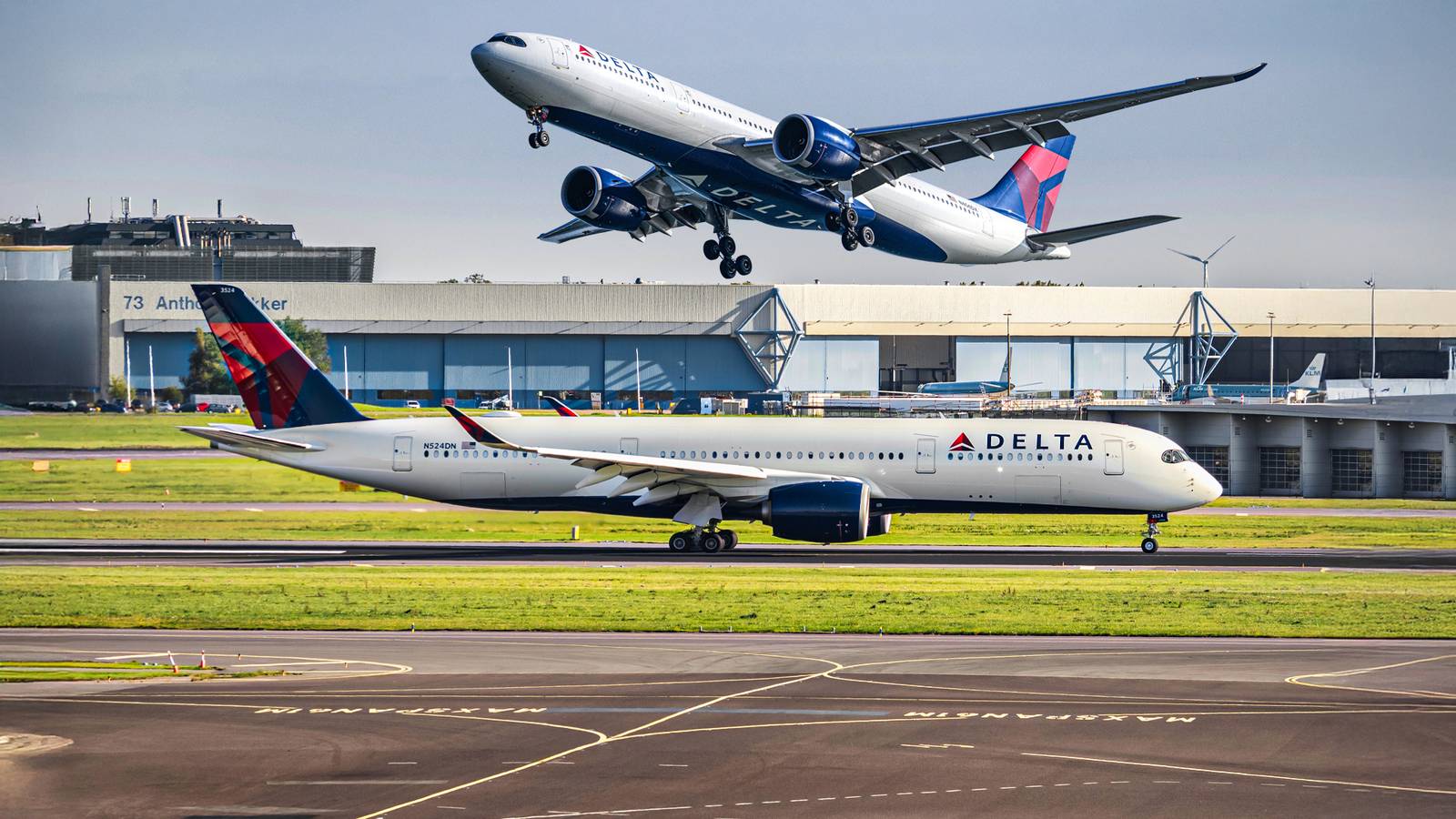
Delta Air Lines has achieved something its biggest domestic competitors once appeared equally capable of doing: building a long-haul fleet around Airbus' newest widebody aircraft. While American Airlines and United Airlines have moved in different directions, Delta has become the only US carrier operating both the Airbus A350 and A330neo, with an even larger commitment to the European manufacturer's latest-generation jets ahead. The distinction stems from decades of fleet planning, corporate mergers, canceled orders, and changing aircraft requirements. American once had A350s on its order book, Hawaiian came close to becoming an A330neo operator, and United still has an outstanding (and problematic) commitment for 45 A350-900s. So how did Delta end up in a position its competitors abandoned, and what role will its expanding Airbus fleet play in its international ambitions? Why Delta Is The Only US Airline Flying Airbus' Newest Widebodies Credit: Ryken Papy | Shutterstock Delta's position comes down to a mix of long-term Airbus relationships and competitors' decisions. The Atlanta-based airline currently operates two of Airbus' latest-generation widebody families: the A350 and A330neo. Neither American Airlines nor United Airlines operates either aircraft type, leaving Delta as the only US airline with both models in commercial service. However, Airbus widebodies were not always absent from competitors' purchasing plans. American inherited an order for 22 A350s following its merger with US Airways in 2013, while United originally ordered the A350 in 2009. Hawaiian Airlines also showed interest in the Airbus' smaller A350-800 design before changing its plans. However, each airline eventually abandoned its original intentions, leaving Delta to establish a considerably stronger relationship with the European manufacturer. The consequences extend beyond aircraft manufacturers and fleet preferences. Delta now has a substantial advantage in operating experience with Airbus' latest widebodies, while its upcoming A350-1000 deliveries will introduce an aircraft no other North American airline currently operates. But what made Delta maintain its Airbus commitments when other US carriers changed direction? How American, Hawaiian, And United Abandoned Their Airbus Widebody Plans Credit: Buzz_v2 | Shutterstock The three airlines took different paths, but their decisions ultimately led to the same outcome: none currently operates the A350 or A330neo. American Airlines inherited the A350 commitment through its merger with US Airways, but in April 2018 the airline decided to terminate its remaining order for 22 A350s and instead expand its Boeing 787 fleet. American's decision was closely tied to its fleet-simplification strategy. The airline announced an order for 47 additional Boeing 787s, comprising 22 787-8s and 25 787-9s. These aircraft were intended to replace older Boeing 767s, Airbus A330-300s and Boeing 777-200s. Consequently, American moved toward an all- Boeing widebody operation built around the 777 and 787 families. The airline's announcement explicitly described the move as an effort to simplify its fleet and reduce operational complexity. Hawaiian Airlines followed a different route. The carrier originally ordered six Airbus A350-800s but replaced that commitment in 2014 with six smaller A330-800neo aircraft, alongside purchase rights for another six. However, the A330-800's limited commercial appeal became a concern. In February 2018, Hawaiian terminated its Airbus agreement and subsequently selected Boeing's 787-9, ordering 10 aircraft with purchase rights for another 10. The airline's decision meant that it would not become the first US operator of the A330neo family. United's story has been much more complicated. The airline initially ordered 25 A350-900s in 2009 to replace its aging Boeing 747-400 fleet. In 2013, it changed the order to 35 larger A350-1000s before returning to the A350-900 in 2017, increasing the commitment to 45 aircraft. Deliveries were initially pushed back to 2022-2027, with subsequent revisions leaving the program increasingly uncertain. By February 2026, the airline's order faced renewed uncertainty following a contractual dispute with Rolls-Royce, the A350's sole engine supplier. Airline Original Airbus commitment What happened American Airlines 22 A350s inherited from US Airways Canceled in 2018; expanded Boeing 787 fleet Hawaiian Airlines Six A350-800s Replaced by A330-800neo order, subsequently canceled for the Boeing 787-9 United Airlines 25 A350-900s Changed variants and increased to 45 A350-900s; deliveries repeatedly deferred Delta Air Lines A350-900 and A330neo commitments Became the first North American A350 operator and continues expanding both families With these three competitors taking different procurement paths, Delta's commitment to Airbus became distinctive. However, its relationship with the European manufacturer did not begin with the A350. It dates back to a major corporate transaction that fundamentally changed Delta's international fleet. From Northwest Airlines To The A330neo: Delta's Airbus Widebody Foundations Credit: Bjoern Wylezich | Shutterstock Delta's Airbus widebody strategy has its roots in the 2008 merger with Northwest Airlines. Completed on October 29, 2008, the transaction brought together two major US carriers and gave Delta access to Northwest's established international network and existing Airbus aircraft. Importantly, Northwest had already been operating the A330 family for several years, having introduced the A330-200 in 2004 to improve its transatlantic and transpacific operations. The aircraft helped replace older DC-10-30s and Boeing 747-200s on selected international routes, as per the Delta Flight Museum. The merger gave Delta an established Airbus widebody platform it could continue developing. Its A330-200s offered long-range capabilities, while the larger A330-300 provided additional passenger capacity for high-demand international markets. Delta subsequently expanded the family with new A330-300 deliveries, beginning in 2015. The airline eventually introduced the A330-900neo, becoming its North American launch operator in 2019 after announcing its initial commitment in 2014. Unlike the older A330ceo models, the A330neo incorporates new-generation engines, aerodynamic improvements and updated systems to deliver better operating economics. The three A330 variants serve different roles within Delta's network. The A330-200 is the smaller, longer-range aircraft, making it suitable for routes where demand does not justify a larger widebody. The A330-300 offers greater capacity and is particularly useful on established international corridors. Meanwhile, the A330-900neo combines the aircraft family's familiar operating characteristics with significantly updated technology, making it an important part of Delta's fleet renewal strategy. The A330 family gave Delta a foundation for operating Airbus widebodies across different international markets, but the airline wanted something capable of serving its longest and most demanding routes. This is where the A350 entered the picture, eventually becoming the centerpiece of its long-haul expansion strategy. The Airbus A350: Delta's Flagship For Long-Haul Expansion Credit: Karolis Kavolelis | Shutterstock Delta became the first North American airline to operate the Airbus A350-900, introducing the aircraft in 2017. The aircraft offered long-range performance, improved fuel efficiency, and greater passenger comfort, allowing Delta to strengthen its international network while replacing older widebodies. The A350-900 became particularly important for the airline's transpacific operations, where its range and efficiency suit demanding long-haul missions. According to Delta's published fleet information, the airline currently operates 41 A350-900s, with another 18 on order. The aircraft features Rolls-Royce Trent XWB-84 engines and offers four cabin products: Delta One, Delta Premium Select, Delta Comfort+, and Delta Main. Its role extends beyond replacing older aircraft. The A350-900 also supports international expansion, including services to destinations such as Seoul, Taipei, and other important markets across Asia and beyond. Delta's Airbus widebody fleet Aircraft Fleet size Primary role Airbus A330-200 11 Smaller-capacity, long-range international operations Airbus A330-300 31 Higher-capacity international and transatlantic routes Airbus A330-900neo 39 Next-generation medium- and long-haul operations Airbus A350-900 42 Long-haul, intercontinental and high-demand international routes Airbus A350-1000 20 on order Highest-capacity long-haul operations, replacing older widebodies on major international routes Source: planespotters.net However, Delta's ambitions extend beyond the A350-900. In January 2024, the airline announced an order for 20 Airbus A350-1000s, selecting the larger aircraft over Boeing's delayed 777X program. The decision was significant because the A350-1000 would become the largest aircraft in Delta's fleet, offering additional passenger capacity and cargo capabilities. Powered by Rolls-Royce Trent XWB-97 engines, the aircraft is expected to deliver more than 20% lower fuel consumption per available seat mile than the aircraft it replaces, according to Delta. The first A350-1000 deliveries are scheduled to begin in early 2027, making Delta the first North American airline to operate this particular variant. The aircraft will also introduce an updated premium cabin, including next-generation Delta One Suites with longer lie-flat beds, improved storage, and additional comfort features. Delta has also highlighted the aircraft's increased premium seating capacity, with approximately 15% more premium seats than the retiring aircraft it is intended to replace. The A350-1000 order is more than an opportunity to introduce another aircraft type. It is central to Delta's plan to reorganize its existing widebody fleet, allowing the airline to move aircraft between routes according to passenger demand and operating requirements. This raises an important question: how will the new aircraft change the roles of Delta's existing A330s and A350-900s? Delta's Cascading Upgauging Strategy: Moving Aircraft Between Routes Credit: Wangkun Jia | Shutterstock Delta's approach to fleet renewal involves what can be described as cascading upgauging. Instead of simply introducing larger aircraft to replace older ones on a one-for-one basis, the airline can use its newest and largest widebodies on the busiest routes, freeing up existing aircraft for other markets. The A350-1000 will initially take on some of the most demanding international operations, while the A350-900s can gradually move into markets currently served by older A330s and Boeing 767s. This strategy makes sense when considering the different capabilities of Delta's widebody aircraft. The A350-1000 offers greater capacity and expanded cargo potential, making it suitable for routes where passenger and freight demand justify a larger aircraft. The A350-900 provides much of the same long-range capability in a smaller package, allowing Delta to serve international destinations without necessarily committing to the larger aircraft. Meanwhile, the A330-900neo offers a modern and efficient alternative for medium- and long-haul markets where the A350's additional capacity may not be necessary. The A330-200 and A330-300 will also remain important during this transition. Delta's 11 A330-200s provide flexibility on routes that require widebody range without the capacity of an A330-300 or A350. Its 31 A330-300s continue to serve established international markets, including high-demand transatlantic services. However, these aircraft are considerably older than the A330neo and A350 fleets, making them natural candidates for gradual replacement as newer aircraft arrive. The next stage of this strategy will be supported by another significant Airbus commitment. In January 2026, Delta announced an order for 31 additional widebodies: 16 A330-900neos and 15 A350-900s. The aircraft are scheduled to begin arriving in 2029, and the agreement also includes 20 additional future widebody options. According to Delta, the announcement will eventually increase its A330-900neo fleet to 55 aircraft and its overall A350 fleet to 79, including the 20 A350-1000s. This means Delta is building a complementary widebody portfolio in which each aircraft has a specific role, allowing the airline to match capacity and operating costs with the requirements of individual routes. Nevertheless, such a substantial commitment to Airbus raises another question: will Delta maintain its position as the US airline with the most distinctive Airbus widebody fleet as international competition intensifies? Delta's Airbus Commitment Could Define Its International Fleet For The Next Decade Credit: Joe A. Kunzler | Shutterstock Delta's widebody strategy demonstrates how aircraft procurement decisions made over several years can fundamentally shape an airline's international capabilities. While American Airlines has consolidated its long-haul operation around Boeing aircraft and United continues to evaluate its outstanding A350 commitment, Delta has chosen to deepen its relationship with Airbus. Its strategy is particularly notable because it encompasses both Airbus widebodies, providing flexibility across a wide range of international markets. The planned expansion is considerable too. Currently, Delta operates 123 Airbus widebodies, and future commitments include 20 A350-1000s, 18 additional A350-900s, and 16 more A330-900neos. Once the announced deliveries are completed, the airline expects to operate 79 A350s and 55 A330-900neos, establishing an even stronger foundation for international growth. The real test, however, will be how effectively Delta manages the transition. Adding aircraft is only part of the equation: the airline must also retire older widebodies, allocate capacity efficiently, and ensure its expanding premium-cabin offering generates sufficient returns. The arrival of the A350-1000 in early 2027 will be the next major milestone, potentially marking the beginning of a new chapter in Delta's long-haul fleet strategy.
Fleet Strategy: How Delta Air Lines Became The Only US Carrier Operating Airbus' Newest Widebodies
Full Article
Original Source
Read the full article at Simpleflying →KhanList aggregates and links to publicly available news content. We do not host full articles from third-party sources. Always verify important information with original sources.