
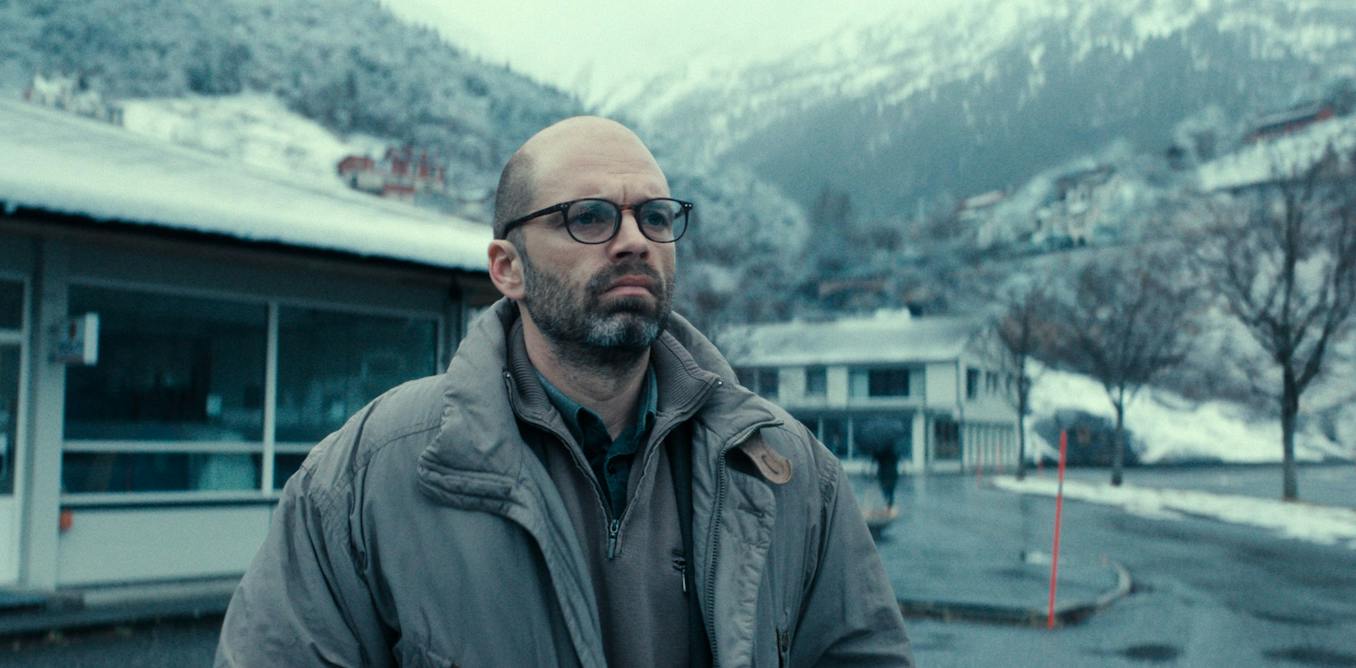
Over the summer I took respite from the UK heat in the Norwegian fjords. So I was pleased to revisit that dramatic landscape through director Christian Mungiu’s new film, Fjord. Norway provides the backdrop to his story of an incomer family fighting for the right to keep their children amid accusations of mistreatment. The film opens with the musical strains of the hymn Amazing Grace. The song hints at both the long-held traditional values of Norway’s religious past, and the key battleground of belief and cultural values in the drama to come. From there, the film pushes into a tangle of competing loyalties and sympathies. As the characters’ allegiances shift, the audience is forced to constantly reexamine their own values. Ultimately, the fractures of the dramatic landscape mirror the complex human relationships carved out within it. The tale begins with the arrival of the Gheorghius family. Romanian Mihai (an unrecognisable Sebastian Stan) and Norwegian Lisbet (Renate Reinsve) move into the small community of Lisbet’s birth with their children. They live next door to amiable headteacher Mats (Markus Tønseth) and his family. Here, everyone knows everyone. The Gheorghius seem likeable, but they are viewed warily as they express their Christian evangelical faith through mundane acts. Welcome quickly turns to suspicion and then escalates to accusation as one of the children, Elia, arrives at school with bruises. The remainder of the film provides an emotionally harrowing account of the interaction of the state and personal life as the children are removed from their parent’s care. The trailer for Fjord. Through tense encounters with the police, schools and social welfare services, the film tackles cultural and moral divides in all their forms. It explores discipline and abuse, religious dogma, gender roles, sexuality and the clash between progressive ideals and conservative faith. Fjord questions where lines should be drawn when navigating conflicting values, highlighting the dangers of weaponising difference. These themes speak directly to long-standing concerns in my own field as an anthropologist and sociologist of migration. This work examines how newcomers are routinely cast as “other”, asking instead how we can live together with and across our differences. Fjord asks unsettling questions about power: whose responsibility is it to safeguard rights? And precisely whose rights take precedence? The rights of children to be protected, the right of parents to a family and religious life of their choosing, or the demand of wider society not to be offended? Mungiu artfully compels viewers to vacillate between being drawn to and then repelled by both the family and state’s actions. The Gheorghius children have no power to challenge abuse, whether physical, through slaps, or mental through religious indoctrination. Here, the universal (western) values of human and child rights trump the localised, religious, conservative values of the incomers. Yet the Norwegian state is not depicted as a pure saviour: its representatives are icy, detached and bureaucratic in their engagement with the family. The state expects “assimilation” and rejects the family’s old-fashioned parenting beliefs, uncomfortably echoing its historical policies of erasing Sámi language and culture under Norway’s project of nationalism and cultural homogeneity. Words are put in the mouths of the newcomers. We see language twisted and the parents’ limited understanding of rights misused. The Gheorghius family in Fjord. Tudor Panduru Meanwhile “modern” values around liberal parenting and care for older people are exposed. Teenage Noora, scrolling screens in her bedroom, is sad, anxious and hiding her self-harm. And Mat’s ageing, disabled father does not fare much better. While a story of fissures, Fjord examines bonds too, across family, peers, lovers and community. Mia (Lisa Carlehed) feels like a breath of fresh air as she gains sympathy for the family, resuming the career she stepped down for caring reasons, by representing them as their defence lawyer. Mingui skilfully exploits the empathy of his viewers based on their own personal values and experiences. As a mother myself, I felt visceral pain as Lisbet, unable to breastfeed her youngest child, struggles to express her milk under the stress of separation. Yet some of the bonds that Mingui explores – of religion and motherhood – are also questioned. The community’s quiet, religious nature is quickly reframed as cronyism. At the same time, it is uncomfortable to watch Mihai exploit the family’s hardship by rallying media-savvy, conservative Christian networks across Romania and the United States. Motherhood itself is also weaponised, with the welfare officer’s childlessness dragged into the child protection hearing to undermine her competence and authority. Although some critics have argued that the film relies on caricatures of child protection services, it actually critiques that exact mindset: the cartoonish binaries, the political weaponisation and the urge to jump to easy conclusions. Instead of tidy resolution, the film offers only mounting ambiguity. Fjord closes on a deliberate, painfully quiet anti-climax. It’s a reminder that when clashing worldviews scream across a void, nobody wins.
Fjord turns a Norwegian child protection battle into a chilling moral thriller
Full Article
Original Source
Read the full article at Theconversation →KhanList aggregates and links to publicly available news content. We do not host full articles from third-party sources. Always verify important information with original sources.