
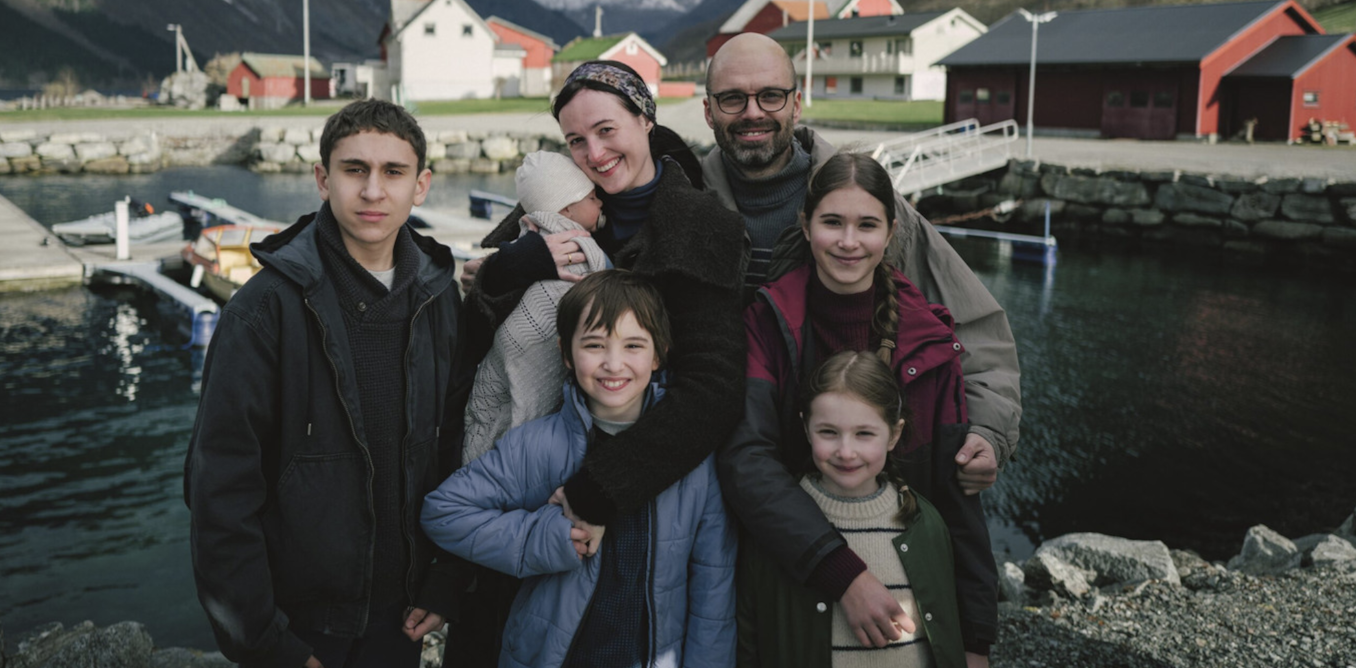
Written, produced and directed by Romanian film-maker Cristian Mungiu, Fjord won the prestigious Palme d’Or at Cannes in May 2026. The film tells the story of the Gheorghiu family, immigrants from Romania to a remote Norwegian town where they live at the end of the fjord of the film’s title. Mihai (Sebastian Stan) and his Norwegian wife Lisbet (Renate Reinsve) are devout evangelical Christians with five equally devout children. They live next door to the headteacher of the local school, Mats Halberg (Markus Tønseth) and his wife Mia (Lisa Carlehed), a lawyer, as well as Mats’ elderly father and teenage daughter from a previous marriage. When the Gheorghius’ eldest daughter Elia is the subject of a report to social services after her PE teacher spots bruises on her shoulder, all five children are taken into care and the parents put on trial. Fjord fictionalises several real-life cases that brought international attention to Norway’s child protection laws. Mungiu has described a grander ambition in making Fjord – that of forcing a difficult confrontation with an ethical dilemma: what if the liberals are the real authoritarians? Read more: Fjord turns a Norwegian child protection battle into a chilling moral thriller Mungiu, who also won the Palm d'Or in 2007 with 4 Months, 3 Weeks And 2 Days, belongs to the Romanian New Wave, a group of film-makers whose unflinching realism broke from the orthodoxies of Romanian communism. These strictures required filmmakers to present a positive image of the nation that many felt was increasingly at odds with the truth. Fjord is Mungiu’s first international film and taps into topics of more global relevance. Complaints of the so-called intolerant left unite the modern right, encapsulating concerns from meddling judges to DEI quotas, cancel culture and mask-wearing. One dimensional characters Despite its 147 minutes running time, Fjord struggles to move beyond a political provocation. This would not be a problem if there were some kind of dramatic development, but the film’s characterisations are one-dimensional, without internal conflict or development. Political filmmaking often embodies antagonistic political positions in its characters – for example the radical classic The Battle of Algiers (1966), or last year’s One Battle After Another. But unlike these films, Fjord refuses either narrative action or political commitment. Instead, the film adheres to a core generic value of contemporary festival-circuit cinema, that is, ambiguity. Fjord most closely resembles the real 2015 case of the Bodnariu family, where the state took away the five children of a Romanian Christian couple who disciplined their children by slapping them, which is a crime in Norway. Fjord adds suggestions that Mihai and Lisbet are committing far more violent abuse, presumably because without this there is in reality no uncomfortable ethical dilemma. Norway’s child services have drawn international condemnation for their wildly disproportionate responses to such cases and have been the subject of numerous rulings by the European Court of Human Rights. Had Fjord instead exhibited genuine suspicion about the parents’ behaviour, it would present a much more difficult proposition about the limits of toleration. But instead the film pulls its punches, dropping the question of physical violence and denying viewers the information they need to know what kind of dilemma is even being posed. Mungiu describes his film as concerning a “culture clash”, but exhibits similar confusion as to which cultures are actually clashing: the national cultures of Norway and Romania, the ethical worlds of religion and secularism, the generational cultures of tradition and change or the regional cultures of northern and southern Europe. Director Cristian Mungiu on set in Norway. Landmark Media / Alamy A film that showed how these factors intersect would be truly impressive, but Fjord is not that film, let down by its fundamental lack of curiosity about the dynamics of the situation it presents. The Gheorghius attend a local evangelical church, but these Christian Norwegians remain mere background detail. The children drop out of the narrative when the trial beings, meaning we never explore the difficulties of their position. Reinsve is criminally underused as Lisbet, a Norwegian woman adhering to the strict Christianity her husband insists is part of his national belonging as a Romanian. Criticisms of Fjord have been mischaracterised as centring on its sympathetic presentation of a conservative patriarch. If that were the case then such criticism would also have been made of last year’s Cannes winner It Was Just an Accident, a film about a former torturer who now lives in peace with his wife and family. Such complexity helps in making compelling drama. It is this kind of complexity that the facile unreality of Fjord’s ambiguity rejects. We may then question whether Fjord, whose funders include the Council of Europe, EU and the Nordic Film Institute, acts as any kind of challenge to liberal pieties at all. No belief system enjoys questioning itself so much as liberalism. Especially if that questioning comes from its right, for this confirms its proclaimed values of tolerance and sophistication. At the same time, ambiguity, and a reassurance that everything is indeed far too complicated to take a clear stand, flatters the arthouse sensibilities of the festival circuit audience. With all the courage of its own lack of conviction, Fjord does in the end impart a moral lesson: blessed are the uncommitted.
Fjord: 2026 Cannes winner fails to engage with the complexity of Norway’s real child welfare controversies
Full Article
Original Source
Read the full article at Theconversation →KhanList aggregates and links to publicly available news content. We do not host full articles from third-party sources. Always verify important information with original sources.