
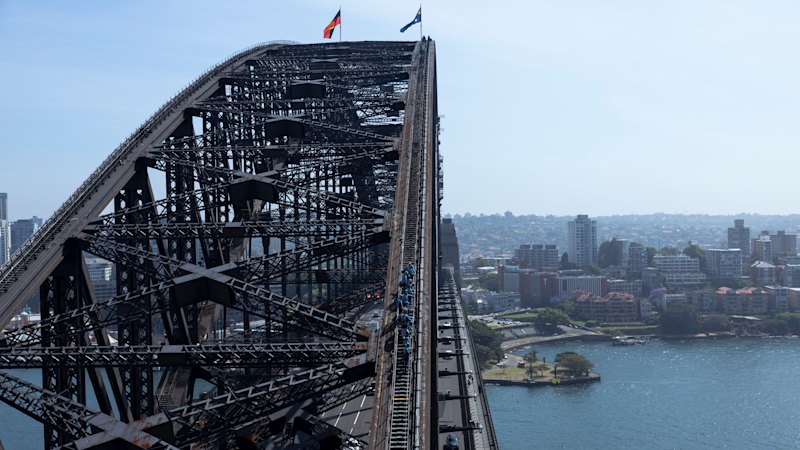
As a passenger who frequently crosses Sydney’s engineering icon, I am horrified by the amount of rust covering the metal structure of our Sydney Harbour Bridge (“Key Harbour Bridge fix gathers dust in storage”, September 7). The lack of maintenance is very clear, with rusty members and noxious weeds growing on the northern pylons. How could our state government(s) fail to carry out the necessary maintenance on one of Australia’s main heritage-listed tourist magnets, not to mention a piece of vital infrastructure, which without constant maintenance is unlikely to survive another 100 years? Meanwhile, another of our fabulous old buildings, the Sydney Powerhouse Museum, is under threat (“Secret plan to sell off Powerhouse museum building as budget crisis looms”, September 5). What’s next – the Opera House replaced by a data centre? One of the state government’s top priorities is to maintain our infrastructure, as well as our historic buildings, and it looks like they are failing. Brian McDonald, WilloughbyA render of one of the arch maintenance units for the Sydney Harbour Bridge.Transport for NSWGreens transport spokesperson Cate Faehrmann is to be commended for questioning why the two special German-built maintenance cranes for the Harbour Bridge have been in storage since they were delivered, despite Transport for NSW officials flying twice to Germany in 2024 to ensure they could be installed safely. As Ms Faehrmann has stated, “Someone has to be held accountable. With the centenary coming up, it’s vital that essential maintenance work on the bridge isn’t disrupted.” Accountability in the public service is poor. In private enterprise, such a situation would have consequences, but not in our public service. The two units should be brought into operation as soon as possible. The centenary is only a few years away. A bigger issue is how to achieve accountability in the state’s public service. It will take more than two giant cranes to get that job done. Dennis Bluth, CammerayJust rummage around in the box, chaps, the installation diagrams will be there somewhere. Failing that, look on the parts for letters like A and B. They should help you get the sequence right: push tab A through slot B. You’ll get the hang of it. Greg Baker, Fitzroy FallsArts under threatWhat wonderful irony that Linda Morris’ story (“Financial inferno facing Powerhouse”, September 7) was published on the same page as an advert for the Scott Sisters performance at the State Library by the Australian Haydn Ensemble. For they are the absolute opposites of the state government’s funding priorities. The 12-year-old ensemble has faced funding cuts year after year as money was lavished on the Powerhouse, so that its ongoing community project in Menindee could only be achieved with philanthropic funds. The state’s public galleries are no better off. Government ministers and bureaucrats must be held responsible for letting the arts beyond the Powerhouse wither and potentially die. Jeremy Eccles, Clifton GardensThere is a parallel to be drawn between the building of the Opera House and the moving of the Powerhouse Museum that future planners and leaders should heed. Both projects suffered from unrealistic and optimistic cost projections, political pressure often due to looming elections and building before the design was completed. Well before the budget and timeline trajectory is planned, there needs to be an exhaustive examination of multiple similar projects worldwide, comparing failures and successes. It’s no coincidence that both these were cultural projects subject to clashes between government, heritage organisations and the public. Elizabeth Maher, GordonFlagging jingoismLiberal leader Angus Taylor seems to be worried about flag-burning in public and agendas creeping into our school system (“Angus Taylor wants to criminalise flag burning”, September 7). He states that some teachers are wearing “free Palestine” badges in schools. Where is this happening? It would be against the code of conduct for a teacher to wear any political insignia and they would be directed by their principal to remove it. Taylor has stated that he would make burning of the Australian flag a criminal offence. Where are all these flag-burners? It seems that Angus Taylor is dog-whistling to attract some of the One Nation voters to support the Coalition. Leo Sorbello, LeichardtOpposition Leader Angus Taylor seems to be worried about flag-burning.Alex EllinghausenBurning the Australian flag is certainly offensive and unpatriotic, but it is none of the government’s business how people choose to destroy their personal property. The Coalition’s latest half-baked proposal to ban the burning of the Australian flag is an unacceptable interference with our freedom of speech, which ultimately betrays the small government, anti-nanny state principles that the Liberal Party has long championed. Nikhil Dhanabal, Clyde North (Vic)Angus Taylor has now joined Pauline Hanson in calling for the criminalisation of flag-burning, something even John Howard refused to do. The world itself is burning before our eyes, children are dying in useless wars, bodies are being dug out of the mud in Nepal and trivialities are all that occupy the minds of some who hanker for political power. For all our sakes, let’s hope they never get it. Bernard Moylan, BronteSean Kelly suggests it’s flippant for Angus Taylor to object to teachers pushing a political agenda by wearing Palestinian badges (“As Labor leaves an opening, Coalition takes the wrong path” September 7). Teachers should maintain neutrality on contentious political issues. They shouldn’t be pushing their beliefs on these matters onto their students, especially if it makes some students feel uncomfortable or alienated. I wonder if Kelly would be so sanguine if teachers were to wear badges showing support for Israel or the Liberal Party. Danny Samuels, Malvern Photo: Megan HerbertIndefensible errorNapoleon is reputed to have said “never interrupt your enemy when he’s busy making a mistake”. What would he have had to say about Albo, who appears to adopt and continue those mistakes? Two of Scott Morrison’s legacy disasters, AUKUS and the GST divvy-up between the states, are continuing policies under Labor. Leaving aside the GST mistake, recent developments in drone warfare make it clear that the AUKUS scheme is outdated (“Game of drones: defence giants battle new threat to model”, September 7). It may be understandable that some seniors in defence are planning for the next war using models from the last century, but for Labor to endorse all this is unforgivable. Carl Boyd, Cooks HillClueless solutionI can just imagine the conversations that would take place if Pauline Hanson’s superannuation proposal was ever adopted (“The people’s money. Hanson, Joyce defend proposed super shake-up”, September 7). Young home buyer: “Our mortgage payments are going to be so high if we buy this house.” Real Estate Agent: “Don’t worry. Just take some money out of your super.” Renter: “We can’t afford this rent increase.” Landlord: “Don’t worry. Just take some money out of your super.” By encouraging landlords to increase rents and house vendors to increase their asking price, Ms Hanson’s proposal would worsen Australia’s already appalling housing affordability rate. Not that this would concern Hanson or Joyce who have access to the most generous superannuation arrangements in the country. Mike Reddy, VicentiaOne Nation’s Barnaby Joyce and Pauline Hanson.Alex EllinghausenOne Nation has neither the intelligence nor the fiscal rectitude to ever hold the Treasury benches of any Australian Parliament (“Hanson says Chalmers is ‘hysterical’ for super plan opposition”, September 7). Its latest policy of permitting people to receive the compulsory superannuation levy paid by employers before retirement is an example. The point of superannuation is to guard future generations against having to pay more government aged pensions than they can afford. A person’s entitlement to pension is potentially reduced by the amount of superannuation they have. One Nation can’t think beyond the now – it doesn’t have any imagination. John Rome, Mt LawleyWhat the One Nation superannuation proposal amounts to is a pay rise for some workers, paid not by their employer but by the workers themselves. In the long run, that will make the worker poorer and the bosses happier. Only a sucker would be attracted by that deal. William Forbes, MedowieTruth and politicsI was disappointed to learn of Strathfield Council’s decision to cover up the $400,000 gateway signage that read “Wangal Country, always was, always will be”, which recognised the area’s Indigenous people (“Sydney council sparks backlash after erasing Indigenous signs”, September 7). My parents and my grandmother came to Sydney from Russia as stateless refugees and eventually moved to Strathfield, where there was a community of people with similar backgrounds. I was born there and received my otherwise excellent education in local schools, but I was taught nothing about the plight of Indigenous people after 1788. I have since read 19th-century accounts and wept at their terrible treatment and suffering. Yes, I agree that politics should not intrude onto council signage, but I believe the existing sign is a statement of historical fact and should be acknowledged. It helps in understanding the geography of the Sydney basin and in no way detracts from our multicultural identity. I, for one, acknowledge, with humility, that I live on Wangal land. Olga Pitt, StrathfieldStrathfield Council’s decision is a regressive step and a waste of money. At the same time, the council, which held the Strathfield Spring Festival on Saturday, refused to waiver its $86 stallholder fee for my not-for-profit stall. I have donated all the money raised over the past few years (amounting to thousands of dollars) to the charity Australia for UNHCR, which supports some of the world’s poorest people who languish in refugee camps. Shame on Strathfield Council. Ruth Carter, StrathfieldThe “divisive” words on the gateway to Strathfield were covered over with tape. Sitthixay DitthavongVeteran healthMy dad joined the Royal Australian Navy six months before the start of World War II. He survived the war, but had many close calls, not that he spoke much about them. My mum and I found out that about 18 months after he came home, he reported to the medic with “nerves” and received a dose of a primitive antidepressant. Sadly, he spent the rest of his life suffering with nightmares and insomnia, which led to my parents sleeping in separate beds. Our veterans deserve the very best of care. Money should not come into it – they served our country, and we owe them a big debt (“Veterans to lay down medals in escalation of fight with Albanese government over healthcare cuts”, September 7). Genevieve Milton, Dulwich HillStoreys of taxationTaxing new housing is making the crisis worse. Australia cannot seriously address its housing shortage while continuing to load new housing with layers of taxes, charges and government costs (“It will take a generation to fix the housing crisis, says top economist”, September 5). The final price of a new home incorporates GST, stamp duty and land-related taxes, development charges, infrastructure contributions, planning costs, financing costs and other government-imposed expenses. The result is that up to 50 per cent of the cost of a new home can represent taxation and government charges. The Australian Housing and Urban Research Institute has found that taxes and government charges are among the factors holding back development feasibility and housing supply. If governments genuinely want more affordable housing, they should examine the cumulative tax burden on each dwelling rather than continually introducing measures aimed at making buyers pay higher prices. A sensible housing policy would make it cheaper and easier to build homes – not tax the process at numerous stages and then wonder why new housing is so expensive. If we want cheaper housing, then we need to stop taxing the construction of it. Peter Icklow, GordonAspirations and AII hope I’m wrong, but I suspect agricultural science student Annalise Magill may be overly optimistic about AI not being able to sit in the tractor (“Students head for country as AI bites”, September 7). Unless governments protect certain jobs from AI, there may be virtually no limit to the jobs it could replace. Chair of the Council of Rural Research and Development Corporations Sharon Starick speaks of significant changes to farming and to the value chain, with new technology and research that’s creating new jobs. She says that AI may automate repetitive jobs, but many roles in food and fibre production are based on judgment, creativity and problem-solving. My understanding is that AI is already capable of doing that too. Graham Lum, North RocksAI will affect up to 46 per cent of work activities by 2030, according to McKinsey.AFRMurdoch rocks global boatIt was sobering reading the trail of political machinations and climate disinformation that has arguably culminated in the rock-ice avalanche tragedy on the Nepal-China border (“How Murdoch the Sun King sold out the planet”, September 5). It is clear from just this brief review that Rupert Murdoch was ruthlessly successful in “accumulating political power in the service of profit”, to the extent that “telling his audience the truth [about climate change] became bad for business”. The reality is that the climate doesn’t give a damn about business, or some politician urging “drill, baby, drill”. If humans are crazy enough to continue burning fossil fuels, we will probably collapse under increasingly frequent catastrophic climate events and Nepal-scale disasters. Rob Firth, Red Hill (ACT)Trump’s time is upThis just shows how little Donald Trump knows about how economics works (“‘Closer to the red line’: The perfect storm keeping economists awake at night”, September 7). He wants lower rates so less needs to be paid in interest on government debt. Yet everything he does works against that aim. In the meantime, his spending through the “big, beautiful bill” and the Iran war just adds to the base amount of government debt on which interest has to be paid. If he’s just adding to the problem, then he should be made to get out of the way in favour of those who have real solutions. David Rush, LawsonTo submit a letter to the Sydney Morning Herald, email letters@smh.com.au. Click here for tips on how to submit letters.The Opinion newsletter is a weekly wrap of views that will challenge, champion and inform. Sign up her
Fix the Harbour Bridge before it rusts away
Full Article
Original Source
Read the full article at Smh →KhanList aggregates and links to publicly available news content. We do not host full articles from third-party sources. Always verify important information with original sources.