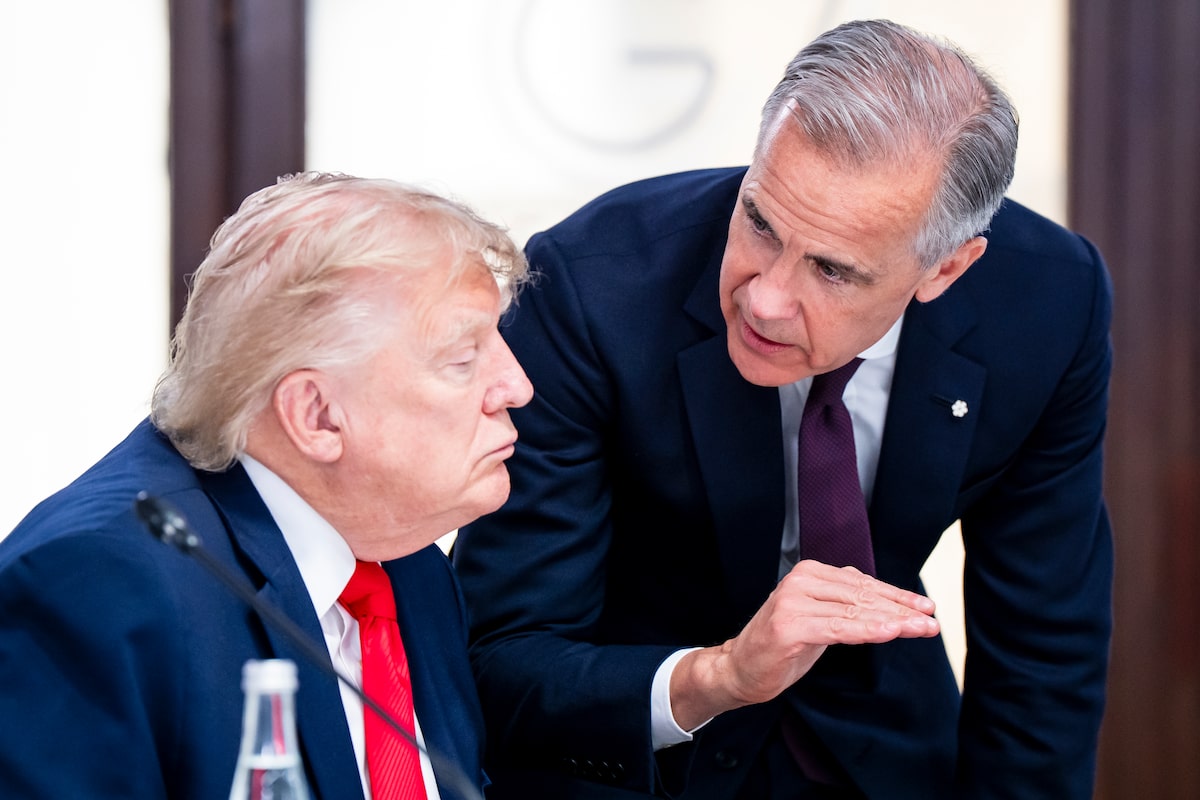
Open this photo in gallery:Prime Minister Mark Carney and U.S. President Donald Trump speak at a working luncheon during the G7 summit in Evian-les-Bains, France, on June 16.Christopher Katsarov/The Canadian PressAmid frenetic negotiations over the past month, the outlines of a deal meant to tamp down U.S. President Donald Trump’s trade war on Canada have taken shape.Under the terms of the prospective agreement, Mr. Trump would lower his tariffs on Canadian autos, steel, aluminum and forest products in exchange for Canada conceding to a long list of U.S. trade demands, including on alcohol, dairy and procurement.The President would also back off his threat to impose new tariffs on more Canadian goods – electronics, alcohol and dairy among them – set to take effect Wednesday, Aug. 19. It was this threat, rolled out by Mr. Trump on July 20, that sparked the urgent, current round of negotiations.But even as Dominic LeBlanc, the Minister Responsible for Canada-U.S. Trade, and Janice Charette, Canada’s chief trade negotiator, remain hunkered down in Washington, trying to hammer out a deal with U.S. Trade Representative Jamieson Greer, major sticking points remain.If there is no deal by Wednesday and Mr. Trump’s new tariffs come into force, Canada is expected to break off talks and retaliate.If there is a deal, it will only be the first phase. Future agreements are meant to address U.S. demands on defence and access to Canadian critical minerals and oil, as well as an overhaul of the U.S.-Mexico-Canada Agreement, which Mr. Trump wants to make more protectionist.It is also an open question whether Prime Minister Mark Carney, who is holidaying in Italy until Monday, can sell a deal to Canadians. The agreement under discussion would only reduce, not eliminate, the President’s tariffs, in exchange for concessions and Canada not retaliating.In dozens of conversations with sources on both sides of the border in recent weeks − who are not being identified because they were not authorized to publicly disclose details of the closed-door negotiations – The Globe and Mail has learned what a prospective deal would look like, what the holdups are and what Canadian officials have said will happen if Mr. Trump fires another tariff broadside at Canada on Wednesday.Opinion: In the trade war showdown, it’s strong-hand Carney vs. weak-hand TrumpMr. Trump’s tariffs: autos, steel, aluminum and forestryThe deal under discussion would reduce the sectoral tariffs Mr. Trump imposed on Canada last year. Sources have told The Globe that the two sides discussed cutting auto tariffs roughly in half from 25 per cent to between 10 and 15 per cent.Both steel and aluminum, meanwhile, would be subject to tariff rate quotas. Steel would face 10-to-15-per-cent tariffs, and aluminum a single-digit tariff within the quota, while both would have much higher tariffs outside of it. Currently, both metals are tariffed at 50 per cent.Less clear is what would happen to forestry tariffs, which range from 10 per cent on lumber to 25 per cent on furniture and other wood products. These are on top of a range of separate tariffs that have been in place for nearly a decade.Forestry is a significant sticking point in talks, two sources said, with Canadian officials wary of a deal that offers significant tariff relief for autos, steel, and aluminum but leaves out forest products or offers a much smaller reduction.Two sources cited autos as a roadblock. With single-digit profit margins in the industry, they said, a tariff of 10 per cent or more would leave operations in Canada economically unviable. One of the sources said Canada has proposed that U.S. tariffs apply only to the value of components that come from outside North America, a demand Mexican negotiators have also made in separate talks with the U.S.Mr. Trump brought in the sectoral tariffs under Section 232 of the Trade Expansion Act of 1962. His other threatened suite of tariffs, which would use Section 338 of the Smoot-Hawley Tariff Act of 1930, would target another US$20-billion worth of Canadian products.Canada’s concessions: alcohol, dairy and retaliatory tariffsThe U.S. is demanding that Canada agree to a list of about 10 demands to address what Washington refers to as trade irritants.These include Canada dropping all retaliatory tariffs on the U.S., such as on American-made autos; provincial governments ending their bans on sales of U.S. alcohol and scrapping Buy Canadian policies; and Ottawa agreeing to Washington’s interpretation of how licences for the supply-managed dairy sector should be allocated.The provincial component to these demands adds a crucial complication to reaching a deal. Mr. Carney must convince premiers to agree to these concessions at the same time as major industries in their provinces are at stake: autos and steel in Ontario, aluminum and dairy in Quebec and forestry in British Columbia.Already beset by tariffs, Quebec braces for another big trade hitThe wild cards: Critical minerals and defenceWhile U.S. demands on defence, critical minerals and oil and gas are expected to be dealt with in more detail during a future phase of negotiations, five sources said that progress on the files will also influence the current deal.Washington’s demands, according to two of the sources, are that Canada grant the U.S. a right of first refusal on purchasing critical minerals necessary for the defence and technology sectors; Ottawa follow through with its long-delayed $88-billion purchase of F-35 fighter jets; Canadian forces buy American technology such as radar planes as part of joining Mr. Trump’s planned Golden Dome missile defence system; and that there be some guarantee of increased oil and gas exports.Some commitment on critical minerals may be written into a “phase one” deal this week, the sources said, even if it’s just a broad agreement by Canada to work with the U.S. toward a more detailed pact.Two of the sources said progress on defence and Canada’s receptiveness on U.S. demands is expected to weigh on what Washington will agree to in the current deal, even if it isn’t put into the text. One of these sources said, for instance, that Canada could privately agree to the F-35 purchase with the understanding that it only becomes public when a future phase agreement is signed.Another source said that Canada could leverage progress on critical minerals against the 232 tariffs, bargaining for a reduction in the levies, for instance, in exchange for giving the U.S. more on minerals.What if there’s no deal?Ms. Charette has told Mr. Greer that if there is no deal by Wednesday and Mr. Trump’s next suite of tariffs takes effect, Canada would effectively be forced to stop negotiating and retaliate, The Globe has reported. The warning was not delivered as a threat, sources told The Globe, but framed as a frank explanation of reality, given the anger among the Canadian public and unpredictable reactions of provincial leaders.What Trump’s threatened 50% tariffs could mean for Canadian businesses, according to expertsOttawa is working on potential retaliation options, two sources told The Globe last week. The exact contours of the retaliation are not yet clear, but could involve returning to retaliatory tariffs that former prime minister Justin Trudeau put in place in early 2025 and which Mr. Carney rolled back twice last year.What happens nextIt may take until late Tuesday night, right before Mr. Trump’s latest tariffs kick in, to reach a deal, some sources warned. Another possibility, said two of them, is that the President will decide to hold off on the tariffs longer while negotiations continue. Two other sources said that, so far, the U.S. has not committed to this. If a deal is reached, the next stage would be to negotiate further on critical minerals and defence. The two countries, plus Mexico, would also work toward Mr. Trump’s planned overhaul of the USMCA. The U.S. wants a guarantee of 50-per-cent American content in all autos produced in Mexico and Canada and required North American content to rise from 75 per cent to 82 per cent.With a report from Bill Curry
Five things you need to know about the Canada-U.S. trade talks
Full Article
Original Source
Read the full article at Theglobeandmail →KhanList aggregates and links to publicly available news content. We do not host full articles from third-party sources. Always verify important information with original sources.